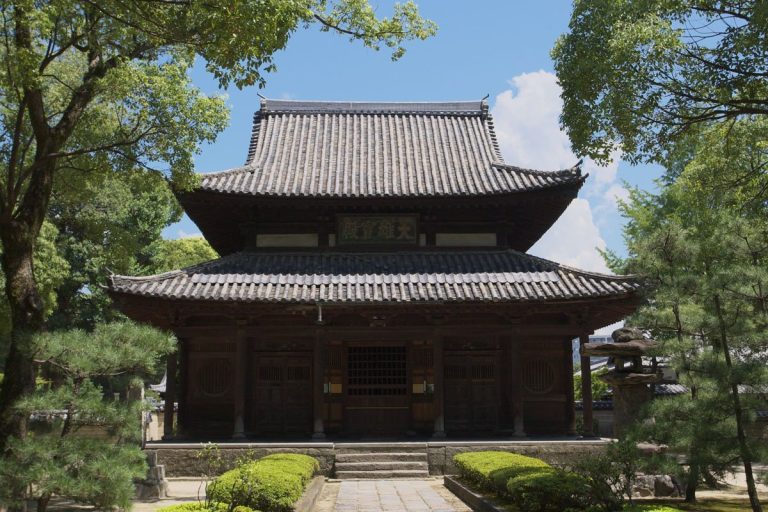
Shikaumi Shrine: A Maritime Shinto Sanctuary on Shikashima Island


Site at a Glance
- Rating
- 4.5
- Popularity
- Medium
- Country
- Japan
- Primary era
- Early Modern
- External website
- Open
- Eras represented
- Medieval, Early Modern
- Civilizations
- Ashikaga shogunate, Tokugawa, Toyotomi regime, Yamato
- Site type
- Religious
- Remains
- Sanctuary
On this page17 sections
History
Shikaumi Shrine is a Shinto shrine in Japan, on Shikashima Island in Fukuoka, whose present main sanctuary is a nagare-zukuri building first built in 1439. A nagare-zukuri shrine has a gabled roof whose front slope extends over the entrance. The shrine’s foundation date is unknown, but its history is closely tied to the Watatsumi, or sea, deities and to the Azumi, an ancient maritime clan associated with seafaring communities in northern Kyushu.
The three sanctuaries and the Azumi
Shrine tradition says that the institution originally comprised three sanctuaries at Katsuma, on the northern side of Shikashima. These were the Upper Palace, Middle Palace, and Offshore Palace. The Upper Palace was later moved to Katsuyama on the southern side of the island, where the present main shrine stands. The Middle Palace and Offshore Palace remained at Katsuma as subsidiary shrines.
The three principal deities are the upper, middle, and lower sea deities. Early Japanese traditions regard these gods as ancestral or tutelary figures of the Azumi lineage. The Azumi controlled seafaring groups and sea routes in northern Kyushu, and Shikashima and the surrounding Sea Road were regarded as their base. Shikaumi Shrine is therefore considered the central religious institution of the clan. The hereditary chief-priest family also claims descent from the Azumi.
The shrine is described as the head shrine of shrines dedicated to Watatsumi and other sea deities throughout Japan, and is also known as the “Dragon Capital.” Its identity developed around maritime transport and navigation. A tradition associates the shrine with a visit by Emperor Keiko during his twelfth-year journey through Kyushu. Historical investigation regards that connection as an unsupported interpretation of a passage in the Chronicles of Japan, rather than an independently established event.
Early records and medieval connections
An early eighth-century record refers to the institution as the “three sanctuaries of the Azumi shrine” and as Shika Shrine. In 806, the Azumi deity received eight tax-supported households. In 859, the rank of the Shikaumi deity rose from Junior Fifth Rank, Lower Grade, to Junior Fifth Rank, Upper Grade. In 880, the deity associated with Katsuma, identified with the Middle Palace, received the rank of Junior Fifth Rank, Lower Grade.
The Register of Deities of the Engishiki, compiled in 927, lists the shrine as three major shrines of eminent deity in Chikuzen Province. A shikinaisha was a shrine included in the Engishiki, a tenth-century compilation of court regulations and religious institutions. In 1026, a shrine official traveled to Song China and returned to Japan in the following year, reinforcing the shrine’s association with maritime travel.
Shikashima became a battlefield during the Mongol invasions of Japan. The shrine appears in the Scrolls of the Mongol Invasions under the name Shikashima Daimyojin. After the conflicts between the Northern and Southern Courts, Ouchi Mochiyo rebuilt the shrine in 1439. In 1469, the priestly office of Shikashima was formally confirmed for the abbot of Togetsuji in Tsushima.
The Ouchi family subsequently protected the shrine. Ouchi Yoshioki and Ouchi Yoshitaka made offerings that included swords and horses, while Ouchi political authority prohibited the cutting of bamboo and trees within the precinct. Envoys traveling to Ming China also visited before their voyages to pray for safe passage. The Ming envoy Tōyō came in 1452, and the monk and scholar Sakugen Shuryo visited in 1539. In 1560, the shrine sought contributions to rebuild its gate tower.
Early modern rebuilding and maritime worship
Toyotomi Hideyoshi granted the shrine an estate assessed at 50 koku during the Bunroku era. A koku was a premodern measure of assessed agricultural production, conventionally based on the rice needed to support one person for a year, so this grant represented an income-bearing estate rather than an area of land.
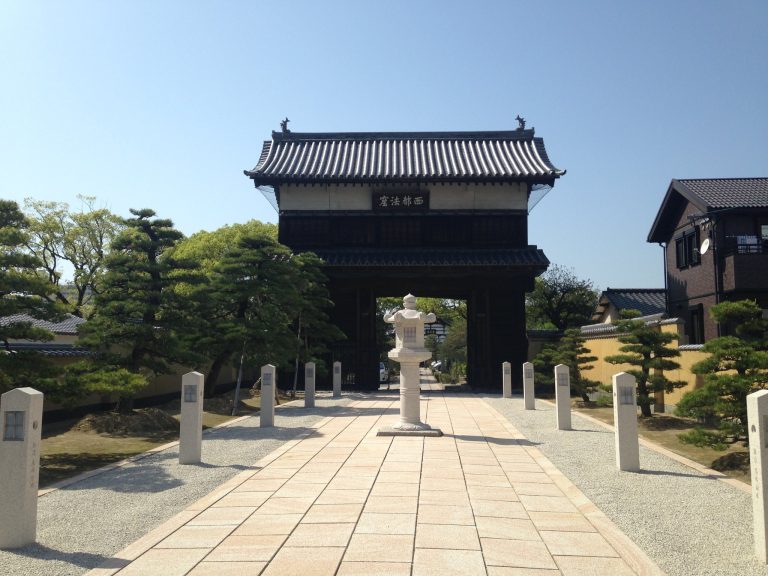
In 1600, Kuroda Nagamasa sponsored construction of the main sanctuary, worship hall, gate tower, and other buildings. Kuroda Mitsuyuki, lord of the Fukuoka domain, sponsored the first torii in 1670. A merchant from Meinohama provided the second torii in 1700, sailors sponsored the seaside torii in 1774, and a Niomon gate was built in 1718. The shrine’s estate was still assessed at 50 koku in 1817.
The former Buddhist shrine-temple Kongo-san Kichijoji is said to have been founded between 1429 and 1441. It began as a Tendai temple and later became a Zen temple affiliated with Jotenji in Hakata. Its Monju Hall supported strong devotion to Monju, who was also revered there as a deity of navigation. The temple was abolished in 1868 during shinbutsu bunri, the Meiji-period policy separating Buddhist institutions and practices from Shinto shrines. Nearby Sogonji is regarded as its successor.
Modern status and living traditions
In 1872, the shrine was classified as a village shrine. It was elevated in 1926 to the former modern rank of Imperial Government Shrine, Minor Grade, and in 1948 became one of the shrines included in the Association of Shinto Shrines’ Beppyo Shrine category. Its heritage includes a nationally designated Important Cultural Property, prefectural archaeological and intangible folk-cultural properties, and Fukuoka city designations for paintings, historical documents, and the shrine’s strength stone.
The shrine’s festivals preserve traditions connected with protection, seafaring, hunting, fishing, and the origins of the institution. The Foot Archery Festival is held to avert evil and divine the coming year’s fortunes. Eight young parishioners undergo purification, perform a fan dance in the worship hall, and shoot at a target from the approach. Each archer fires three rounds of two arrows, after which the crowd destroys the target. The rite is associated with the tradition that Azumi no Momotari defeated the earth spiders.
The Mountain-Praising Festival takes place in spring and autumn. Its rites recall seafarers presenting mountain and sea delicacies to Empress Jingu during her legendary campaign against the Three Han. Participants cut a sacred branch, purify and praise the three mountains of Shikashima, conduct a deer-hunting dialogue, shoot a forked hunting arrow at a sacred tree, and reenact a departure from Isorazaki to catch sea bream.
The Tanabata Festival traditionally seeks fishermen’s safety and abundant catches. Fishermen from Hakata Bay arrive in boats decorated with fishing flags, visit the shrine and its subsidiary shrines, and receive sacred branches and shrine tea. Leaves from the branches are carried as protective talismans before going to sea.
The Shrine Procession Ritual, held every other year on the day before the Kunichi Festival, is the shrine’s largest festival. Three portable shrines carry the deities to a temporary sanctuary, where dragon, maiden, and small-drum dances are performed before the deities return to the main shrine. The following festival includes horseback archery. Together, the procession and performances preserve traditions concerning the shrine’s origin.
The sacred song of the Mountain-Praising Festival is traditionally said to resemble the national anthem “Kimigayo.” A tradition preserved at Kashii Shrine says that traveling performers spread the song, that it entered the Collection of Ancient and Modern Poems, and that it later became “Kimigayo.” This remains a tradition rather than an independently established history.
Remains
Shikaumi Shrine stands in a settlement on a coastal elevation in southeastern Shikashima, near the entrance to the Sea Road, with the Genkai Sea to the east. Reported figures for the precinct range from approximately 28,185 to 99,174 square meters. The complex includes the main sanctuary and worship buildings, entrances marked by several torii, a gate tower, subsidiary shrines, ritual facilities, storehouses, and surviving objects associated with maritime and religious practice.
Main shrine buildings and entrances
Main sanctuary and halls
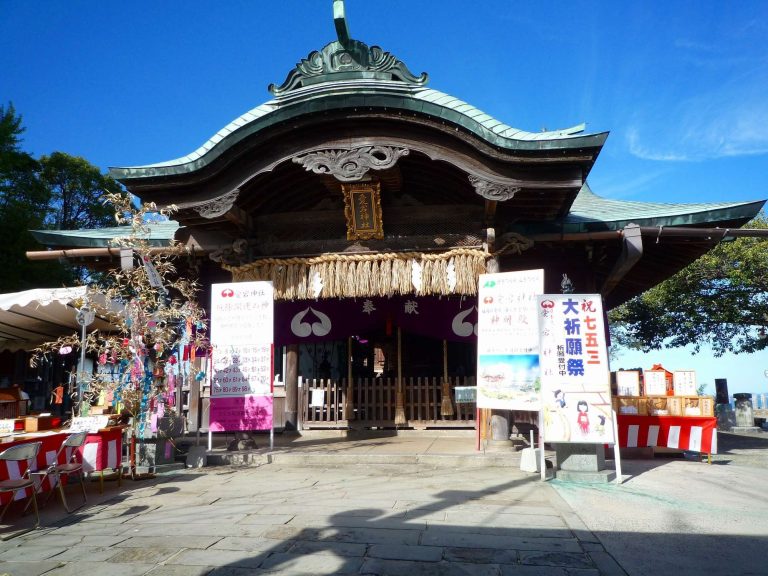
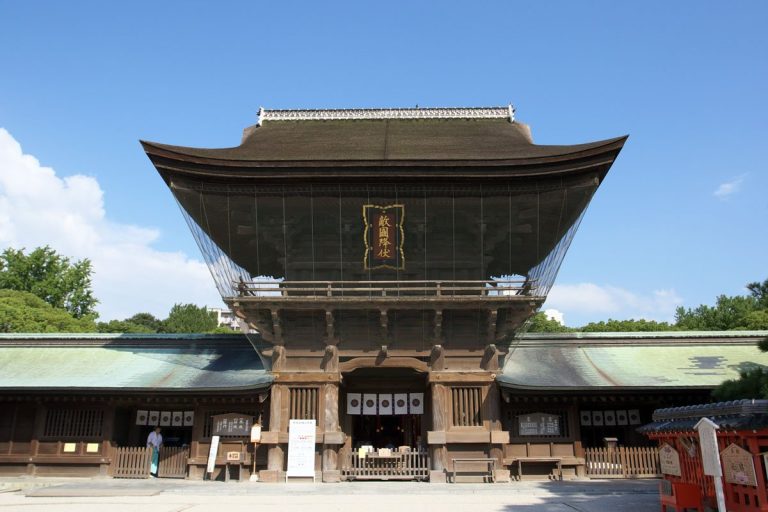
The main sanctuary occupies approximately 46.3 square meters and has three bays in the nagare-zukuri form, with a cypress-bark roof. It was first built in 1439 and rebuilt in 1590 and 1609. The offering hall covers approximately 23.1 square meters, while the worship hall covers approximately 62.8 square meters. Both halls were rebuilt in 1930. The two-story gate tower was rebuilt in 1609.
Torii and precinct facilities
The first torii dates to 1670, the second to 1700, and the torii beside the shore to 1774. A stone drum bridge forms part of the approach. Other precinct buildings include a treasure exhibition room, shrine office, hand-water pavilion, food-offering hall, portable-shrine storehouse, and treasure storehouse. Sacred sand called oshioi is placed at the entrance to the stone stairs and in the worship hall, where it is used to purify body and mind.
Subsidiary shrines and ancient sites
The Palace shrines at Katsuma
Five officially affiliated shrines and nineteen branch shrines form the shrine’s wider network. The affiliated shrines are the Offshore Palace and Middle Palace at Katsuma, Imamiya Shrine within the main precinct, Hiroten Shrine at Hiro, and Otake Shrine at Otake. The nineteen branch shrines are distributed among Shika, Katsuma, Hiro, and Otake. The Middle Palace is associated with the middle sea deity and with the historical deity recorded as Katsuma.
The Katsuma tomb
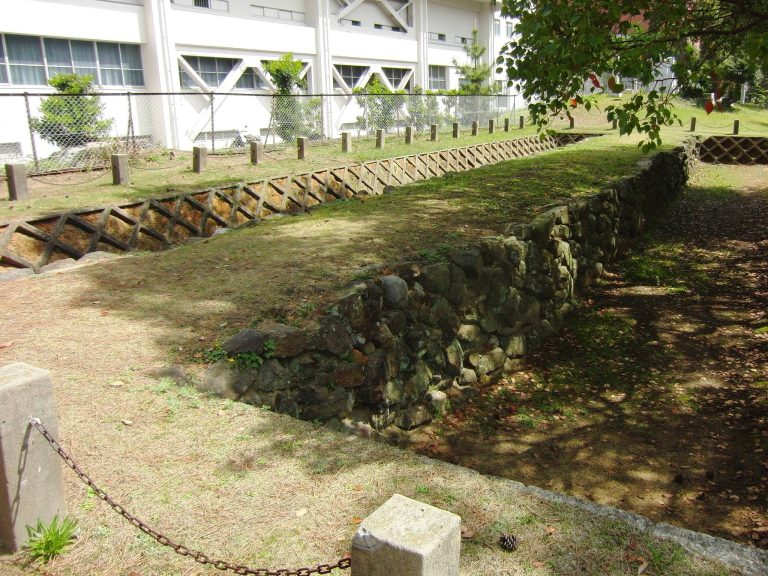
A tomb discovered in front of the Middle Palace in 1994 dates to the first half of the seventh century. Later shrine construction obscured the original mound’s form and dimensions, but a vertical stone chamber and grave goods survived. The tomb is considered the burial place of a local chief of a maritime group. The former site of the Upper Palace is also traditionally identified at Katsuma, while the present shrine is regarded as that palace after its relocation.
Ritual objects and religious remains
Deer-Horn Hall
The Deer-Horn Hall is traditionally said to contain more than 10,000 deer antlers, with offerings perhaps beginning 500 or 600 years ago. Maeda Toshinaga, lord of Kaga, is said to have offered six antlers. A local practice involved attaching floats to antlers and allowing them to drift at sea before recovered examples were presented to the shrine.
Turtle Stones
Two sacred stones known as the Turtle Stones were transferred to the shrine in 1670. Tradition connects them with Empress Jingu’s campaign against the Three Han. In the story, Azumi Isora, a legendary ancestor of the Azumi, prayed for seven days and nights for victory. The shrine deities then appeared riding golden turtles and guided the fleet. The female and male turtles later became stones and were found near the area now known as Gold Seal Park.
Reliquary tower and strength stone
A granite Buddhist reliquary tower beside the approach has a base, body, roof, and finial. It stands 334.5 centimeters high and bears the inscription “15th day of the eighth month, Kowa 3,” corresponding to September 20, 1347. A hokyointo is a Buddhist reliquary tower intended to enshrine a text or relic, especially material connected with the Treasure Casket Dharani Sutra. This tower is considered the oldest completely preserved example of its type in Fukuoka Prefecture.
Beside the worship hall stands a basalt strength stone measuring 66 centimeters long and 36 centimeters wide, with a weight of 118.2 kilograms. Its inscription suggests that it was offered by San’emon of Keya. The shrine also possesses a fragment of a sandstone mold for a slender bronze sword, excavated in the Katsuma area in 1947. Attributed to the first half of the Middle Yayoi period, the surviving fragment is 18.1 centimeters long, with both ends missing.
Gilded bell and associated collections
The shrine’s gilded bell is a small Korean-style bronze bell, 52.8 centimeters high and 30.5 centimeters in diameter, with traces of gilding. Its unusually large finial takes the form of a dragon. Peony arabesques decorate the upper and lower bands, while four sixteen-petaled lotus bosses, four seated Buddhist figures, and pairs of guardian figures complete its decoration. Although unsigned, its style is comparable to a dated Korean bell at Mandaraji Temple and places it in the early thirteenth-century Goryeo period. The bell is deposited at the Fukuoka City Museum.
Three painted silk hanging scrolls depict traditions concerning the shrine’s origins, and forty-five historical documents are associated with the shrine. The paintings are deposited at the Fukuoka City Museum. South of Shikaumi Shrine, Sogonji preserves a wooden standing statue of Kannon from the Heian period and a bronze seated bodhisattva from the Nanboku-cho period, linking the temple with the former Kichijoji shrine-temple tradition.