Ube Shrine: Inaba’s Historic Provincial Shrine
Site at a Glance
- Popularity
- High
- Country
- Japan
- Primary era
- Early Modern
- Eras represented
- Classical, Early Modern, Modern
- Civilizations
- Japanese, Tokugawa, Yamato
- Site type
- Religious
- Remains
- Sanctuary
On this page13 sections
History
Ube Shrine is a Shinto sanctuary at Miyanoshita in Tottori, Japan. Tradition places its foundation in 648, although its early history is uncertain. The present main building, rebuilt in 1898, follows nagare-zukuri, a shrine style with a roof extending farther over the front. Ube served as Inaba Province’s ichinomiya, or leading provincial shrine.
Origins and provincial standing
One account places the shrine’s beginnings in the Kofun period, an era associated with large burial mounds, as a family sanctuary of the Ifukube clan. The family traditionally provided its priests and held a position as local leaders in Inaba. Clan tradition says an ancestor received swords from Emperor Seimu and enshrined them. Its genealogy traces descent from Ōnamuchi, while also incorporating other lineages.
The shrine’s principal deity is Takenouchi no Sukune, a legendary court figure revered for exceptional longevity. A tradition says that in 367 he reached Inaba at an age of more than 360, left a pair of sandals on Kamekin Mountain, and then disappeared or died. The story is traceable to the early 13th century, rather than to an ancient provincial chronicle. Another interpretation identifies an Ifukube ancestor as the shrine’s earlier deity, with Takenouchi no Sukune adopted later. The name was once pronounced “Uhe,” though its meaning is unknown. Suggested origins connect it to Ueno Mountain, an old name for Mount Inaba, or to a former shrine later incorporated into the precinct.
From the Heian period through the medieval era, the shrine was known as Ube Shrine or Ichinomiya; during the Edo period it was also called Kokufu Ichinomiya and Ichinomiya Daimyojin. Its ichinomiya standing is documented by the early 12th century. It was also listed as a Meishin taisha, a high-ranking shrine category in the 10th-century Engishiki, a compilation of court regulations and shrine listings. Among nine such shrines in Hōmi District, Ube was the only one of that rank in Inaba and Hōki provinces.
In 848, a fire at the Inaba provincial government threatened to spread. The governor prayed at Ube, and a wind arose as the fire went out. The shrine was then admitted as an official shrine and awarded the rank of Junior Fifth Rank, Lower Grade. Its court rank rose repeatedly, reaching Senior Third Rank in 878.
In 1099, a newly appointed provincial governor visited Ube after first paying respects at the province’s general shrine. At Ube he read a land petition from district officials, held a Hundred-Seat Nio ceremony, recited the Great Perfection of Wisdom Sutra, conducted a spring festival, and made offerings before announcing his journey to the capital. A 1165 record associates the shrine, also called the Upper Shrine, with an offering to the Jingikan, the central court office for Shinto affairs, of 50 tan of cloth, about 303 metres, and a wood-turner. Its estates included land in Hattori Manor and Takakari. A catalogue compiled around 1224 lists Ube Manor as an imperial prayer estate, possibly within the Chōkōdō estate lands. In 1289, retired Emperor Go-Fukakusa granted the shrine part of the estate proprietor’s rights in Hattori Manor.
Medieval decline and destruction
The shrine received imperial decrees during the 1460s. In 1527, it gained a document from the Ashikaga house, and an imperial decree authorized rebuilding after fire damage. The following month, the chief priest received Junior Fifth Rank, Lower Grade. The shrine’s estates and resources declined amid medieval warfare. Between 1555 and 1570, the head of the Ifukube family moved to Sakon to escape the fighting. In 1565, he sold about one chō of land at Yoshikata, approximately 0.01 square kilometres, which was thought to have belonged to the shrine.
In 1581, the vanguard of Toyotomi Hideyoshi’s campaign in Inaba burned Ube. The fire destroyed its treasures and documents, and the Ifukube priests took temporary refuge at Izumo Taisha.
Rebuilding and early modern support
A descendant of the displaced Ifukube family returned to Miyashita in 1626 and built a small shrine. The Ikeda rulers granted Ube land yielding five koku of rice, with another 30 koku added under Ikeda Mitsumasa. A koku was a traditional rice-volume measure, conventionally the amount needed to feed one person for a year. After Ikeda Mitsunaka took control of Tottori in 1632, he granted the shrine about 25 koku and four to, another traditional measure of rice volume. That year, a woodland measuring about 70.9 metres east to west and 38.2 metres north to south was set aside as tax-exempt shrine land. By 1693, the annual first-fruit rice income from Hōmi District had fallen from about 49 to 25 koku.
In 1714, Ube attained Senior First Rank and became a place where the domain lord prayed, receiving 12 silver pieces each year for prayers. From 1854 to 1860 it was briefly called Ubeno Shrine; its earlier name returned in the early Meiji period, which began in 1868.
Modern standing and festival traditions
Ube became a Middle-Rank National Shrine in 1871 and has been included among the shrines listed by the Association of Shinto Shrines since 1948. Its annual festival takes place on April 21, with a lion dance and procession. The procession of retainers and warriors is said to follow the model of a Tottori domain lord’s procession during the Genroku period, from 1688 to 1704.
The shrine’s lion dance is associated with the Gongen style. Its origins are uncertain: tradition links the style to Tottori Toshogu, while a local historian argued that the dance developed in Inaba and that its Gongen name reflects changes to kagura, ritual music and dance offered to deities, made by Toshogu priests, particularly between 1751 and 1772. The dance is also said to preserve elements of the now-defunct Ochidani Shrine’s tradition, and it later influenced lion dances at many other Inaba shrines. In 1907, Crown Prince Yoshihito, later Emperor Taisho, watched it during Tottori’s Gongen festival.
The shrine’s dance was designated an intangible folk cultural property by Tottori Prefecture in 1959, and its festival implements received prefectural designation in 1964. In 2019, the shrine and its dance were included in a Japan Heritage designation for the cultural landscape of Inaba and Tajima associated with kirin lion dances. A kirin is a mythical auspicious creature often depicted in Japan as a horned, scaled beast. A depiction of the worship hall appeared on a five-yen banknote issued in 1899, and banknotes issued in 1916 and 1943 showed the shrine and Takenouchi no Sukune. These images helped associate the deity not only with longevity but also with wealth and treasure.
Remains
The precinct lies at the southwestern foot of Mount Inaba and overlooks the former provincial capital area, including the sites of the government offices, provincial temple, and nunnery. The former Ikeda family cemetery is to the north, while the eastern group of burial mounds includes Sagiyama and Kajiyama. Estimates of the precinct’s area range from about 21,200 to 25,100 square metres, with several measurements close to 23,000 square metres. The main sanctuary, connected halls, subsidiary shrine, and other buildings occupy this setting.
Main shrine and connected halls
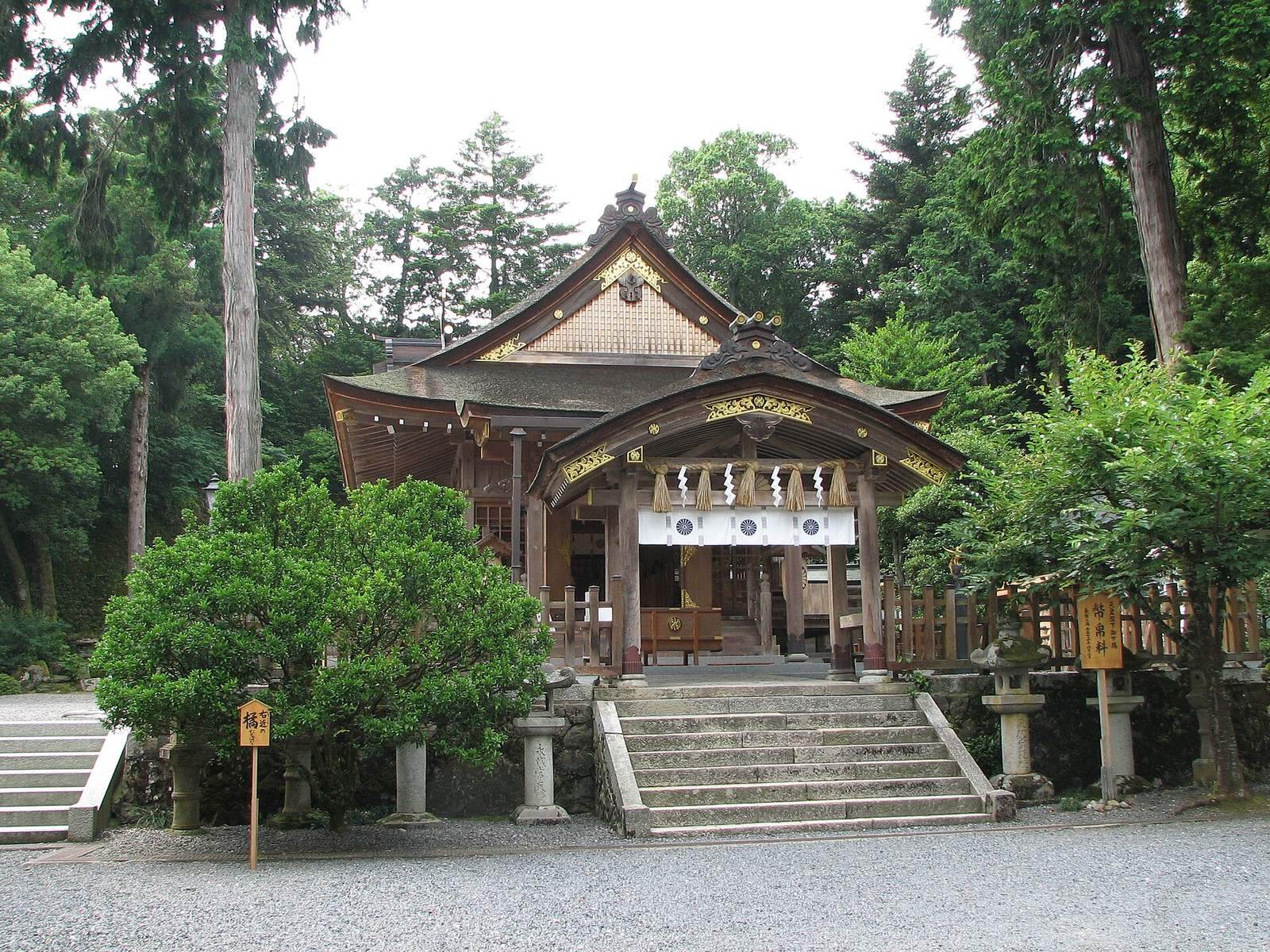
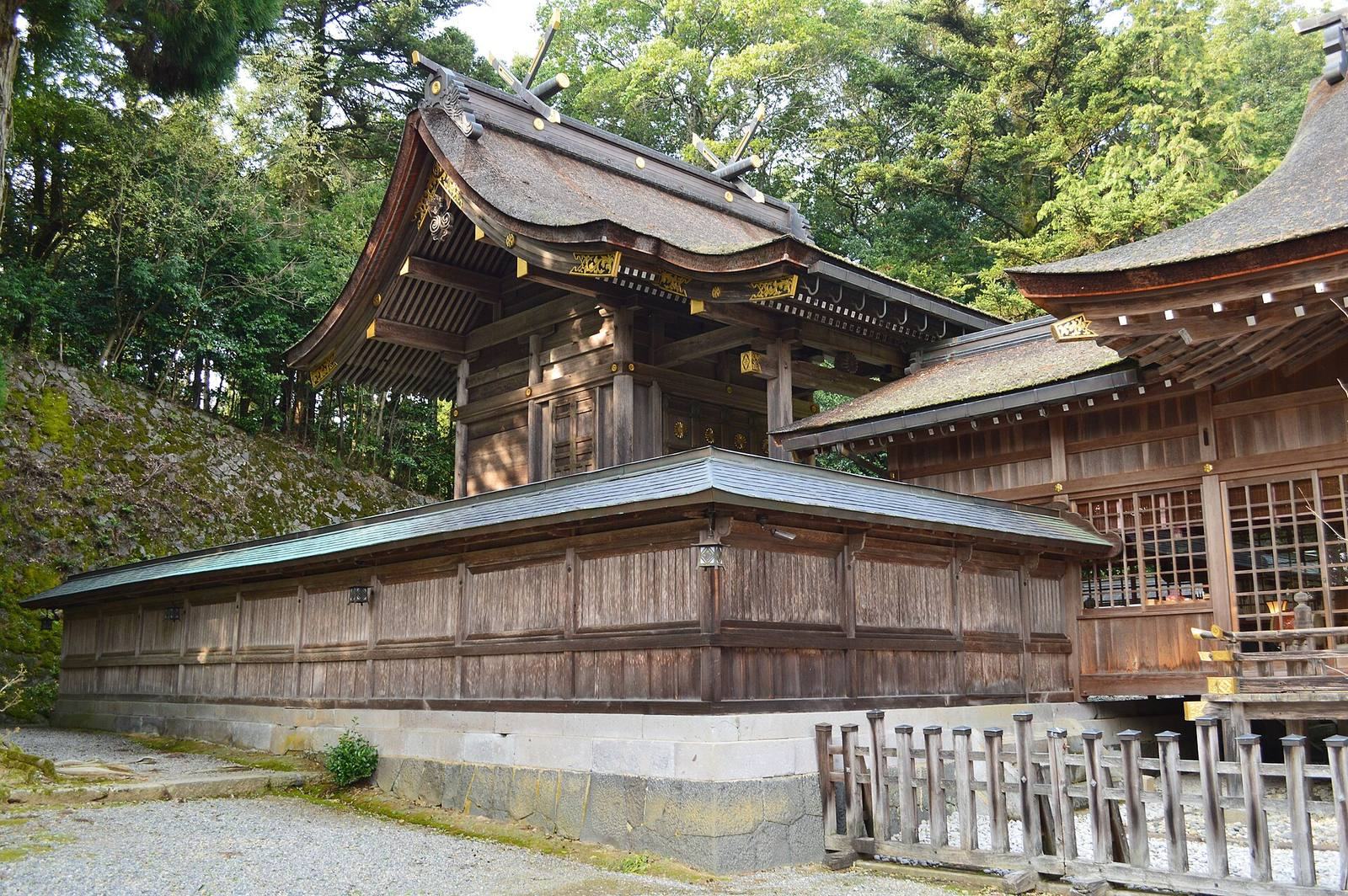
The main shrine is a three-section-wide by two-section-deep building with cypress-bark roofing, crossed ornaments at the roof ends, and short logs set across the ridge. A projecting, one-section-deep worship porch extends from the front. Lattice doors are fitted at the front and along the outer sides of the outer chamber. The one-section-wide, two-section-deep offering hall connects the main building with the worship hall; it has a gabled roof covered in cypress bark and is entered through its gabled end. The worship hall is three sections square, with a porch one section deep, cypress-bark roofing, and a roof combining hipped and gabled forms.
Kokufu Shrine
Kokufu Shrine stands to the left of the main sanctuary and enshrines ten deities: Takemikazuchi, Yamato Takeru, Hayasasurahime, Takenouchi no Sukune, Izanagi, Kukurihime, an earth-ancestor deity, Okitsu-hiko, Okitsu-hime, and Ukanomitama. In Shinto, deities and sacred powers are called kami.
Other precinct buildings
The oldest building in the precinct is a water-purification pavilion. A hall for storing festival implements was built in 1963, followed by the shrine office in 1985 and a gathering hall in 2009.
Twin stones and burial mound
Two stones called the Twin Sandal Stones sit on Kamekin Mountain behind and above the main shrine. They are revered as a sacred rock formation. Directly below them is a circular burial mound about 14 metres across, known as the Ube Shrine Kofun and also by the names Kamekinoka Kofun and Miyashita No. 46. It dates to the first half of the fifth century. A landslide in 1942 damaged part of the mound and exposed its east-to-west burial chamber, which measures about two to three metres long and roughly one metre deep. Flat, split stones set upright form the chamber. Finds included a bronze mirror, an iron sword, beads, iron arrowheads, and other iron objects. The chamber and most of the finds were reburied.
Festival objects and lion dance
Festival implements
The shrine’s 23 festival implements include a large portable shrine made during the Meiji period, along with lion masks and musical instruments. Two types of spear, donated by the Ikeda family, bear the date 1714.
Lion dance
Six performers take part: a leading shōjō, a mythical spirit represented in Japanese performance traditions, one performer at each end of the lion costume, and three musicians playing a drum, gong, and flute. The lion head weighs about seven kilograms, and red is the group’s principal costume colour. The performance follows the Three-Direction Dance form, accompanied by a section called Inkstone Rhythm from The Entry Music. Its measured movement has been compared with gigaku, an ancient masked dance-drama, and Noh, a classical form of Japanese musical theatre.
The dance begins in front of the worship hall’s left side. The shōjō uses a staff to purify the lion, then the two figures dance and bow toward the sanctuary, priests, and offering envoy. They begin facing away from the sanctuary, using alternating one-footed steps and head tilts before turning toward it and advancing and retreating. The pattern is performed first to the right and then to the left before the dancers return to their starting point. The sequence conveys that even a sacred beast is subject to divine authority.