Inaba Provincial Office: A Ritsuryō-Era Administrative Center in Japan

Site at a Glance
- Rating
- 3.9
- Popularity
- Very Low
- Country
- Japan
- Primary era
- Medieval
- External website
- Open
- Eras represented
- Medieval
- Civilizations
- Yamato
- Site type
- Civic
On this page9 sections
History
The Inaba provincial office in Japan was the administrative center of Inaba Province, a territory corresponding roughly to the eastern half of present-day Tottori Prefecture. Built and operated under the ritsuryō system, an ancient framework of centralized imperial government and law, it represents the development of provincial administration from the Nara period into the early Heian period.
Creation of the provincial government
Provincial offices were established after the Taika Reform of AD 645, a series of political changes that strengthened centralized government and reorganized administration on a Chinese model. Each province was managed by a centrally appointed kokushi, or provincial governor, who replaced the earlier kuni no miyatsuko. This administrative structure continued through the Nara period, conventionally dated from AD 710 to 794, and into the Heian period, which lasted from AD 794 to 1185. Its authority declined as feudal institutions expanded during the late Heian period.
Inaba was associated with Ōtomo no Yakamochi, an eighth-century court poet and government official who served as provincial governor. Local tradition holds that the final poem of the Man’yōshū was composed at this location in the first month of AD 759, linking the provincial office with one of Japan’s major early poetry collections.
Rediscovery and archaeological investigation
The location of the office had been forgotten for centuries. Researchers suspected an area that included former Fukube Village in Iwami District and Kokufu Town because place names connected with provincial administration survived there. Building foundations came to light during a farmland-improvement project in 1973. Excavation in 1977 then revealed a group of buildings thought to have stood close to the center of the provincial complex.
The excavated remains are dated to the early Heian period or later. Wooden documents and other materials contributed to this dating, including a narrow wooden administrative slip found in a nearby ditch and inscribed with the second year of Ninna, equivalent to AD 886. The site was designated a National Historic Site of Japan on 21 July 1978. Afterward, approximately 7,000 square meters of the 32,000-square-meter site was maintained as a historic park.
Remains
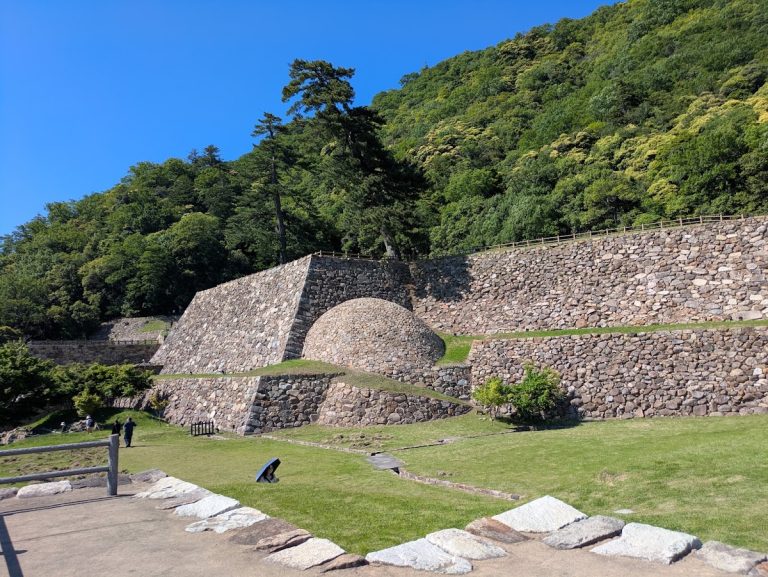
The Inaba provincial office is preserved as an archaeological ruin in the Nakago area of Kokufu, about 10 kilometers east of central Tottori. Excavation revealed foundations for more than 10 buildings, together with two fences, two wells, several roads, and several ditches. The complex was enclosed by stone-built features and ditches. Its buildings used posts set directly into the ground, a construction method that preserves the building plans through the arrangement of post foundations.
Central administrative buildings
Main building
The central building stood on a plan measuring five bays along its main axis and four bays in depth. A bay is the interval between structural posts, so these figures describe the spacing of the building’s supports rather than modern metric dimensions. The structure had projecting eaves on both its northern and southern sides.
Building behind the center
Approximately 7 to 8 meters behind the central building stood a second post-built structure on the same axis. It measured five bays by two bays and had a gabled roof. Its position and plan form part of the group of buildings considered to lie near the center of the provincial office.
Southern boundary building
About 750 meters south of the central building was the foundation of an east-west-oriented post-built structure measuring at least seven bays by three bays. Dating to the medieval period, it is considered to mark the southern limit of the provincial-office complex. The foundation survives within the historic park as part of the wider archaeological layout.
Written and material evidence
Excavated objects include stone belt fittings, inkstones used to prepare writing ink, wooden title slips, wooden tablets, earthenware bearing ink writing, and green-glazed pottery. A wooden title slip was a narrow administrative document used to identify or accompany goods, records, or other materials. These finds help connect the structural remains with the record keeping and official activities carried out at the provincial center. Some of the objects are displayed at the Prefectural Museum.