Wakasa Oniga Castle: A Sengoku-Period Mountaintop Fortress in Japan


Site at a Glance
- Rating
- 4.3
- Popularity
- Low
- Country
- Japan
- Primary era
- Early Modern
- Eras represented
- Medieval, Early Modern
- Civilizations
- Toyotomi regime
- Site type
- Military
- Remains
- Castle
On this page11 sections
History
Wakasa Oniga Castle is a Japanese Sengoku-period mountaintop castle in Wakasa, Tottori, built around 1200 and developed as a stronghold at a strategic junction of routes linking Tottori with Kyoto, Harima, and Tajima. The Sengoku period was an era of political fragmentation and warfare when regional lords competed for territory and castles served military and administrative purposes. The site remained the residence of the Yabe clan from the Kamakura period through the late Sengoku period.
Yabe Clan Origins
A Yabe clan leader who had entered the region from Mikawa Province established the first fortification at the site around 1200. The Yabe controlled this part of southeastern Inaba Province from the Kamakura period onward, using the mountaintop position as a base for residence and defense.
Sengoku Conflict
During the Sengoku period, the Yamana clan held Inaba as its shugo, a medieval provincial military governor. The earlier Yabe fortification was rebuilt during this era. In the sixteenth-century contest for Inaba among the Yamana, Amago, and Mōri clans, Yamanaka Yukimori captured the castle lord through a stratagem in June 1575, and the castle fell to Amago restoration forces.
Kikkawa Motoharu attacked later in 1575. Yamanaka Yukimori and his allies resisted the assault, but they abandoned the castle and withdrew the following year. When Oda forces led by Hashiba Hideyoshi invaded Inaba, Wakasa Oniga Castle became one of their bases.
Kinoshita and Yamazaki Rule
After the siege of Tottori Castle in 1581, Kinoshita Shigekata entered Wakasa Oniga Castle with a domain assessed at 20,000 koku. A koku was a historical measure of agricultural revenue used to assess a lord’s domain. Kinoshita completely rebuilt the castle according to contemporary designs, an undertaking that left him deeply in debt.
Kinoshita belonged to the Western Army during the Battle of Sekigahara in 1600, the conflict that determined control of Japan between rival coalitions. After its defeat, he was dispossessed and forced to commit seppuku, a ritual form of suicide historically practiced by samurai after defeat or disgrace.
Tokugawa Ieyasu then awarded the castle to Yamazaki Iemori, a former Toyotomi retainer who had married a sister of Ikeda Terumasa and had rescued Ieyasu’s daughter Tokuhime, held hostage by Ishida Mitsunari. Yamazaki made Wakasa Oniga Castle his residence and held a 30,000-koku domain. His son, Yamazaki Ieharu, fought in the Battle of Osaka in 1614–1615 and received a reward. In 1617, he was transferred to a 30,000-koku domain in Bitchū Province and later to Marugame.
Abandonment and Recognition
After the Yamazaki departure in 1617, the castle was unoccupied and came under the control of the Ikeda clan of the Tottori Domain. It was later abolished and dismantled under the Tokugawa shogunate’s one-country-one-castle edict, a regulation that limited each province to one officially maintained castle and led to the abandonment or destruction of others.
A distribution survey of castles and fortified sites by the Tottori Prefectural Board of Education between 1998 and 2003 revealed the exceptional extent of Wakasa Oniga Castle’s remains and established its national archaeological importance. Land-ownership issues delayed formal designation, but the ruins became a National Historic Site on March 28, 2008. In 2017, the castle was selected for the Continued Top 100 Japanese Castles as number 168.
Remains
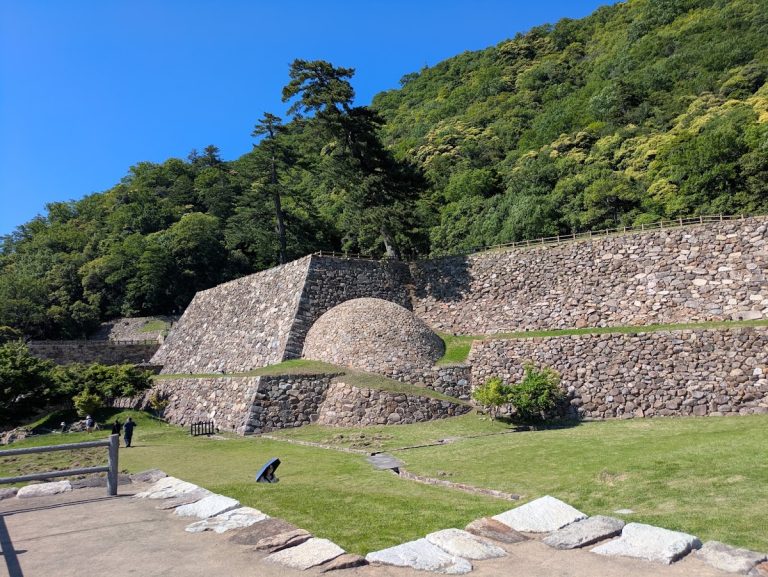
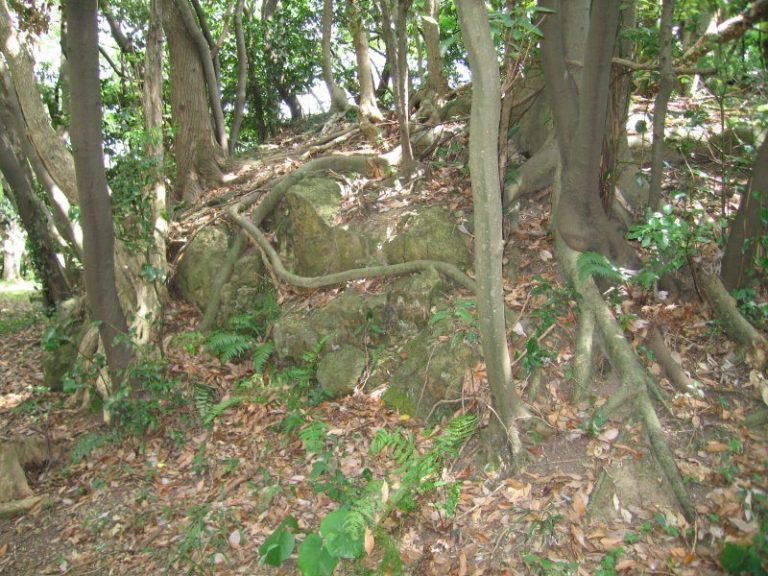
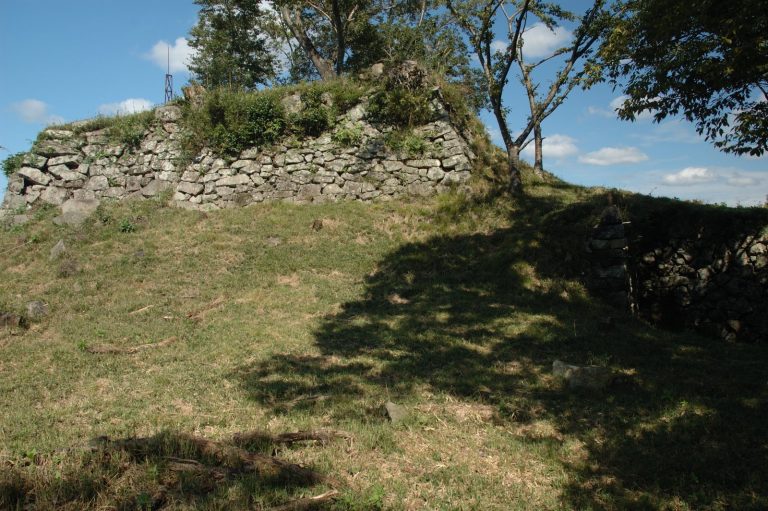
Wakasa Oniga Castle occupies the summit and ridgeline of the triangular Tsuruoyama hill, which rises to 452 meters above sea level with a relative height of 252 meters. Its linked-compound mountain-castle plan extends across approximately 150 by 50 meters. Three principal enclosures descend along the ridge, combining medieval elements associated with the Yabe period with the early-modern work of Kinoshita and Yamazaki. Surviving features include stone walls, entrances, tower platforms, vertical dry moats, and moats. Collapsed sections of wall preserve evidence of the dismantling carried out in 1617.
Summit Enclosure
Central Bailey
The central bailey, an enclosed castle area used for defense, administration, or residence, stands on the summit. It is roughly pentagonal, with sides measuring about 50 meters. Within it are the ruined foundations of a compound-style castle keep, the principal fortified tower of a Japanese castle, measuring approximately 10 meters square.
Compound Gate
Access to the central bailey was provided through a compound gate on its northwest side. The later castle used stone as its principal building material, and the gate formed part of the summit enclosure’s controlled entrance system.
Lower Enclosures
The second and third enclosures lie farther down the slopes. Each was reached through a compound gate protected by stone walls, extending the castle’s defensive arrangement beyond the summit and along the mountain ridgeline.
Walls and Moats
Stone walls survive across the castle, together with tower platforms, entrances, vertical dry moats, and moats. The surviving walls and earthworks now form the principal visible remains of the ruined castle, while collapsed wall sections retain physical evidence of its early-seventeenth-century dismantling.