Hirano Shrine: A Heian-Era Imperial Shrine in Kyoto, Japan


Site at a Glance
- Rating
- 4.2
- Popularity
- Medium
- Country
- Japan
- Primary era
- Early Modern
- External website
- Open
- Eras represented
- Early Modern, Modern
- Civilizations
- Japanese, Tokugawa
- Site type
- Religious
- Remains
- Sanctuary
On this page8 sections
History
Hirano Shrine is a Shinto shrine in Kyoto, Japan, whose origins are associated with the establishment of the Heian capital around 794. Shinto is Japan’s indigenous religious tradition, centered on the worship of kami, sacred beings or powers connected with deities, ancestors, natural phenomena, and places. The shrine’s principal deity, Imaki, had previously been worshipped in Yamato and was probably revered as an ancestral deity of Takano no Niigasa, the mother of Emperor Kammu. When the capital moved to Heian-kyo, the shrine was likely transferred to a position near the imperial palace.
The foundation is variously dated to 785, 794, or the wider Enryaku period, from 782 to 806. Around 794 is the commonly accepted date, although the tradition that the shrine reached its present site at exactly the time of the capital’s transfer remains an attribution rather than a firmly established fact. In its early history, Hirano was connected with the protection of the imperial heir and was regarded as a guardian of the capital and court.
The Four Deities and Heian Court
Hirano Shrine now enshrines four deities: Imaki-no-Sume-Ookami, Kudo-no-Ookami, Furuaki-no-Ookami, and Hime-no-Ookami. Imaki is the principal deity, while the other three are housed separately. Earlier records indicate that the shrine initially contained Imaki, Kudo, and Furuaki, with Hime added later. Their original identities and functions remain uncertain. They have been understood as ancestral deities of Takano no Niigasa, hearth deities, spirits associated with the emperor’s mother and her ancestors, or ancestral deities of the Minamoto, Taira, Takashina, and Oe lineages. The shrine’s own interpretation links Imaki with renewal and restoration, Kudo with the cooking pot, Furuaki with new beginnings, and Hime with fertility.
During the Heian period, Hirano was particularly venerated as an ancestral shrine by several court-descended and Haji-related lineages. These included the Minamoto, Taira, Takashina, Oe, Nakahara, Kiyohara, Sugawara, and Akishino clans, leading to the description of the shrine as the ancestral deity of eight surnames.
The Engishiki, a tenth-century compilation of administrative regulations and ritual procedures, lists four shrines of Hirano in Kadono District of Yamashiro Province. They ranked among the Myojin Taisha, high-ranking shrines whose kami were considered especially eminent. Hirano received offerings at monthly and first-fruits festivals and was later included among the Twenty-Two Shrines, a select medieval group that received important imperial offerings. It is also regarded as one of the central shrines of Yoshida Shinto.
The shrine’s institutional standing grew during the early Heian period. Imaki received the court rank of Junior Fourth Rank, Upper Grade, in 782 and eventually rose to Senior First Rank in 864, the highest rank mentioned for a deity at Hirano. Kudo and Furuaki reached Senior Third Rank in 863, while Hime received Junior Fourth Rank, Upper Grade. Hirano also possessed a ten-household estate in Yamashiro in 806 and was recognized as a Myojin shrine in 843.
Festivals and Imperial Patronage
The Hirano Festival, the shrine’s principal annual observance, was historically held twice each year, in April and November. The crown prince led imperial relatives in worship, presented offerings, recited prayers, and offered products of the mountains and sea before Kudo and Furuaki. These rites sought the protection of the court and realm. The November observance later lapsed, while the annual festival is now held on April 2.
Emperor Enyu visited Hirano in 981, and emperors and other members of the imperial family continued to visit repeatedly. A shrine-temple called Semui-ji was associated with Hirano at the time of Emperor Enyu’s visit.
An imperial temporary festival was first held at Hirano in 985 during the reign of Emperor Kazan. It developed into the Cherry Blossom Festival, which includes a visit to Emperor Kazan’s mausoleum and a procession between the mausoleum and the shrine. Cherry-blossom viewing has been associated with Hirano since 985, and the festival is regarded as Kyoto’s oldest regularly held festival. The shrine’s cherry garden and its religious observance became especially celebrated during the early-modern period.
Destruction, Revival, and Modern Protection
The shrine declined during the medieval period, and earlier main halls were destroyed by fire during the Onin War, the conflict from 1467 to 1477 that divided Kyoto and weakened the authority of the medieval shogunate. Hirano was revived during the Kanei era, from 1624 to 1644, through the efforts of Nishioin Tokiyoshi, who sponsored construction of the present main sanctuary. Its early-modern estate was assessed at 100 koku, a historical measure of land income based on rice production.
The southern pair of sanctuary halls was constructed in 1625 and the northern pair in 1632. Hirano was designated a Kanpei Taisha in May 1871, placing it in the highest rank of the modern state-supported shrine system used until 1946. In 1948 it became a Beppyo shrine of the Association of Shinto Shrines, a specially listed shrine within the postwar organization.
The Muroto Typhoon of 1934 caused extensive damage when fallen trees struck the main sanctuary and other buildings. Reconstruction and improvements continued while the new Nishioji Street was built. The shrine surrendered land equivalent to six traffic lanes, and the works were completed in 1943. Typhoon Jebi damaged the grounds and trees in 2018 and destroyed the worship hall. Restoration of the worship hall was completed in September 2021.
Several buildings retain high-level cultural-property protection. The two main-sanctuary buildings are Important Cultural Properties. The worship hall and south gate are tangible cultural properties designated by Kyoto Prefecture, while Agata Shrine and the inner gate are registered tangible cultural properties of the prefecture.
Remains
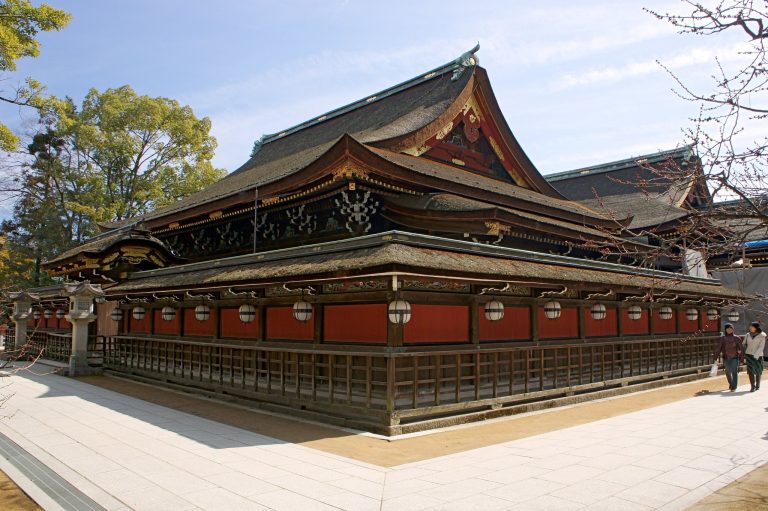
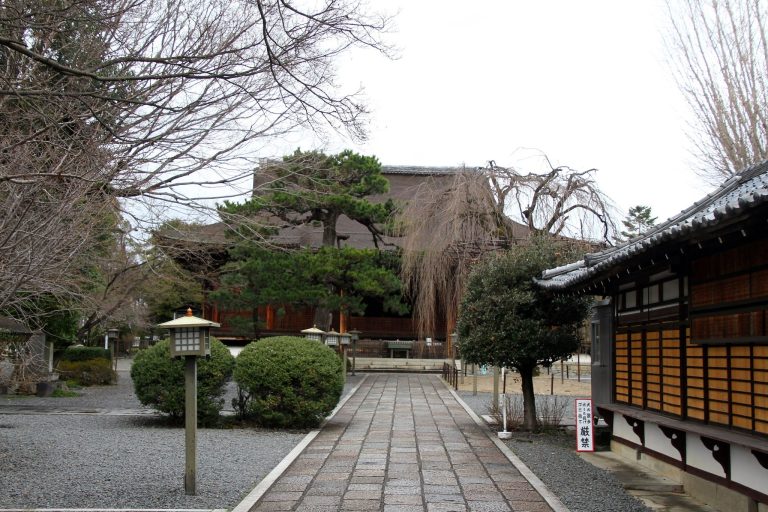
Hirano Shrine’s surviving precinct is organized along an east-facing axis that leads through gates and covered corridors toward the worship hall, inner gate, and four-part main sanctuary. The principal buildings combine cypress-bark roofing with forms associated with Kasuga-zukuri, a compact shrine design with a projecting front gable. The sanctuary’s paired arrangement is known as Hiyoku Kasuga-zukuri, or Hirano-zukuri after the shrine.
Main Sanctuary
The main sanctuary consists of four halls arranged in two connected buildings. The first and second halls form the southern building, while the third and fourth form the northern building. Each pair is joined with an empty bay between the halls. The four halls face east and house the deities individually in order from north to south, with Imaki in the northernmost first hall. The eastward orientation is traditionally connected with the sanctuary’s former status as a palace deity. The first and second halls date to 1625, and the third and fourth to 1632. The two sanctuary buildings, together with two associated ridge plaques, are Important Cultural Properties.
Gates and Worship Hall
The inner gate stands before the main sanctuary and connects on both sides with covered corridors. Shrine records place its construction around 1653. It has a four-bay front, one-bay depth, a karahafu roof form with a curved gable, and cypress-bark roofing. It began as a karayakuimon, a gate type with a roofed entrance structure, and later alterations added three bays behind it.
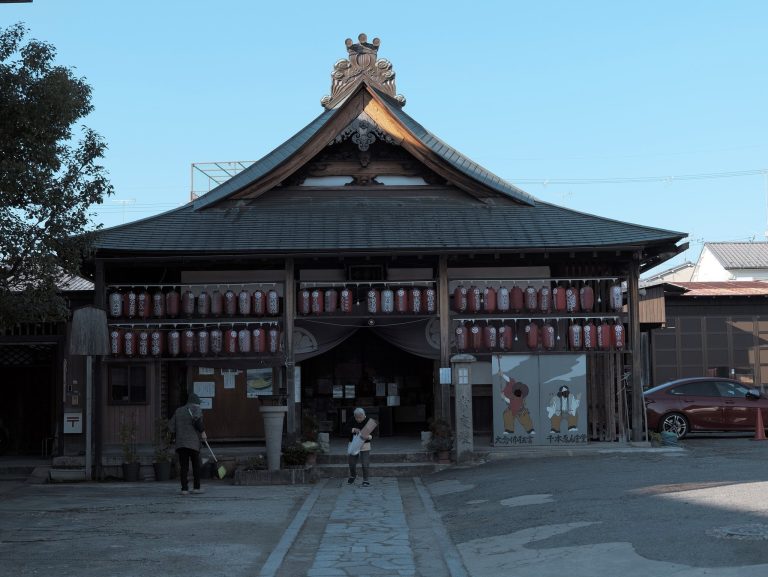
The worship hall stands in front of the inner gate. Tofukumonin, also known as Tokugawa Kazuko, donated it in 1650. It is popularly called the joined-timber worship hall because it was built without nails. The open-sided hall has a two-bay front, one-bay depth, and an irimoya roof, a hipped roof combined with a gabled section, covered with cypress bark. Its interior contains paintings of the Thirty-Six Immortal Poets. Hiramatsu Tokikazu donated the paintings, Konoe Motohiro supplied the calligraphy during the Kanbun era, from 1661 to 1672, and Kaiho Yusetsu created the artwork.
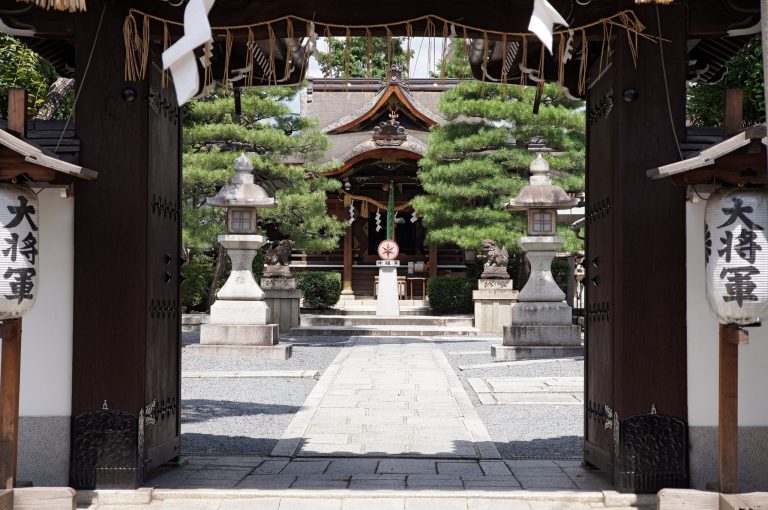
The south gate is a yakui-mon, a gate traditionally associated with warding off evil influences. It has a kirizuma roof, a simple gabled roof form, covered with interlocking roof tiles, and a heavy timber design. The imperial palace reportedly presented it in 1651. It probably had been built around 1619 as a gate for a residence of an imperial consort. The gate formerly stood at the site of the large torii on the eastern side of the grounds and was moved to its present southern position in 1943.
Grounds and Associated Shrines
The wider grounds include a front gate, a large torii, an eastern gate, covered corridors, a norito hall for the recitation of prayers, an administrative office, the worship hall, the inner gate, the south gate, and the main sanctuary. The cherry garden is a major landscape feature. It is traditionally associated with a cherry tree planted by Emperor Kazan in 985 and with the celebrated night cherry blossoms of Hirano, a reputation established by the early-modern period. The grounds include the tree known as Sakigake-zakura, and the annual Cherry Blossom Festival remains a religious observance.
Agata Shrine stands south of and alongside the main sanctuary within the sacred enclosure. Dedicated to Ame-no-Hohi no Mikoto, it is a one-bay Kasuga-zukuri building with a cypress-bark roof. Its ridge plaque gives a construction date of 1631, and the building underwent major repairs in 1937. The shrine crest is a double cherry blossom, known as Yaezakura.
A model of the Imperial Japanese Navy heavy cruiser Kinugasa is also held within the grounds. The ship had an onboard shrine associated with Hirano Shrine, giving the model a connection with the shrine’s wider religious associations.
Nearby sites