Tomen y Mur: A Roman Military Site in Wales



Site at a Glance
- Rating
- 4.3
- Popularity
- Very Low
- Country
- United Kingdom
- Primary era
- Classical
- External website
- Open
- Eras represented
- Classical, Medieval
- Civilizations
- Norman, Roman
- Site type
- Military
- Remains
- Fort
On this page16 sections
History
Tomen y Mur is a Roman military site in Wales, United Kingdom, near Trawsfynydd, established during the campaigns of Governor Gnaeus Julius Agricola in north Wales, probably in AD 77–78. The site occupied a strategic position between Maentwrog and Trawsfynydd, on the slopes of Mynydd Maentwrog northeast of Llyn Trawsfynydd. It formed part of a wider Roman network connected by roads with Segontium, the fort at present-day Caernarfon, and Canovium, a fort and settlement in north Wales.
Roman foundation and garrison
The first fort was constructed from earth and timber during the Roman conquest of the Ordovices, a Celtic people of central and north-west Wales who resisted Roman rule. It probably accommodated about 1,000 mounted troops. Its functions included maintaining Roman authority after the campaigns, overseeing local communities, protecting road communications, and controlling the territory of the Ordovices.
During the reign of Emperor Hadrian, who ruled from AD 117 to 138 and reorganised Roman frontiers, the fort was rebuilt in stone on a smaller scale. This rebuilding probably took place around AD 110–120 and produced a garrison installation for about 500 infantry. The change reflects a movement away from active campaigning towards the more settled duties of a permanent military post.
Tomen y Mur was probably abandoned around AD 140. A fifth-century tombstone indicates later occupation or use, although the character of that activity remains uncertain. The Roman name of the fort is also uncertain. Heriri Mons has been proposed as an identification, but no surviving written reference securely establishes the ancient name.
Medieval reuse and Welsh tradition
The Roman fort was reused for a Norman motte, probably built around 1095 during William Rufus’s campaign to conquer Wales. William Rufus was the regnal name of William II, king of England from 1087 to 1100. The mound was placed within the Roman earthworks and later became the feature that gave Tomen y Mur its modern Welsh name, meaning “mound of the wall.” The wider site is also described as a motte-and-bailey fortification, with a raised mound supporting a stronghold and an adjoining enclosed area.
The surrounding area was involved in a battle between the forces of Henry I of England and the Welsh in 1114. Henry I ruled from 1100 to 1135. Later Welsh tradition connected the site with princes of the Cunedda family, a legendary ancestral line associated with an early Welsh royal dynasty. It was also identified with the legendary palace of Ardudwy, or Mur-y-Castell, in the fourth branch of the Mabinogi, a medieval collection of Welsh prose tales containing major mythological traditions. Other legends link the site with Lleu Llaw Gyffes and Blodeuedd, figures in Welsh mythology.
Modern interpretation and protection
Tomen y Mur is regarded as one of the most complete Roman military sites in Britain. Its surviving remains and later features have made it possible to interpret the site as a Roman fort and associated military settlement that was subsequently adapted for medieval defence. It is a scheduled monument, a legally protected archaeological or historic site designated for national importance, and is managed by the Snowdonia National Park Authority.
Remains
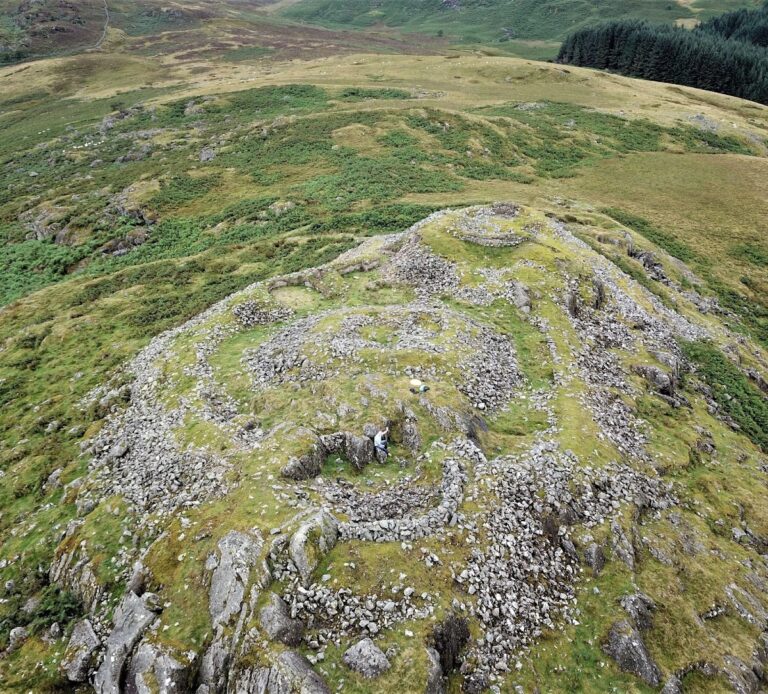
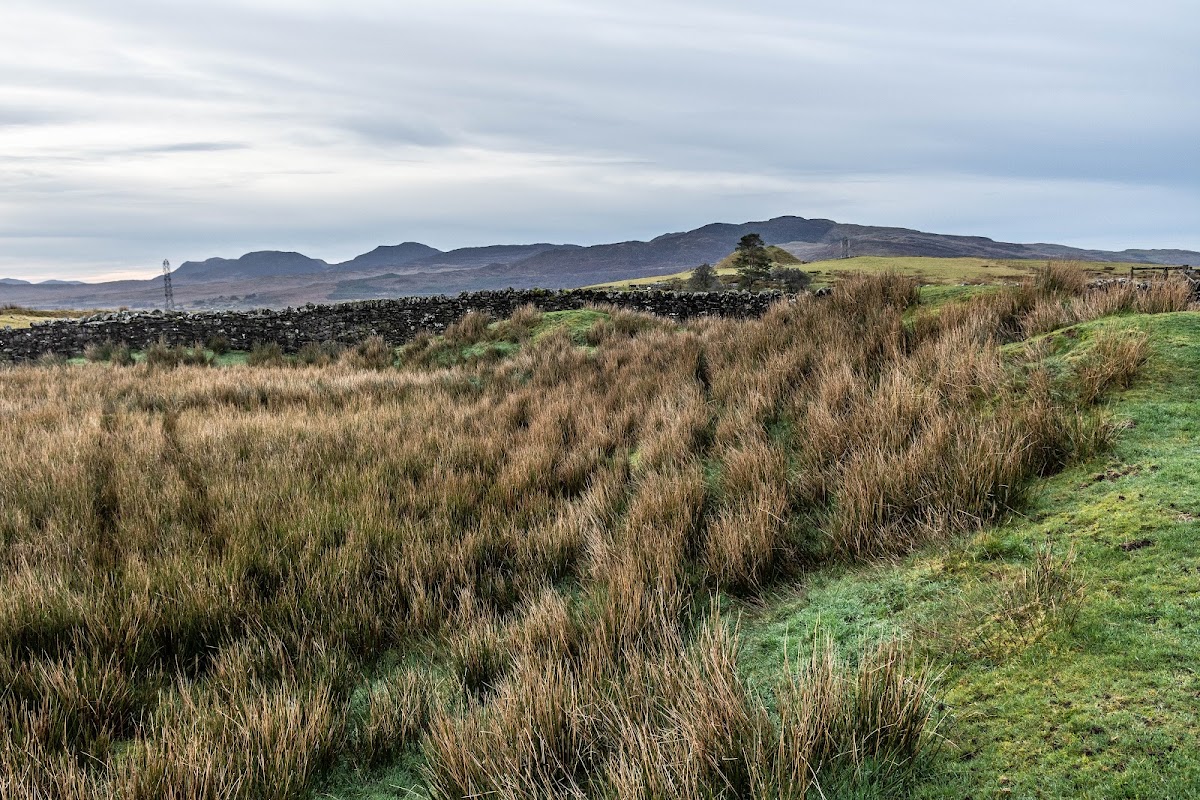
The archaeological site covers approximately 1.7 hectares, or about 17,000 square metres, on the slope of an isolated spur northeast of Llyn Trawsfynydd. The Roman fort occupies the centre of a wider complex of military, administrative, residential, religious, and transport-related remains. The Norman motte rises within the Roman embankments, while the fort stood beside Sarn Helen, the Roman road network in Wales, and was linked with the roads connecting Segontium and Canovium.
The Roman fort and central defences
Fort and motte
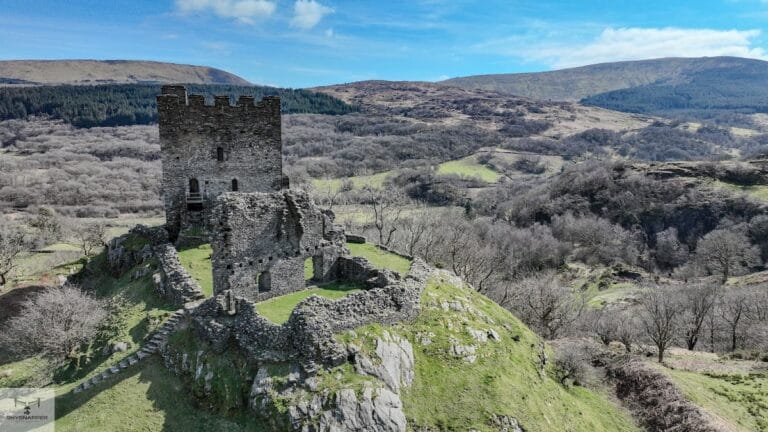
The Roman fort was enclosed by earthworks in its earliest phase and later by stone defences. A section of the second-century curtain wall has been reconstructed to illustrate the appearance of the Roman fortifications. At the centre of the former fort stands the Norman motte, whose position within the Roman enclosure preserves the physical relationship between the medieval stronghold and the earlier military site.
Inscribed wall stones
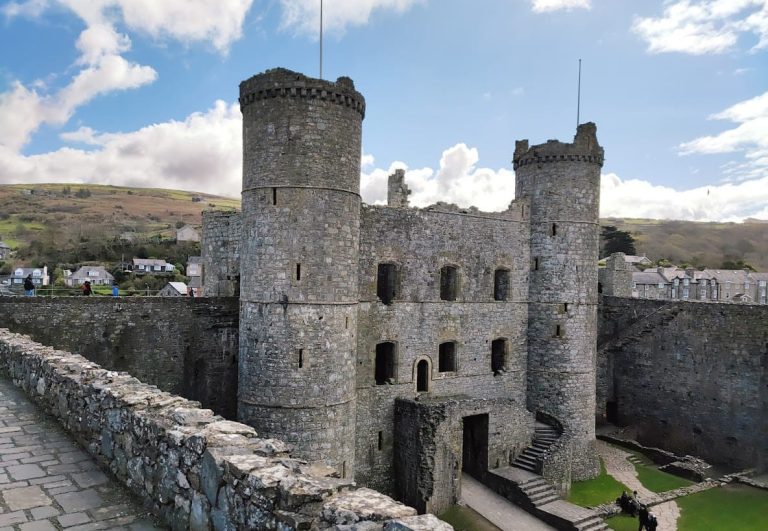
Inscribed stones found at Harlech Castle are believed to have originated at Tomen y Mur. They record completed lengths of fortress wall in Roman paces and name the centuriae, the military subdivisions responsible for construction. Some of these stones were displayed at the former Segontium museum in Caernarfon.
Military and administrative buildings
Military arena
Among the remains is an amphitheatre or small military arena known as a ludus. Its survival is an unusual feature among Roman forts in Britain and forms part of the wider complex outside the main fort.
Bathhouse and roadside establishment
Earthworks outside the fort mark a bathhouse and a mansio, a Roman roadside establishment that provided accommodation and services for official travellers. Their position outside the principal enclosure reflects the extent of the settlement and the infrastructure supporting the garrison.
Residential and religious buildings
The Roman complex also includes residential buildings and a temple or possible temple. Roads and other ancillary features connect these elements with the fort and its surrounding activity areas. The remains indicate that Tomen y Mur was more than an isolated enclosure, incorporating facilities for military life, movement, accommodation, and religious practice.
Landscape features and later remains
Parade ground and burial mounds
Further earthworks outside the fort mark a parade ground and burial mounds. These features extend the archaeological layout beyond the defensive enclosure and form part of the remains associated with the Roman military community.
Bridge and roads
A bridge and sections of roads belong to the transport system serving the site. The fort’s position beside Sarn Helen placed it within the wider network that connected Roman military installations across north Wales.
Welsh court
Just outside the fort are remains thought to represent a court associated with Welsh princes. This feature contributes to the evidence for later activity around the Roman complex and relates to traditions connecting Tomen y Mur with Welsh rulers and the Cunedda family.
Nearby sites