Tamsel: A Historic Palace Estate in Poland


Site at a Glance
- Rating
- 4.1
- Popularity
- Very Low
- Country
- Germany
- Primary era
- Early Modern
- External website
- Open
- Eras represented
- Early Modern, Modern
- Civilizations
- Holy Roman Empire, Margraviate of Brandenburg
- Site type
- Domestic
- Remains
- Manor House
On this page11 sections
History
Tamsel, also known as Dąbroszyn Palace, is a historic palace estate in Dąbroszyn, Poland. It was founded and constructed around 1686 by Hans Adam von Schöning, a Brandenburg Field Marshal, after his return from the siege and assault of Ofen, the historical German name for Buda, in present-day Budapest. Greek craftsmen assisted with the palace and its surrounding park.
The Schöning Estate
The estate was established as the seat of the von Schöning family. Hans Adam von Schöning was a seventeenth-century military commander whose career and titles were later commemorated in the estate chapel. His family’s connection with Tamsel remained central to the complex, even as ownership later passed through the female line.
Frederick II and Tamsel
Tamsel became closely associated with Frederick II of Prussia, later known as Frederick the Great, who ruled from 1740 to 1786. Before becoming king, Frederick was Crown Prince and served in Küstrin, about 5 kilometres southeast of Tamsel along the Oder. He visited the estate between August 1731 and February 1732.
Frederick was infatuated with Luise Eleonore von Wreech, the estate’s heiress, and referred to Tamsel in his letters as “Calypso’s island.” The Katte affair, the political and personal crisis surrounding Frederick’s failed escape attempt and the execution of his friend Hans Hermann von Katte in 1730, had left a deep impression on him. At Tamsel, he found diversion through music and social life.
Luise Eleonore inherited the castle at the age of four and married Lieutenant-General von Wreech when she was sixteen. After the last male members of the Wreech family died without heirs, ownership passed to a daughter of Luise Eleonore, who had married Count Doenhoff.
War and Commemoration
During the Seven Years’ War, a major European conflict fought from 1756 to 1763, Russian troops looted and burned the estate and the surrounding settlement around the time of the Battle of Zorndorf in 1758. Frederick returned to Tamsel on 30 August after the battle. Several children and teachers were killed during these events.
In May 1840, the centenary of Frederick II’s accession to the throne, a statue commemorating the king and his connection with Tamsel was erected in the estate park. Theodor Fontane later helped make the estate known through a chapter on its history, setting, and chapel in Walks through the March of Brandenburg, Volume II, Oderland. He presented Tamsel as both a historical setting and a place associated with the cultivation of the arts.
Twentieth-Century Changes
In the final days of the Second World War, the largely undamaged palace briefly served as the headquarters of Marshal Georgy Zhukov, commander of the First Belorussian Front, a major Soviet military formation. Zhukov used it during preparations for the Berlin operation. Although the surrounding area suffered extensive destruction, the estate and palace sustained comparatively little damage. Toward the end of the war, the palace also became a Red Army military hospital.
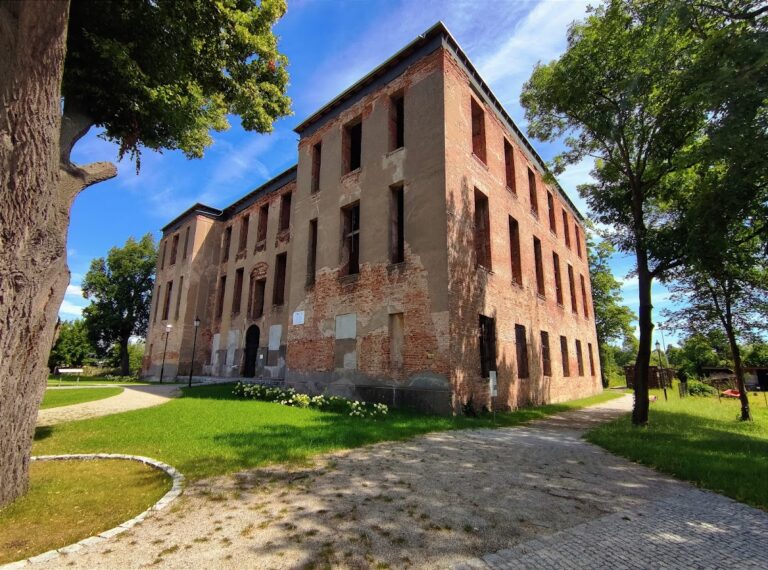
After the 1945 Potsdam Agreement, the Allied settlement that established postwar arrangements for territories affected by Germany’s defeat, the area passed to Poland. The palace subsequently underwent various uses. From around 2000, restoration and conversion for cultural purposes were pursued with the involvement of German heiress Jutta von der Lancken. European Union funding allowed restoration of the lower floor by 2004, but the available funds did not complete the work. The palace later remained unfinished while an investor was sought.
Remains
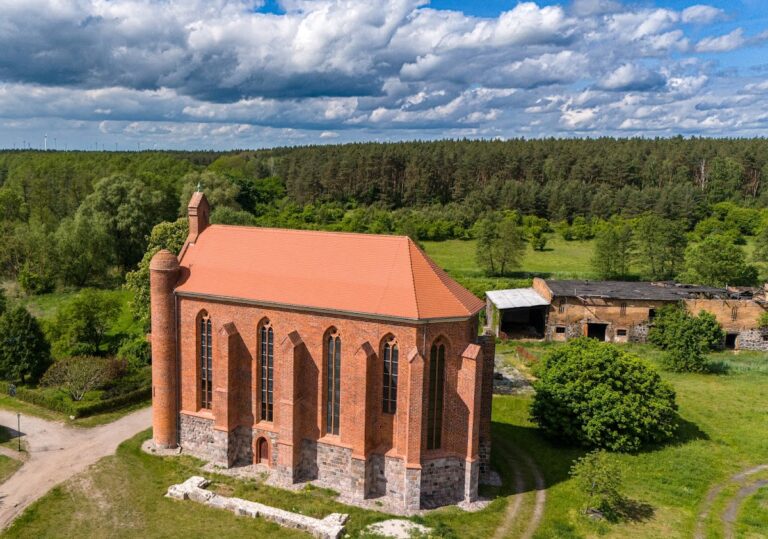
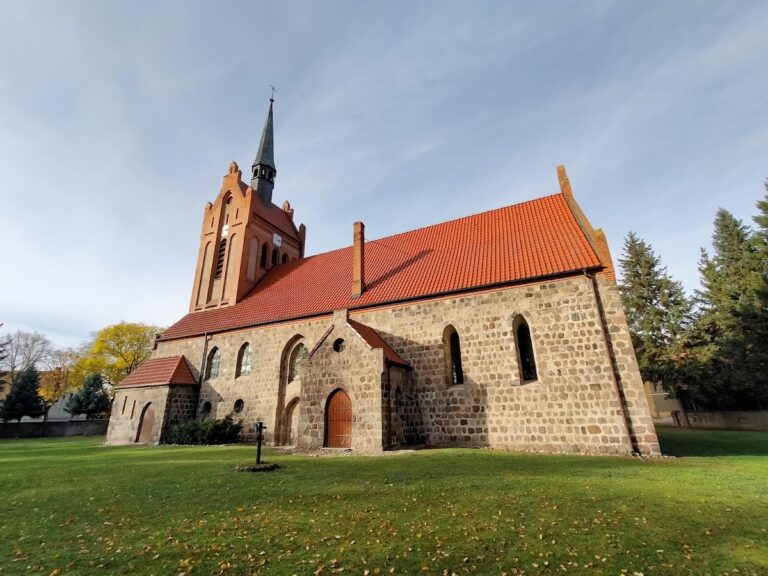
The surviving estate is organized around a manor house, a chapel, and a surrounding park. Together, these elements preserve the principal components of the complex founded around 1686. Restoration has left the palace only partly completed, with some areas used as a kindergarten and lending library and other parts remaining empty.
Chapel Memorials
Hall of Fame
The chapel contains a Hall of Fame dedicated to Hans Adam von Schöning. This commemorative space contains monuments and objects associated with his family and career. Its left transept, the section crossing the chapel’s main axis, holds statues, arms, and trophies. A double niche contains large stone statues of Hans Adam von Schöning and his wife.
A marble bust of Schöning’s son, Johann Ludwig von Schöning (1675–1713), also stands in the chapel. The memorial arrangement presents the family’s military and dynastic associations within the religious building.
Schöning’s Coffin and Memorial Flags
Hans Adam von Schöning’s large copper coffin is preserved in the chapel. It bears a gold or silver crucifix and the family emblem. Flags on the chapel walls record his titles, his birth at Tamsel on 1 October 1641, and his death in Dresden on 28 August 1696.
Wreech Family Burials
The chapel also contains the coffins of Eleonore Luise von Wreech, who died at the age of sixty, and her sons Friedrich Wilhelm von Wreech and Ludwig Graf von Wreech. These burials preserve the connection between the chapel and the family that later inherited the estate.
Park Statue
The statue erected in the park in 1840 is a replica of Christian Daniel Rauch’s Victoria. Its pedestal carries a quotation from Jeremiah 3:27: “It is good for a man that he bear the yoke of his youth.” The monument commemorates Frederick II and the historical association between the king and Tamsel.
Nearby sites