Kostrzyn nad Odrą Fortress: A Cross-Border River Fortress in Poland and Germany


Site at a Glance
- Rating
- 4.6
- Popularity
- Very Low
- Country
- Germany
- Primary era
- Early Modern
- Eras represented
- Early Modern, Modern
- Civilizations
- French, German, Holy Roman Empire, Kingdom of Prussia, Swedish
- Site type
- Military
- Remains
- Fortified Town
On this page17 sections
History
Kostrzyn nad Odrą Fortress is a historic fortress in Poland, centered on the former town of Kostrzyn at the confluence of the Oder and Warthe rivers. Its principal construction belonged to the sixteenth-century early modern period, when the Hohenzollern rulers of Brandenburg created a fortified residence and river stronghold. The fortress later expanded through Swedish, Brandenburg, Prussian, French, and German phases, and its surviving works are now divided between Poland and Germany.
From river crossing to Hohenzollern fortress
Kostrzyn was first documented in 1232 and occupied a strategic position beside two navigable rivers. A fortification probably protected the river crossing. After changing hands several times, the town was sold to Frederick II of Brandenburg in 1455, bringing it into the possession of the Hohenzollern ruling house of Brandenburg and, later, Prussia.
In 1535, Johann of Brandenburg-Küstrin inherited Kostrzyn and made it his residence. He built Kostrzyn Castle between 1535 and 1537, then began the fortress. Earth defenses were raised from 1537 to 1543, but repeated flooding weakened them. After a pause in construction, the defenses were reinforced with masonry between 1553 and 1568, when the fortress was completed. The sixteenth-century masonry work is associated with the builders Francesco Chiaramella and, later, Rochus zu Lynar.
Swedish occupation and Brandenburg expansion
During the Thirty Years’ War, a major European conflict from 1618 to 1648, the Swedish king Gustavus Adolphus established a field fortification on the left bank of the Oder opposite Kostrzyn in July 1630. It controlled the river crossing and shipping. Under Swedish pressure, Brandenburg transferred Kostrzyn to Swedish administration in June 1631. Expansion continued under Elector Frederick William, the Brandenburg ruler who consolidated the state after the war.
Between 1631 and 1688, the defensive system gained a bridgehead, a hornwork with projecting arms, the Brandenburg Bastion, additional redans, four ravelins, and a barrier that closed the moat. These additions made Kostrzyn one of the strongest fortresses in Germany.
The fortress also served as a place of political and religious detention. In October 1675, Frederick William imprisoned the Lutheran theologian Aegidius Strauch II because of his opposition to the Reformed confession and his alleged support for Sweden. Political and civic pressure, including a delegation from Danzig, contributed to Strauch’s release on 9 July 1678.
Royal imprisonment and eighteenth-century warfare
After attempting to flee in 1730, Crown Prince Frederick, later King Frederick II of Prussia, was imprisoned in Kostrzyn Castle by his father, King Frederick William I. On 6 November 1730, Frederick was forced to witness the execution of his companion, the Prussian lieutenant Hans Hermann von Katte. His detention ended in April 1732.
The fortress endured a severe attack during the Seven Years’ War, the conflict fought from 1756 to 1763 among major European powers. Russian forces besieged Kostrzyn from 15 to 18 August 1758. The largely wooden town burned completely, although the fortress was not captured. Frederick II relieved the fortress and defeated the Russian army at the Battle of Zorndorf east of Kostrzyn on 25 August 1758.
During the War of the Fourth Coalition against Napoleonic France in 1806, Friedrich Wilhelm Heinrich Ferdinand von Ingersleben surrendered Kostrzyn to French forces without a general engagement. A brief clash occurred at the western bridgehead, and the Oder bridge was destroyed. The French occupied the fortress until 1814 and continued its expansion. The Redemptorist Klemens Maria Hofbauer, a member of a Catholic religious congregation, was imprisoned there from 24 June to 17 July 1808.
Russian forces shelled Kostrzyn for the first time in March 1813. For strategic reasons, the French burned the Long and Short Suburbs and Kietz on the Oder island. Russian and later Prussian troops blockaded the fortress until it capitulated in March 1814.
Nineteenth-century modernization
Improved artillery range led to extensive modernization during the nineteenth century. The bridgehead on the Oder island was enlarged, flank lunettes were added, and the independent New Fort was built near the railway station between 1863 and 1872. In the 1880s, Kostrzyn became the center of a ring of detached forts, intended to extend the defense beyond the older bastions.
Four Biehler-type forts, a standardized late nineteenth-century German design, were constructed around the town. Fort Gorgast and Fort Zorndorf were built in 1882, Fort Säpzig in 1887, and Fort Tschernow between 1882 and 1885. Explosive shells and longer-range artillery had already made this style of defense militarily outdated by the time the forts were completed.
The fortress restricted urban growth, although access through the defenses gradually widened late in the century. The narrow Kietz Gate was replaced by the much wider Küstrin Gate in 1887, allowing carts to pass. The Oder embankments near the castle began to be dismantled around 1901.
Demilitarization, destruction, and division
Fortress use formally ended in 1920, when the Inter-Allied Military Control Commission ordered the removal of the stationed artillery and weapons. Restrictions placed on the personnel of the Reichswehr, the German army permitted after the First World War, also ended Kostrzyn’s importance as a garrison.
During the interwar period, parts of the eastern old-town defenses were demolished. Zorndorf Gate and Crown Princess Bastion were removed in 1921, Queen Bastion and Albrecht Gate from 1925, and Crown Prince Bastion, also called the High Cavalier, from 1930 to 1931. The moats were filled to create a road around the old town. After 1929, the Kattewall green spaces were laid out on the Oder embankments. A casemate museum opened in Philipp Bastion, while some outer works were rented for commercial use. A coup attempt in 1923 became known as the Küstrin Putsch.
Adolf Hitler declared Kostrzyn a fortress on 25 or 26 January 1945, intending to obstruct the Red Army’s advance toward Berlin. Heinz Reinefarth became fortress commander a few days later. Soviet forces reached the Oder near Kostrzyn in early February and established bridgeheads on the western bank. They captured the fortress and town on 12 March 1945, although fighting continued until the end of the month. About 90 percent of the town’s buildings were seriously damaged, along with much of the bastion system. The Soviet bridgehead near Kostrzyn became the main starting point for the offensive toward Berlin on 16 April 1945.
After the Second World War, most of the former town, which had extended across both banks of the Oder, was incorporated into Poland. The area west of the river became the district of Küstrin-Kietz in the German municipality of Küstriner Vorland, dividing the former fortress between the two countries. Russian troops partially demolished the outer forts to make them militarily unusable, while other works, including New Fort, were wholly or partly dismantled for building materials. Fort Gorgast was later used as a storage camp by the East German National People’s Army.
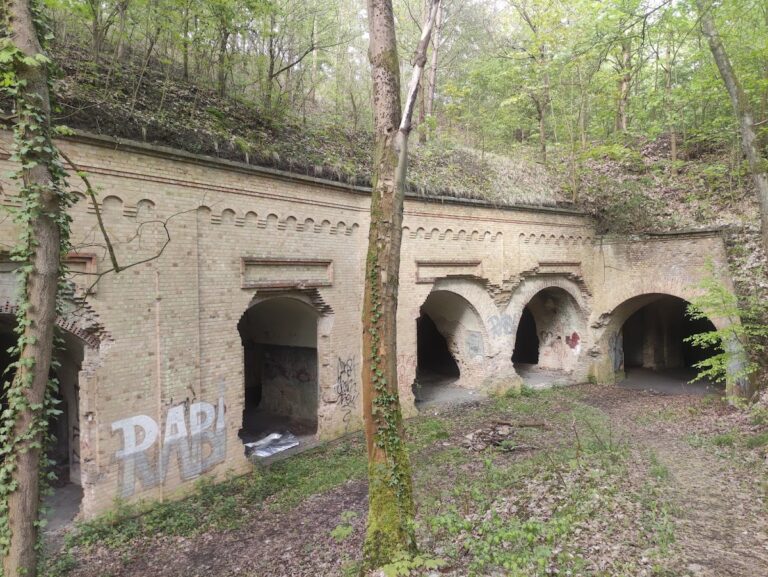
Since the 1990s, restoration has taken place in the old-town fortifications and at Fort Gorgast, which escaped the worst wartime destruction. Other outer works have deteriorated through lack of use. The old-town ruins and the surviving Oder-side enclosure between Berlin Gate and Küstrin Gate became accessible again after 1989. The fortress remains a cross-border historic complex, with most surviving works in Kostrzyn nad Odrą and the remaining outer defenses in Küstriner Vorland.
Remains
The surviving fortress is organized around the ruined old town and the fortified enclosure along the Oder, with detached works extending across the river and into the surrounding landscape. Its fabric combines sixteenth-century earth and masonry defenses, later bastions and waterworks, nineteenth-century forts and bridgehead positions, and twentieth-century adaptations. Wartime damage, postwar demolition, and the removal of masonry for building materials have left the complex in varying states of preservation.
Old-town fortress
Bastions and gates
The completed sixteenth-century fortress contained the King, Queen, Crown Prince, Crown Princess, and Philipp Bastions. A bastion is a projecting fortified platform designed to provide flanking fire along a defensive wall. Berlin Gate and Zorndorf Gate formed the principal city entrances, while Kietz Gate and Mill Gate served pedestrians. The eastern enclosure was progressively dismantled after 1920, but sections of the Oder-side defenses remain between Berlin Gate and Küstrin Gate, together with the ruins of the former old town.
In 1877 and 1878, the gatehouses at Berlin Gate and Zorndorf Gate were demolished and replaced by a city gate with two passages. Powder towers were removed and replaced by powder magazines outside the town. Berlin Gate, Chyżańska Gate, and Philipp Bastion remain among the preserved fortress elements on the Polish side. Philipp Bastion still contains the former casemate museum, a museum installed within a vaulted defensive chamber.
Moats and Oder-side defenses
The original defenses consisted of earth ramparts, which flooding repeatedly undermined. Masonry reinforcement between 1553 and 1568 produced the more durable sections that survive in the old-town enclosure. The expanded system included several redans, projecting fieldworks, and the Gohrin, Albrecht, August-Wilhelm, and Christian Ludwig ravelins. A ravelin is an outwork placed before a wall or gate. At Philipp Bastion, a batardeau, a barrier used to regulate or block moat water, closed the water-filled moat.
The moats were filled during the interwar dismantling of the eastern defenses, and the Kattewall green spaces were established on the Oder-side ramparts after 1929. Much of the built fabric was damaged during the fighting of 1945, while further sections were destroyed by postwar blasting and demolition. Restoration has focused on parts of the old-town fortifications, including the surviving enclosure along the Oder.
Bridgehead and nineteenth-century works
Oder bridgehead and lunettes
The bridgehead stood on the left bank of the Oder opposite the main fortress and formed part of the expanded defensive system. The hornwork, an outer defense with two projecting arms, reinforced this river position, while Brandenburg Bastion was built on the right bank between King Bastion and Philipp Bastion. During the nineteenth century, the bridgehead on the Oder island was enlarged with two flanking lunettes. Lunette B was constructed on the island between 1850 and 1862, while Lunettes C and D were built on the left bank during the same period.
Blockhouses protected the road and railway bridges over the Oder and Warthe. Shortly before the First World War, isolated small shelters were built outside the town to permit more flexible troop deployment during a defense.
New Fort
New Fort was an independent fort built near the former Küstrin-Neustadt railway station, now Kostrzyn railway station, between 1863 and 1872. It formed part of the nineteenth-century response to longer-range artillery and the enlargement of the defensive zone beyond the older town walls. New Fort was later wholly or partly dismantled for construction material.
Detached forts
Fort Gorgast
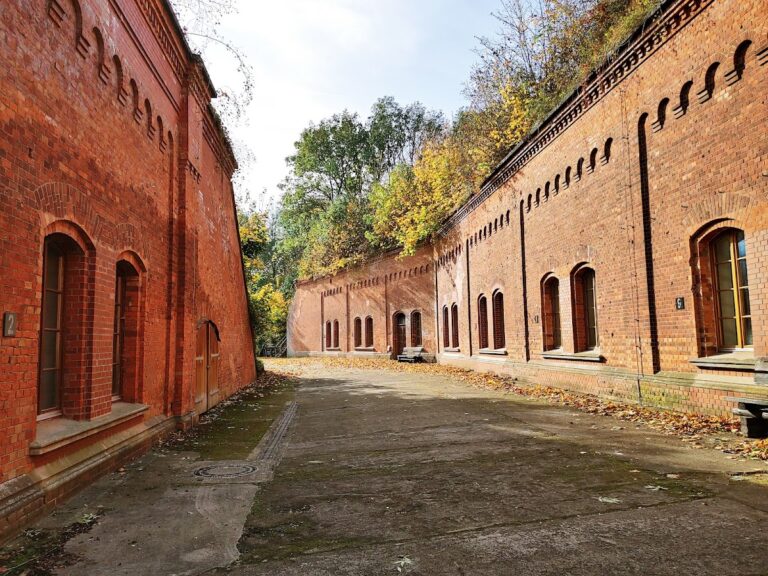
Fort Gorgast formed part of the outer ring built around Kostrzyn in the 1880s. It is a Biehler-type fort, using a standardized late nineteenth-century German plan. The fort escaped the worst wartime destruction and was later used as a storage camp by the East German National People’s Army. Restoration has been undertaken there, and the surviving structure remains one of the better-preserved outer works.
Fort Zorndorf, Fort Säpzig, and Fort Tschernow
Fort Zorndorf near Sarbinowo was built in 1882, Fort Säpzig near Żabice in 1887, and Fort Tschernow near Czarnów between 1882 and 1885. Together with Fort Gorgast, they formed a ring of detached forts around the town. Russian troops later partially demolished the outer works to make them militarily unusable. The forts now survive in varying degrees of ruin, and the remaining works lie west of the Oder in Küstriner Vorland, Germany.
Second World War defenses
During the Second World War, the forts and town defenses were adapted for modern combat. A unified defense system combined three trench belts, an anti-tank ditch, and fourteen combat shelters. The 1945 fighting damaged much of this system along with the town and bastions, leaving the present fortress as a layered archaeological landscape of early modern, nineteenth-century, and wartime defenses.
Nearby sites