Fort Sarbinowo: An Artillery Fort of the Kostrzyn Fortress


Site at a Glance
- Rating
- 4.7
- Popularity
- Low
- Country
- Poland
- Primary era
- Modern
- External website
- Open
- Eras represented
- Modern
- Civilizations
- German
- Site type
- Military
- Remains
- Fort
On this page5 sections
History
Fort Sarbinowo, also known as Fort Zorndorf, is an artillery fort in Poland, in Kostrzyn nad Odrą. An artillery fort was a fortified military position designed to use guns against forces approaching a principal fortress. Built between 1883 and 1889 as part of the nineteenth-century modernization of the Kostrzyn Fortress, it was one of four forts surrounding the main stronghold, alongside Fort Czarnów, Fort Gorgast, and Fort Żabice.
Planning and construction
The transformation of the Kostrzyn Fortress into a wider fortified system was planned in 1872. The initial scheme of 1876 called for eight artillery forts, but this was soon reduced to four. All four were eventually built, including Fort Sarbinowo. Its brick construction offered limited protection against artillery fire, so an additional concrete layer was placed over the vaults of the most important buildings in 1889 and 1890.
Advances in artillery technology continued to weaken the fort’s military value. By 1914, its defensive usefulness was assessed as close to zero. The fort never took part in combat during the First World War, a conflict fought from 1914 to 1918 that involved the major European powers and their allies.
Wartime and later uses
During the First World War, Fort Sarbinowo was used as a prisoner-of-war camp. Among those held there were Roland Garros, a French aviator and pioneering military pilot, and Mikhail Tukhachevsky, a Soviet military commander who later became a marshal.
After the war, the fort became a transit camp for German optants. These were people of German origin living in the territory of the emerging Second Polish Republic who chose not to remain there. During the Second World War, an ammunition factory operated within the fort. After the war, ammunition recovered nearby was detonated on the grounds, destroying part of the buildings. The site was inventoried in 2006 through the Baltic Fort Route project.
Remains
Ramparts and defensive layout
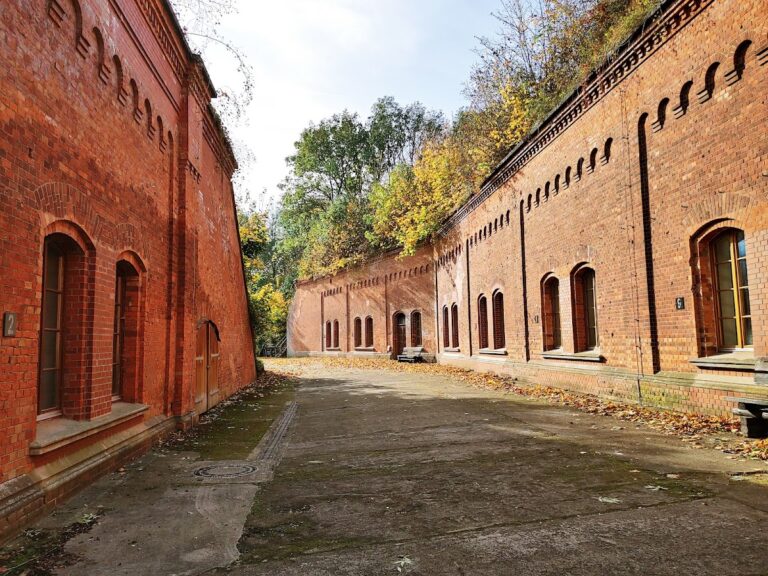
Fort Sarbinowo stands on Sportowa Street, on the road leading toward the village of Sarbinowo. It was equipped with 24 guns and accommodated a garrison of approximately 600 people, including infantry, artillery, sappers, and support personnel. The defensive layout included two ramparts, with a higher central rampart intended for artillery and a lower rampart intended for riflemen.
A dry moat encircled the fort. It measured 6.5 metres in depth, 10.6 metres in width, and 1,082 metres in length. Brick formed the principal building material, while concrete was later added above the vaults of the key structures to improve their resistance to artillery fire. Postwar ammunition detonations left parts of the buildings destroyed, while the surviving fabric continues to express the fort’s original defensive organization.
Nearby sites