Londigny Castle: A Nineteenth-Century Castle in France


Site at a Glance
- Rating
- 4.6
- Popularity
- Very Low
- Country
- France
- Primary era
- Modern
- Eras represented
- Medieval, Modern
- Civilizations
- French
- Site type
- Domestic
- Remains
- Castle
On this page7 sections
History
Londigny Castle, also known as Peu Castle, is a nineteenth-century castle in Londigny, France. Its present form combines Neo-Gothic, Baroque, and Renaissance elements in a historical revival style associated with the architect Eugène-Emmanuel Viollet-le-Duc. The building developed from a small manor into the residence of the Prévost de Touchimbert family and was enlarged extensively between 1870 and 1906.
From manor to important fief
In the fifteenth century, the site consisted of a small manor belonging to Jean Jousserand, a squire and lord of Lairé in Poitou. René Jousserand held it in 1635. Londigny was an important fief dependent on the territorial lordship of Ruffec, a system in which authority was administered from a castle or fortified seat.
By 1687, Casimir Prévost de Touchimbert was lord of Londigny and several other estates. François Prévost succeeded him and later emigrated, but the Prévost de Touchimbert family retained ownership of the castle. Auguste François Prévost Sansac, lord of Londigny and other estates and marquis of Touchimbert, died there in 1786. His widow, Charlotte de Chapt de Rastignac, owned the property in 1795.
The nineteenth-century rebuilding
The castle’s present appearance emerged through an enlargement campaign lasting from 1870 to 1906. Louise Marie Stéphanie, a descendant of the Prévost de Touchimbert family, married the marquis de Lameth in 1872. The work was financed through the sale of a rum distillery in Martinique.
The present building is more specifically believed to have been erected by Léopold Auguste Prévost Sansac, marquis of Touchimbert, and his son-in-law Joseph Ambroise Antoine Alfred de Lameth. De Lameth later became count and, from 1904, marquis of Bussy. Léopold Auguste Prévost Sansac, who served as a general councillor of Charente, died at the castle in 1897.
War and recent ownership
During the Second World War, the ceremonial cannons mounted at the castle attracted repeated visits from German soldiers. They threatened the occupants and questioned whether the artillery pieces were operational.
From 2011 to 2024, the castle was managed by the Château des Chevaliers de Londigny company, based in Échiré in Deux-Sèvres. Ownership passed to an Australian couple in 2024.
Remains
Castle buildings
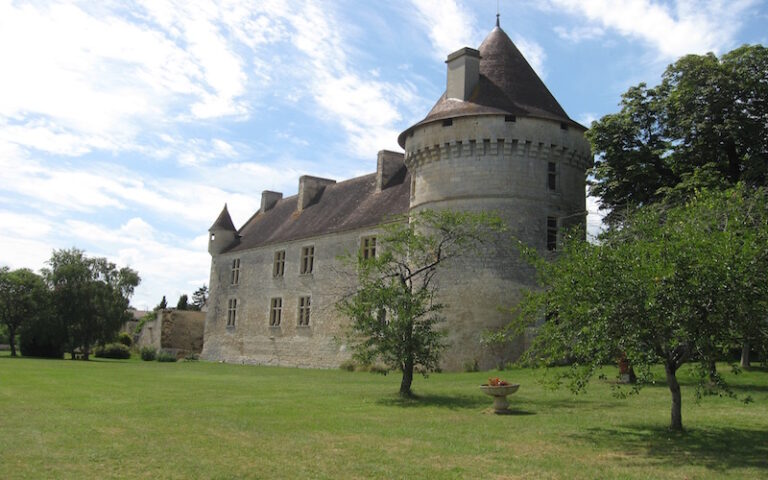
Londigny Castle stands on Peu Hill, about one kilometre south of the village, on the right bank overlooking the Péruse valley. Its principal building has a pointed roof and is flanked by round and square towers. The north-eastern facade faces the valley, while a west wing returns at an angle on the courtyard side. A projecting pavilion on the facade continues into the castle chapel.
The architecture presents an eclectic nineteenth-century composition, bringing together Neo-Gothic, Baroque, and Renaissance features. Its Viollet-le-Duc style reflects a nineteenth-century interpretation of medieval architectural forms. Only a western tower survives from the earlier castle, and ornamental cannons project above its battlements.
Park and commemorative features
A fifteen-hectare landscaped park surrounds the castle. In front of the building stands a 1912 equestrian statue of Casimir Prévost de Touchimbert, shown in armour. The grounds also contain numerous concrete sculptures.
In the woods opposite the castle is a monument to Joan of Arc, the fifteenth-century French military and religious figure who became a national symbol of France. The marquis de Lameth erected it in memory of his two daughters, who died young.