Aramatsuri-no-miya: The Highest-Ranking Subordinate Sanctuary of Naiku


Site at a Glance
- Rating
- 4.6
- Popularity
- Low
- Country
- Japan
- Primary era
- Medieval
- External website
- Open
- Eras represented
- Medieval, Early Modern, Modern
- Civilizations
- Japanese
- Site type
- Religious
- Remains
- Sanctuary
On this page7 sections
History
Aramatsuri-no-miya is a subordinate Shinto sanctuary in Japan, within the Naiku precinct of Ise Grand Shrine in Ise, Mie Prefecture, whose foundation is placed before 804. Known as a Betsugu, a formally recognized sanctuary below a complex’s principal shrine, it is dedicated to the aramitama, or vigorous and dynamic aspect, of Amaterasu Omikami, the central sun deity of Shinto and principal deity of Ise Grand Shrine. It is classified as a major-category Shikinai shrine, meaning that it appears in the higher class of shrines listed in the tenth-century Engishiki, a compilation of laws and ritual regulations. Among Naiku’s ten subordinate sanctuaries, it holds the highest rank.
Foundation and Religious Status
The conventional interpretation of Aramatsuri-no-miya’s name is “the sanctuary that enshrines the aramitama,” although the reason for using this name rather than Aramitama-no-miya is unknown. The Jingu Zatsureishu traditionally places its establishment in the tenth month of the twenty-sixth year of Emperor Sujin and says that it was built at the same time as Naiku’s main sanctuary. The earliest surviving record cited for Aramatsuri-no-miya is the 804 Kotaijingu Gishikicho, and the sanctuary also appears in the 927 Engishiki.
Before the periodic rebuilding and transfer system known as shikinen sengu was established, the aramitama of Amaterasu is thought to have been worshipped within the precinct of Naiku’s main sanctuary. This earlier arrangement is described in the official account of Takihara-no-miya, another Ise subordinate sanctuary. The same aspect of Amaterasu is also enshrined at the outlying Takihara-Narabi-no-miya, but Aramatsuri-no-miya retains the first rank among Naiku’s subordinate sanctuaries, and its buildings are larger than those of the other sanctuaries in that group.
Ritual Continuity and Renewal
The sanctuary’s principal observances generally follow those of Naiku. They include the Kinensai, Tsukinamisai, Kannamesai, and Niinamesai, for which imperial offerings are made and an Imperial envoy visits Aramatsuri-no-miya after the main sanctuary. The Kanmiso-sai, held in May and October, takes place only at Naiku’s main sanctuary and Aramatsuri-no-miya. Clothing, rice, and other offerings for Aramatsuri-no-miya are provided in quantities of approximately half those offered at the main sanctuary.
Aramatsuri-no-miya is traditionally visited after Naiku’s main sanctuary. A remote-worship site was established near the Seed-Rice Stone on a paved stone area for people unable to reach the sanctuary, and it was originally intended for ritual use. During the sixty-second shikinen sengu in 2013, the enshrined deity was transferred to the renewed sanctuary on October 10 at 8:00 p.m., before the transfers at the other subordinate sanctuaries.
Later History
In 1936, bats nested in the sanctuary building, and the deity was temporarily transferred. Prince Takamatsu, a naval officer and younger brother of Emperor Showa, later described the circumstances as exceptionally frightening when he attempted to visit the sanctuary amid a series of ominous events that included the February 26 Incident.
The stone steps leading to Aramatsuri-no-miya were built during the Tenmei era of the Edo period and slightly repositioned in 1909. The cedar tree standing on the steps was deliberately left in place. The precinct faced financial difficulty during the Muromachi period, improved somewhat during the Edo period, and had reached a fully equipped condition by 1909.
Remains
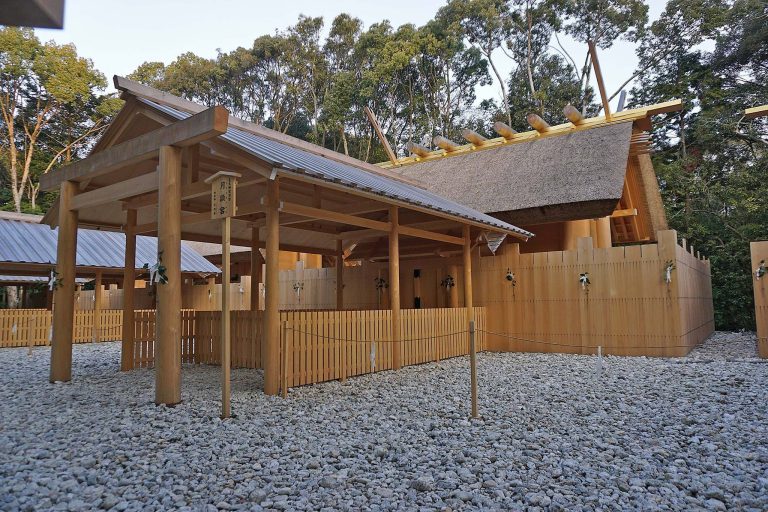
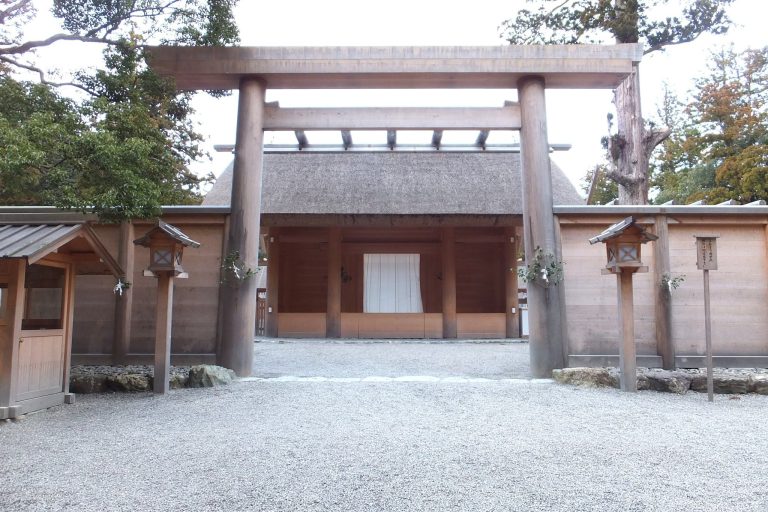
Aramatsuri-no-miya stands north of Naiku’s main sanctuary, behind the main sanctuary building. Its south-facing main building is a thatched timber structure in the Shinmei-zukuri style associated with Ise Grand Shrine. The present building stands beside the adjacent site used for periodic reconstruction, preserving the arrangement through which the sanctuary is renewed while ritual continuity is maintained.
Main Sanctuary Building
The main building measures 6.42 metres in width, 4.24 metres in depth, and 4.48 metres in height. These dimensions exceed those specified for the other subordinate sanctuaries. Its roof has inward-cut chigi, forked finials projecting above the roof, and six katsuogi, short logs set along the ridge. The sacred object inside is a mirror. Several texts give Seoritsuhime and Yaso-Magatsuhi-no-kami as alternative names for the deity enshrined there.
Approach and Ritual Setting
The approach descends one flight of steps and then rises by another toward the sanctuary. About forty steps down the first flight lies a stone split into four parts in a form resembling the character for “heaven.” Called the Stone Not to Be Stepped On, it was already known during the Edo period and is traditionally avoided. A tradition says that it fell from heaven, while its material is sedimentary rock rather than meteorite, leaving its origin uncertain.
A cedar tree rises midway up the steps in front of the sanctuary. When the steps were slightly moved in 1909, the tree was intentionally retained in its original position. The 804 description places the sanctuary north of the main sanctuary and twenty-four jo away, with a jo measuring approximately 1.8 metres.