Synagogue of Tomar: Portugal’s Oldest Surviving Synagogue


Site at a Glance
- Rating
- 4.3
- Popularity
- Low
- Country
- Portugal
- Primary era
- Medieval
- External website
- Open
- Eras represented
- Medieval
- Civilizations
- Portuguese
- Site type
- Religious
- Remains
- Synagogue
On this page12 sections
History
The Synagogue of Tomar is a fifteenth-century Jewish synagogue in Portugal, built by Tomar’s Jewish community between 1430 and 1460 in a Gothic style with proto-Renaissance characteristics. It is the oldest surviving synagogue in Portugal and stands in the former Jewish quarter of the city’s historic center.
The Jewish community and construction
Tomar’s Jewish community probably began in the early fourteenth century, when Jews settled in the town to work for the Knights Templar, a medieval military-religious order. After the Templars were suppressed, many of their Portuguese properties and functions passed to the Military Order of Christ. Infante Henry, the Portuguese prince who served as master of that order, apparently protected the Jewish community.
During the fifteenth century, the community grew quickly and established a Jewish quarter whose gates were reportedly closed from sunset until sunrise. By the middle of the century, approximately 150 to 200 people lived there, representing about 30 to 40 percent of Tomar’s population. The community became larger again in 1492, when Jews expelled from Spain arrived in Portugal. The synagogue was founded to serve this expanding congregation.
Closure and changing uses
The congregation worshipped openly until 1496, when King Manuel I, who ruled Portugal from 1495 to 1521, ordered the country’s Jews to convert to Christianity or leave. The Jewish quarter was abolished and the synagogue closed. Many converts, known as New Christians, moved to other parts of Tomar. New Christians included forcibly converted Jews and their descendants, some of whom were later accused by the Inquisition of secretly maintaining Jewish beliefs.
A private owner acquired the former synagogue and sold it in 1516 for conversion into Tomar’s public prison. The prison had previously been located in the castle, and the building probably continued in this role until at least the 1550s. Inquisition trials involving New Christians accused of secretly observing Judaism were also held there.
After alterations made between the late sixteenth and early seventeenth centuries, the building became the Catholic chapel of Saint Bartholomew. It retained this religious function until the nineteenth century, and a record states that a wedding took place there in 1613. Later in the nineteenth century, the former synagogue was used as a hay barn, followed by use as a wine cellar and a warehouse for grain, foodstuffs, and groceries.
Protection and museum history
Portuguese archaeologists visited the building in 1920. The government classified it as a National Monument on 29 July 1921. On 5 May 1923, the Polish Jewish engineer and scholar Samuel Schwarz purchased it. He organized its restoration and conducted its first excavations.
Schwarz donated the building to the Portuguese government on 27 July 1939, on the condition that it become a museum commemorating Portugal’s Jewish heritage. Portuguese citizenship was granted to Schwarz and his wife in connection with the donation, helping to protect them during the Holocaust. Since 1939, the building has housed the Abraham Zacuto Portuguese Jewish Museum. Abraham Zacuto was a fifteenth-century Jewish astronomer, mathematician, historian, and rabbi associated with Portugal and Spain.
The museum is a Jewish heritage institution rather than an active congregation. Tomar and its surrounding area do not have a Jewish community, so regular Jewish prayers and ceremonies are not held there. Occasional prayers take place during visits by Jewish groups from Israel. The former synagogue is one of two preserved medieval synagogue buildings in Portugal, the other being the synagogue at Castelo de Vide. Portugal’s other surviving synagogues were built after the Portuguese Inquisition ended in 1821.
Remains
Building and worship hall
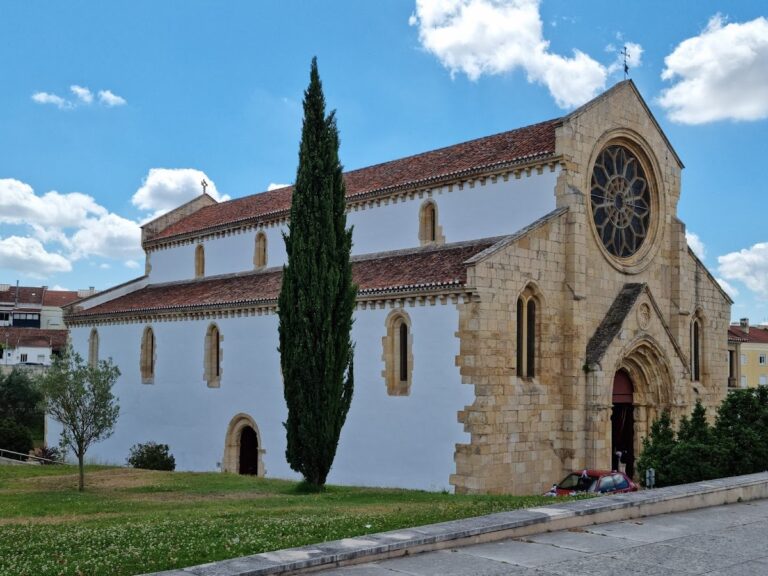
The synagogue stands in the former Jewish quarter, within Tomar’s historic center. Its whitewashed exterior was designed or retained to resemble the neighboring houses, making the building difficult to identify as a synagogue apart from the present Star of David and informational signage. The medieval structure is built of stone, and its architectural character combines Gothic forms with a transitional phase toward the Renaissance.
Worship hall
The principal hall lies below the level of the exterior ground and measures approximately 9.5 by 8.25 meters. Its square or nearly rectangular plan is divided into three naves and three bays by four Gothic columns. The columns carry brick vaulting with sharp-edged surfaces. These vaults meet the outer walls and end in carved brackets or corbels embedded in the masonry.
The capitals of the columns bear geometric and plant-based carvings. Traditional interpretation associates the four columns with the four matriarchs of Judaism, Sarah, Rebecca, Leah, and Rachel. The twelve corbels are associated with the Twelve Tribes of Israel. Two capitals share the same design, while the other two differ, a pattern traditionally explained through the association of Leah and Rachel with Laban.
Eight inverted earthenware jars are set into the walls at the corners. Openings connect the jars with the hall, creating an acoustic system. The interior arrangement and this acoustic feature have been compared with the crypt of Afonso, Count of Ourém, in the parish church of Ourém. Afonso was a fifteenth-century Portuguese nobleman.
Entrances and orientation
The original principal entrance was an east-facing pointed Gothic arch oriented toward Jerusalem. The present entrance is a modest rectangular doorway on the north side, which was not part of the medieval building.
Ritual bath
Excavation beside the synagogue uncovered a rectangular room attached to the main building. It was identified as a mikveh, a Jewish ritual bath used for purification, and was specifically associated with the purification of women.
Museum collection
The museum preserves Jewish books, ritual and cultural objects, and stone tombstones from Jewish communities and cemeteries in several parts of Portugal. These materials extend the building’s historical interpretation beyond Tomar and preserve evidence of Jewish life in different Portuguese communities.
Inscriptions from Lisbon and Faro
Among the objects is a stone inscription from a Lisbon synagogue dated 1307 and bearing a greeting. Another Lisbon stone, dated 1308, is associated with the foundation of the city’s second synagogue. A funerary stele from Faro commemorates Rabbi Joseph, a Jewish resident of Tomar who died in 1315.
Belmonte inscription
The collection also includes an inscription from Belmonte dating to the thirteenth century. It represents the Divine Name with three dots, in a form described as resembling the Dead Sea Scrolls.