Swansea Castle: A Norman Lordship Centre in Wales

Site at a Glance
- Rating
- 4
- Popularity
- Low
- Country
- United Kingdom
- Primary era
- Medieval
- External website
- Open
- Eras represented
- Medieval, Early Modern, Modern
- Civilizations
- English, Norman
- Site type
- Military
- Remains
- Castle
On this page11 sections
History
Swansea Castle is a medieval Norman castle in Swansea, United Kingdom, established around 1106–1107 by Henry de Beaumont after Henry I, the English king, granted him the lordship of Gower. It served as the caput, or principal administrative centre, of the lordship and formed part of the Norman effort to consolidate control in the area.
Foundation and Welsh attacks
A timber castle stood at Swansea by 1116, when Welsh forces attacked it and destroyed its outer defences. Rhys ap Gruffydd, the twelfth-century prince of Deheubarth, besieged the castle in 1192 for ten weeks. The garrison endured starvation until an English army arrived and relieved the stronghold.
Control of Swansea changed repeatedly during the twelfth and thirteenth centuries. In 1184, William de Beaumont surrendered Swansea to the Crown to settle debts. King John granted Gower and Swansea to William de Braose in 1203, but the Crown confiscated William’s lands in 1209–1210 and placed them under the administration of the Earl of Pembroke.
Reginald de Braose captured the castle in 1215 with help from Llywelyn ap Iorwerth, commonly known as Llywelyn the Great, the powerful Welsh prince who ruled much of Wales in the thirteenth century. After Reginald reached a settlement with the Crown, Welsh forces led by Rhys Gryg, a prince of Deheubarth, burned the castle in 1217. Control was restored through another settlement in 1220, after which the castle was rebuilt in stone, probably between 1221 and 1284.
The New Castle and medieval administration
The rebuilt stronghold became known as the New Castle and developed in stages. The inner castle, including at least one tower, was constructed first. A larger outer bailey, the enclosed area beyond the inner stronghold, followed. During Edward I’s campaigns in Wales, William de Braose, 1st Baron Braose, expanded the southern and western outer bailey after 1277 and enclosed it with a stone curtain wall, a defensive wall surrounding the enclosure.
By the fourteenth century, Swansea Castle had lost most of its military importance and functioned mainly as an administrative centre. Its owners became absentee landlords, while Oystermouth Castle was preferred as the principal residence by John de Mowbray and his successors.
Alina de Mowbray held the lordship of Gower until 1331, when it passed to her son John de Mowbray. Following a legal dispute, John was required to surrender the castle to William Beauchamp in 1353. Thomas Mowbray, 1st Duke of Norfolk, recovered it through another legal action in 1397. After Thomas died in exile in 1399, Swansea reverted to the Crown, although his son John Mowbray recovered it in 1413.
The castle may have been held by Welsh rebels during the rebellion of Owain Glyndŵr between 1403 and 1406. Glyndŵr was a Welsh nobleman who led a major rebellion against English rule in the early fifteenth century. Records from the period show that two men were sent north from Swansea to gather intelligence about his activities.
Royal treasure and the end of military use
In November 1326, while fleeing his enemies, Edward II sent part of the Crown treasure to Swansea Castle. Edward was captured on 16 November, and the treasure was then stolen and never recovered.
After the Wars of the Roses, a series of dynastic conflicts in fifteenth-century England between the houses of Lancaster and York, the castle ceased to have an effective military role. Royalist forces occupied it from 1642 to 1645 during the English Civil War, the seventeenth-century conflict between the monarchy and Parliament. Parliamentary troops destroyed its defences in 1647.
Reuse, damage, and conservation
The ruins were repeatedly adapted between the seventeenth and nineteenth centuries. The castle was described as decayed in 1650, but its square tower became a bottle factory in the 1670s. A town hall was built in the courtyard in 1700, and the Great Hall became Swansea’s workhouse in the mid-eighteenth century. The courtyard also served as a market, while a printing works was established there.
In the nineteenth century, the town hall was replaced by a post office, and a military drill room had replaced the workhouse by 1850. The north-east tower was used as a prison and debtors’ tower. Its debtors’ prison closed in 1858, among the last such institutions in Britain to close under an Act of Parliament.
Part of the castle, including much of the large motte, was demolished between 1909 and 1913 for newspaper offices. In the early 1930s, the Welsh poet Dylan Thomas worked for the South Wales Daily Post at the site. The newspaper offices were removed in 1976.
Swansea suffered heavy Luftwaffe attacks from 19 to 21 February 1941, and the castle was damaged during the raids. After the Second World War, non-medieval buildings were demolished, and the surviving ruins were consolidated and secured. Further conservation and restoration followed. Swansea Castle is a Grade I listed building and a Scheduled Monument, with the Grade I designation dating from 1952. Grade I is the highest category for buildings of exceptional architectural or historic interest in England and Wales, while a Scheduled Monument is a legally protected archaeological or historic site. The ruins are owned by Cadw, the Welsh Government’s historic-environment service, and the surrounding site belongs to Swansea city authorities.
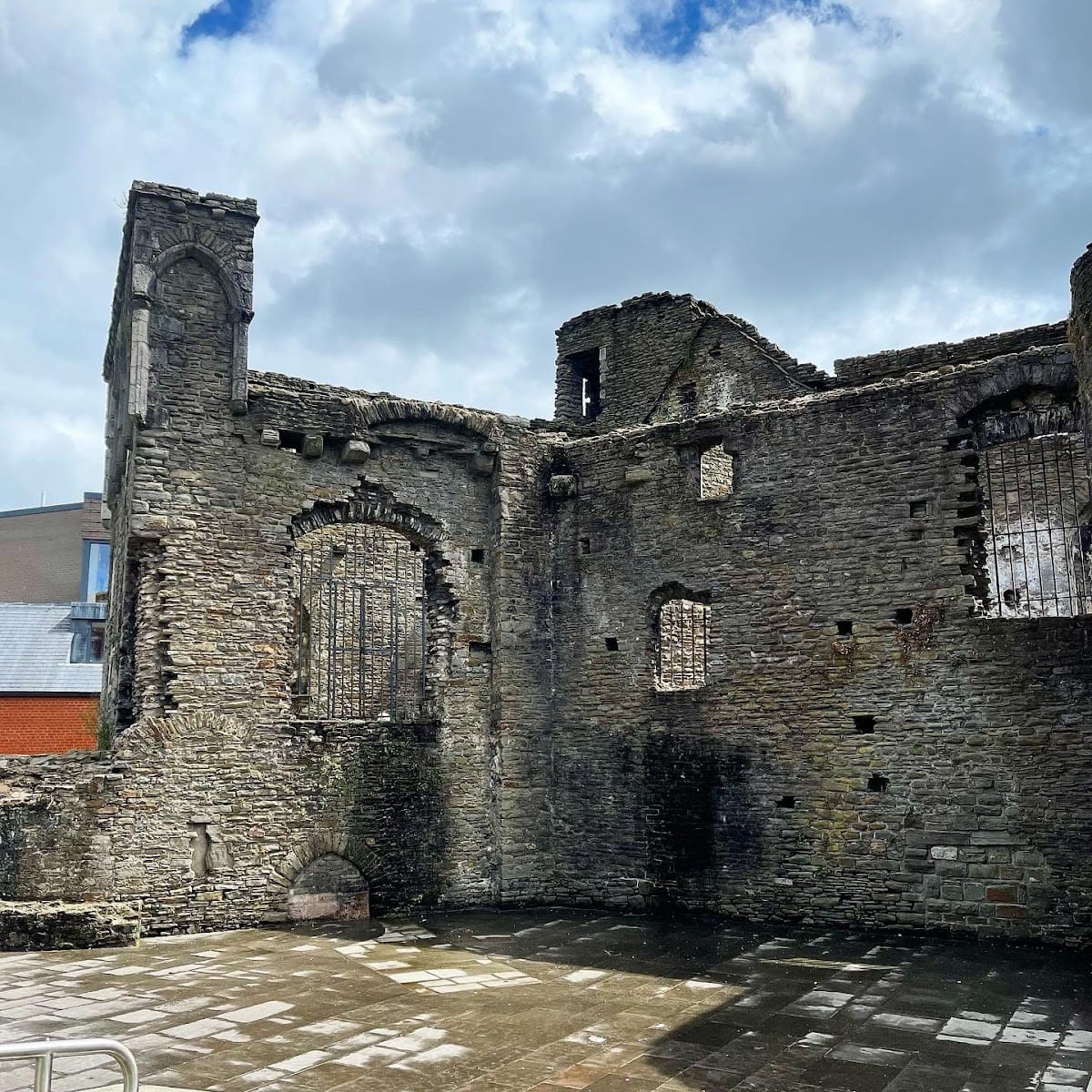
In the early 2010s, a publicly funded project improved the site as a more permanent public space, creating a stone-paved courtyard and installing information panels.
Remains
Layout and surviving medieval fabric
The castle stood on the east side of Swansea city centre, originally on a cliff at the mouth of the River Tawe. The river lay to the east, while a side channel and harbour occupied the shore to the south. The river was straightened and diverted in the 1840s, changing the setting of the medieval enclosure.
The original castle covered approximately 4.6 acres, or 1.9 hectares. Its inner enclosure was sub-rectangular or oval and overlooked the river. A larger sub-rectangular outer bailey surrounded it to the north, west, and south. The inner bailey probably contained a motte, a raised earthwork supporting a fortified position, although another interpretation identifies the feature as a ringwork, a circular earth-and-timber fortification without a conventional central mound. The earthwork measured about 52 metres, or 171 feet, across and survived until the early twentieth century.
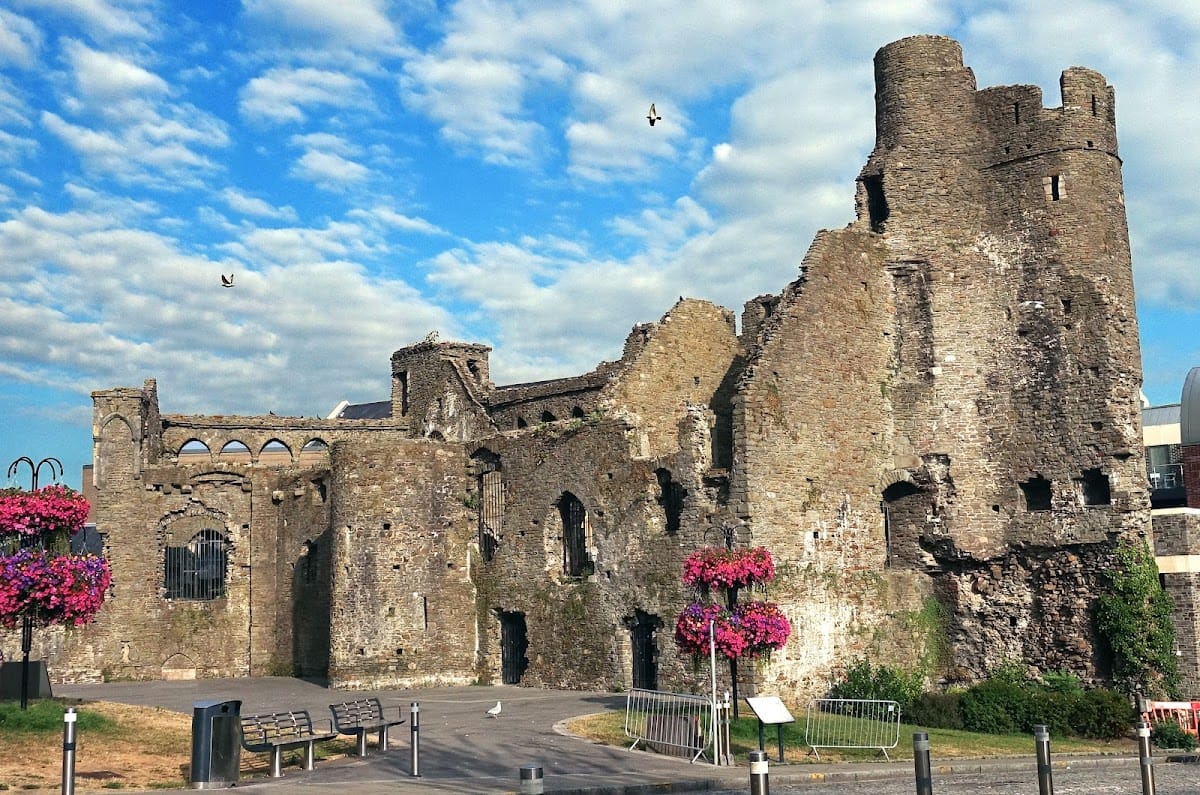
Only limited parts of the twelfth- and thirteenth-century castle survive. Eastern Castle Square was laid out over part of the former outer bailey in the 1990s. The principal visible remains belong to the New Castle at the south-eastern corner of the former outer bailey. They consist of two surviving blocks and two sides of the outer-bailey corner, including an L-shaped section of parapet wall to the south-east. A parapet is a low protective wall along the top of a fortification.
New Castle buildings
Southern residential block
The southern residential block is a two-storey building. Its upper floor contained a hall and private rooms for the lord of the castle, while five basement rooms with tunnel-vaulted ceilings survive below. The southern wall terminates in a tall garderobe tower, a medieval latrine or privy built into a projecting tower or wall. Along the wall-head is an elegant arcade, probably added by John de Mowbray in the fourteenth century. Its form resembles arcaded structures at the Bishop of St Davids’s palaces at Lamphey and St Davids.
Round tower
A small round tower adjoins the residential block on the south. It was probably fitted with gun loops, openings through which firearms could be used, around 1449 during the Wars of the Roses.
North-east tower
The north-east tower survives at ground-floor level. Its remaining rooms include prison cells from the eighteenth and nineteenth centuries, reflecting the later use of the castle as a prison and debtors’ tower.
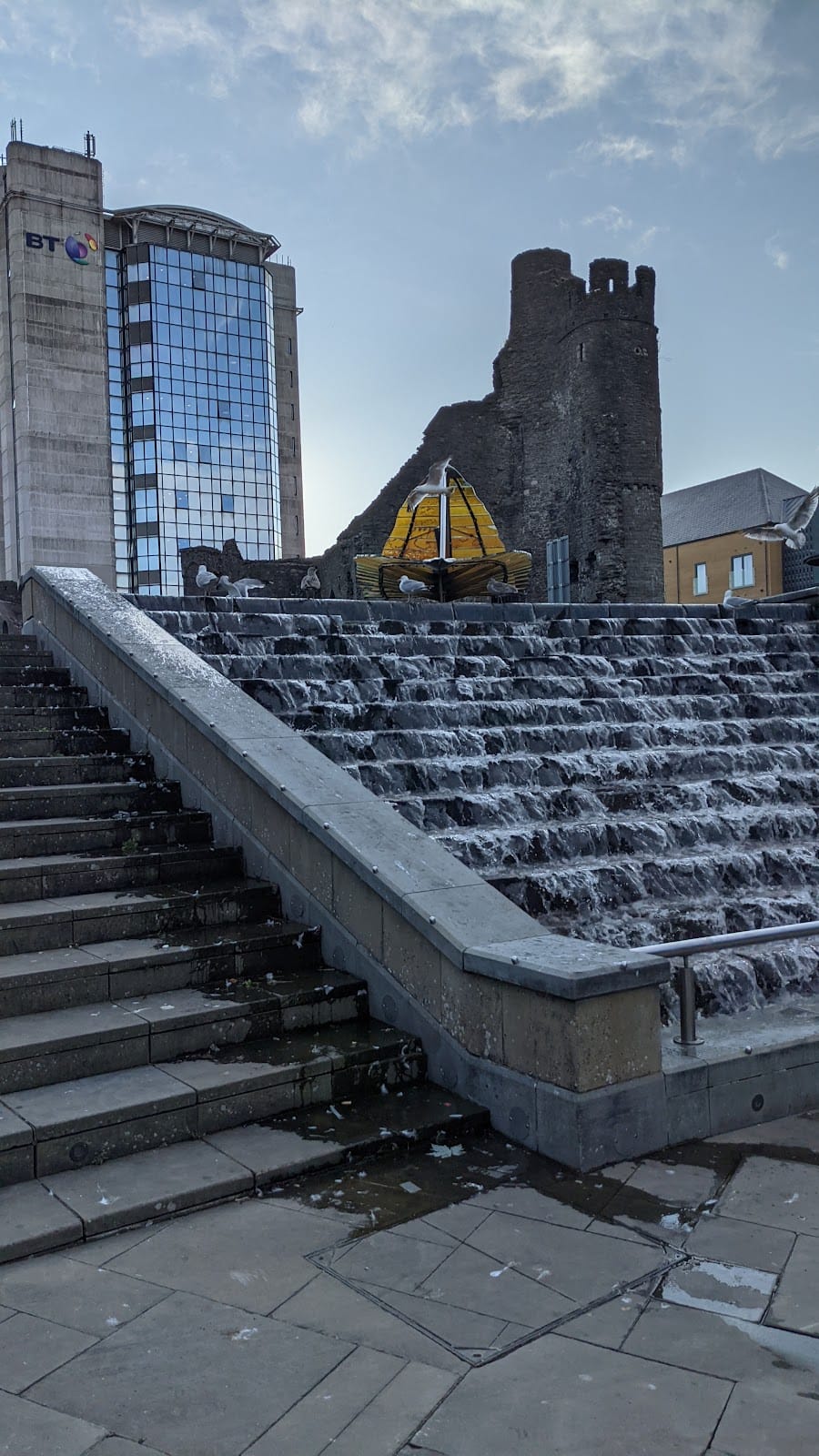
Swansea Castle is now a ruin surrounded by modern buildings. The surviving remains have been consolidated and remain visible from the street, while the stone-paved courtyard reflects the site’s later treatment as a permanent public space.
Nearby sites