Schauenburg Castle: A Medieval Spur Castle in Germany



Site at a Glance
- Rating
- 4.6
- Popularity
- Medium
- Country
- Germany
- Primary era
- Medieval
- External website
- Open
- Eras represented
- Medieval
- Civilizations
- Holy Roman Empire
- Site type
- Military
- Remains
- Castle
On this page7 sections
History
Schauenburg Castle is an 11th-century spur castle in Germany, above Oberkirch in Baden-Württemberg, whose construction is attributed to Duke Berthold II of Zähringen, although its precise date is uncertain. The Zähringen dynasty was a medieval German noble house whose members held ducal authority in southwestern Germany. The castle was first mentioned in writing in 1120 and occupied a fortified position above the Rench valley.
Inheritance and the Eberstein lordship
Gottfried, Count Palatine of Calw, acquired Schauenburg through his marriage to Liutgard of Zähringen. Their granddaughter Uta brought the castle as her dowry when she married Duke Welf VI in 1131. Uta’s brother Eberhard von Eberstein, who helped found All Saints’ Abbey, later inherited it according to the Sindelfingen Chronicle. The Eberstein family retained the castle until 1386, when Wolf von Eberstein was forced to sell it, along with his half of the County of Eberstein, to Rudolf VII, Margrave of Baden-Baden.
The knights of Schauenburg served the Counts of Eberstein as ministeriales, members of the medieval service nobility, and as castle retainers. They also formed a distinct noble family. After Ludwig Winterbach von Schauenburg, the last member of his line, died, Heinrich Truchseß von Höfingen and other Schauenburg branches disputed his share of the fief. They claimed that Schauenburg was a jointly held inheritance castle, a type of arrangement in which several co-heirs or noble families shared ownership. The dispute developed into a feud with Bernhard of Baden in 1402 and 1403, which the Schauenburg family won.
Sieges, decline, and reuse
Schauenburg was besieged several times and captured twice. In 1659, responsibility for maintaining it was transferred to Gaisbach Castle, and stone from Schauenburg was reused during that castle’s expansion in the 17th century. Hans Jakob Christoffel von Grimmelshausen, the administrator of neighboring Ullenburg and author of Simplicius Simplicissimus, obtained castle stone for the work at Gaisbach. In 1670, he dedicated Dietwalds und Amelindens anmutige Lieb- und Leidsbeschreibung to Philipp Hannibal von Schauenburg.
The date and cause of Schauenburg’s transition to a ruin are uncertain. A local tradition holds that French troops under Sébastien Le Prestre de Vauban and Ezéchiel de Mélac burned the abandoned castle during the destruction of Oberkirch in 1689. This explanation is not supported by the list of buildings destroyed in the Oberkirch district soon after 1689, which does not include Schauenburg. A court record instead indicates that French soldiers used the castle as a barracks during another advance in 1693. Grain was stored there in 1703 to protect it from passing soldiers, the last recorded use of the castle. Schauenburg was explicitly described as a ruin in 1731.
Chapel and preservation
The castle chapel of St. Ulrich was recorded in 1275 and stood under the patronage of All Saints’ Abbey, which held responsibility for its ecclesiastical affiliation and support. During the 18th and 19th centuries, local inhabitants quarried the castle, creating much of the appearance seen today. Freiherr Emil von Schauenburg halted further dismantling late in the 19th century and began extensive preservation work. The ruins remain in the ownership of the Freiherren von Schauenburg.
On 8 February 2023, approximately 20 metres of the outer wall slid away. The affected area was closed for safety reasons, and initial stabilization in March included removing debris and adding a wooden support. A small museum now occupies the cellar of the former chapel.
Remains
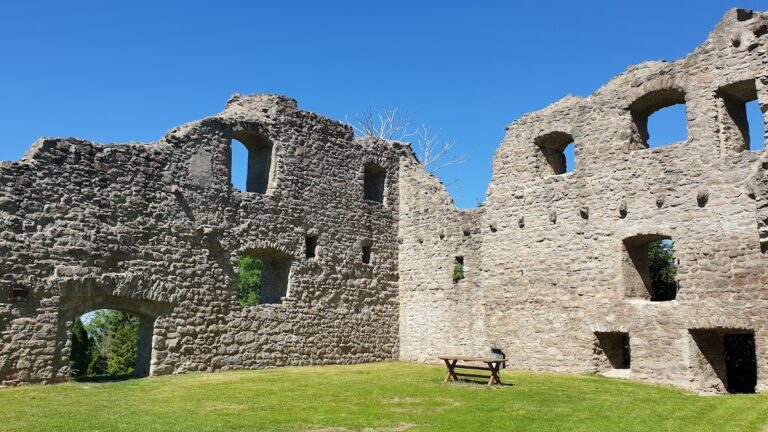
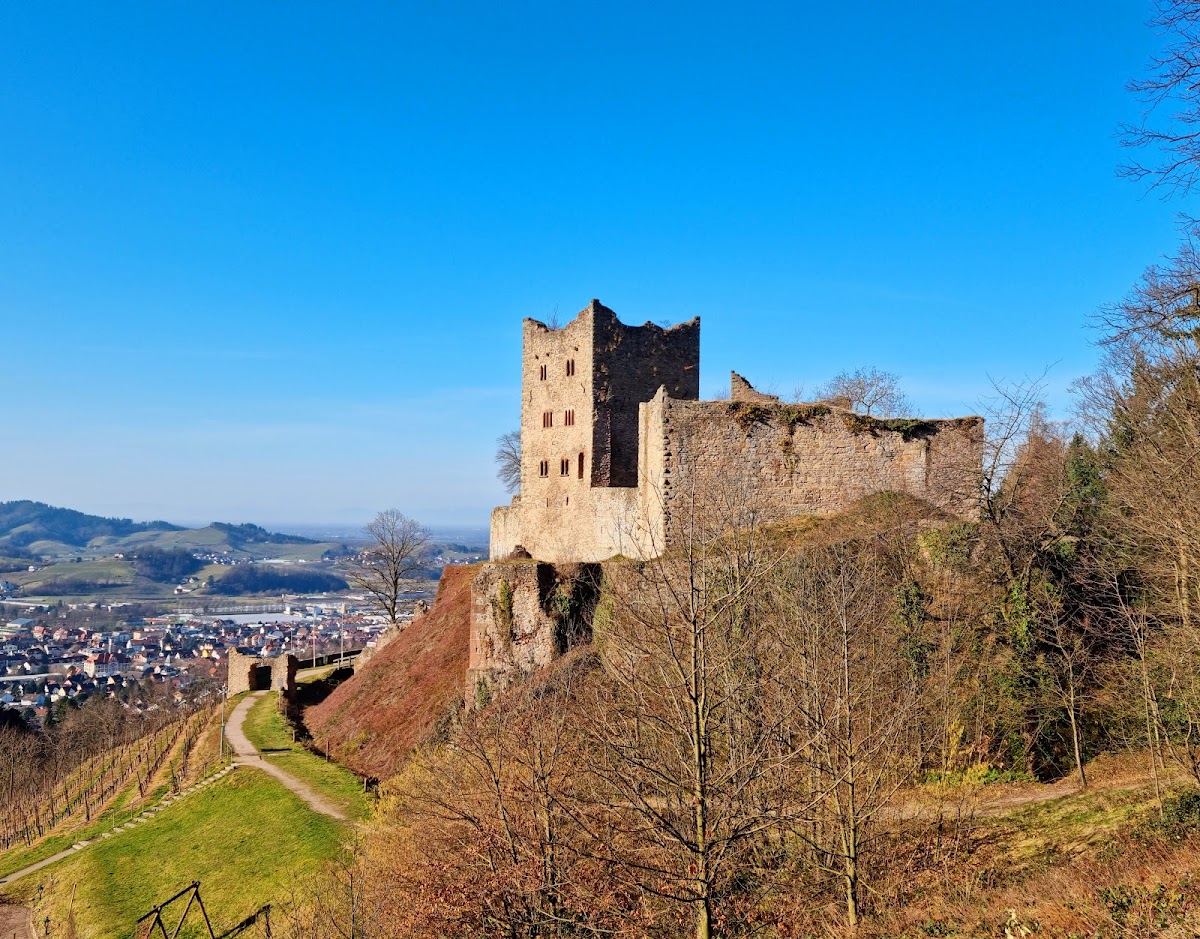
The ruined castle occupies a spur terrace approximately 367 metres above sea level on a mountain spur overlooking the Rench valley above Gaisbach, now part of Oberkirch. Its position reflects the nature of a spur castle, a fortified site built on a projecting ridge or terrace. The surviving complex combines defensive walls and towers with residential structures, while the outer bailey forms an enclosed area beyond the main fortified core.
Defensive works
The castle’s defensive remains include a gate tower, a ring wall, and a shield wall. The shield wall protected the side most exposed to attack, and the chapel was attached to it. The outer bailey is enclosed by a dry ring ditch, or moat, together with an outer rampart. These elements define the surviving defensive enclosure, although a roughly 20-metre section of the outer wall slid away in 2023 and received temporary wooden support during initial stabilization.
Residential and religious buildings
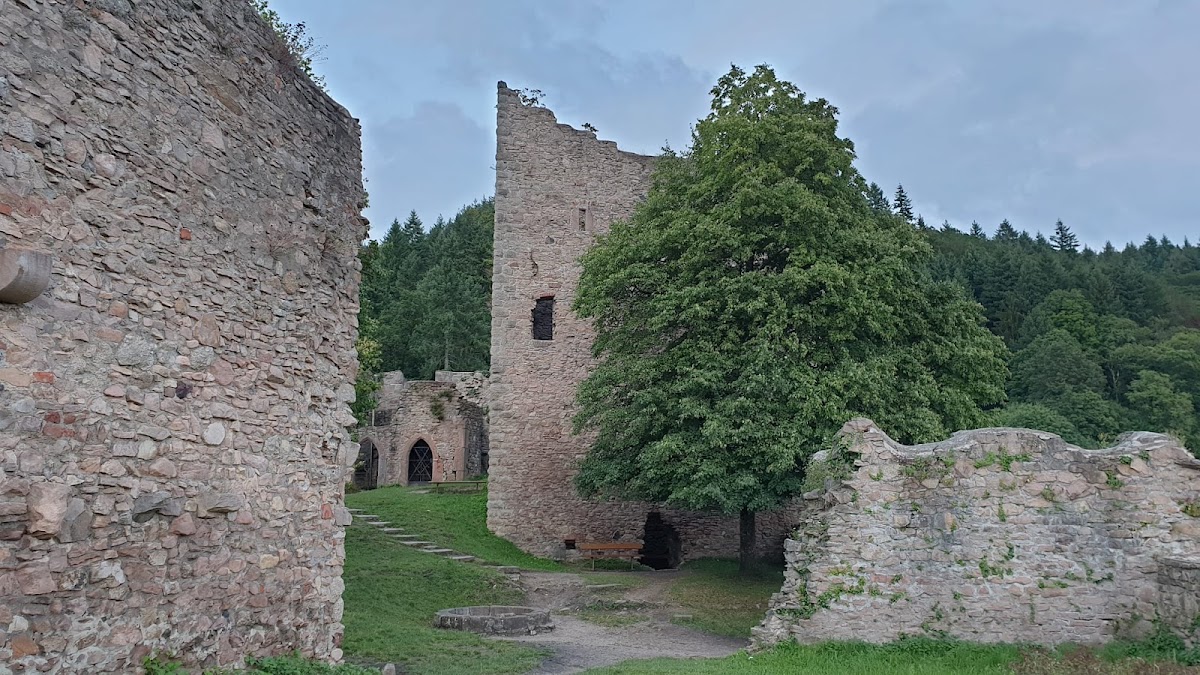
At least three residential towers formed part of the castle complex, with two surviving in partial form. The ruins also preserve the remains of the former chapel of St. Ulrich, whose cellar now contains a small museum. Together, the towers, chapel, gate tower, walls, ditch, and rampart reveal the main components of the medieval fortified settlement in their ruined state.