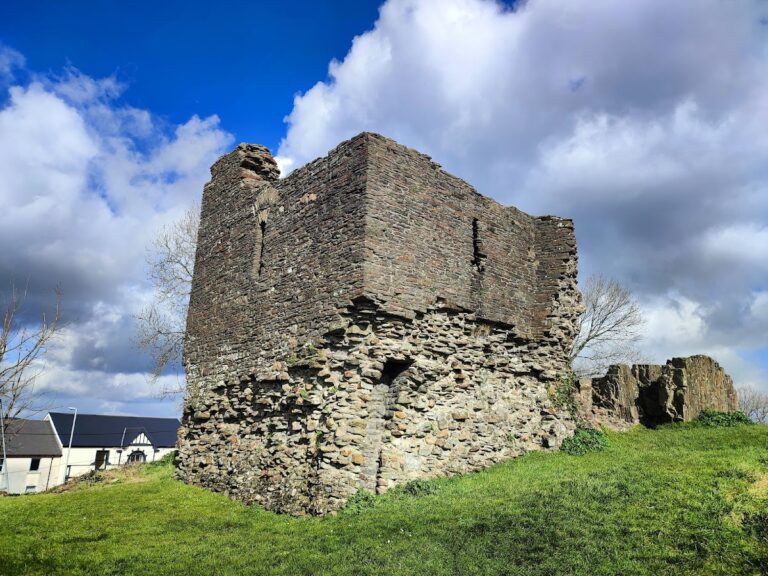
Neath Castle: A Norman Fortress in Wales


Site at a Glance
- Rating
- 4.1
- Popularity
- Very Low
- Country
- United Kingdom
- Primary era
- Medieval
- External website
- Open
- Eras represented
- Medieval
- Civilizations
- Norman
- Site type
- Military
- Remains
- Castle
On this page9 sections
History
Neath Castle is a Norman fortress in Neath, Wales, United Kingdom, whose construction began between 1114 and 1130 during the medieval conquest and administration of south Wales. Robert, Earl of Gloucester, the nominal Lord of Glamorgan, is associated with its foundation, while Richard de Grenville, Lord of Neath, is also credited with building it. The castle remained among the possessions of the Lords of Glamorgan, the successive Anglo-Norman lords who controlled Glamorgan and its associated castles.
The first foundation and Neath Abbey
The earliest fortification stood west of the River Neath, near the Roman fort of Nidum. Probably established by Richard de Grenville, it was a timber motte-and-bailey castle, combining a raised earth mound with an enclosed defensive courtyard. This first stronghold was abandoned around 1130 when de Grenville founded Neath Abbey nearby. Its defences may later have provided building material for the abbey, a monastery governed by an abbot or abbess.
A second castle was established on the opposite bank of the river, at a crossing or ford in the area now occupied by Neath town centre. It is first documented in 1183 and was built by Gilbert de Clare, 5th Earl of Gloucester. William de Cogan, son of Miles de Cogan, became constable soon afterwards. The constable was the medieval official responsible for a castle’s administration, oversight, and defence.
Welsh attacks and stone rebuilding
After William FitzRobert died in 1183, Morgan ap Caradog, the Welsh lord of Afan, besieged the castle. It was relieved by Ranulf de Glanville, the royal justiciar, in early summer 1184. King John visited on 21 May 1210 while travelling towards Ireland and stayed there again from 27 to 28 August on his return. King Edward I spent the night at Neath Castle on 12 December 1284, during his progress through Wales after the final defeat of Llywelyn ap Gruffydd.
Welsh forces linked with Llywelyn ap Iorwerth, known as Llywelyn the Great, destroyed the castle on 29 June 1231 under Morgan Gam’s leadership. Richard de Clare, 6th Earl of Gloucester, later rebuilt the fortifications, probably replacing the earlier timber defences with stone. The garrison repelled Welsh raiders in 1244, and the castle resisted a siege by Llywelyn ap Gruffydd, also known as Llywelyn the Last, in September 1258, although the town was destroyed.
Fourteenth-century conflicts and reconstruction
After Gilbert de Clare’s death, Neath Castle withstood a major Welsh assault in June 1314 and another attack during the revolt of Llywelyn Bren in 1316. During the rebellion against Hugh le Despenser, Humphrey de Bohun, 4th Earl of Hereford, captured the castle in 1321. Its constable, John Iweyn, Lord of Loughor and Despenser’s sheriff of Glamorgan, was taken prisoner, carried to Swansea, and executed by John de Forneaux.
Hugh Despenser the Younger, who held the lordship through his marriage to Eleanor de Clare, recovered his possessions in 1322 and rebuilt the castle. The earlier entrance was probably replaced or supplemented during this work. Edward II and Despenser stayed at Neath from 5 to 10 November 1326 while fleeing their enemies. Edward appears to have left part of his treasury there, but it was later looted. The king and Despenser were captured near Llantrisant on 16 November.
Roger Kyngot was constable in 1376, and the castle was rebuilt in stone in 1377, probably including the surviving great gatehouse. From the fifteenth century, Neath Castle had declining military importance. It nevertheless remained in use until the seventeenth century.
Later use and protection
During the eighteenth century, the castle became a recreational area for Neath and was partly built over after being used for various purposes. Humphrey Mackworth bought the site in 1715 from Charlotte Herbert, daughter and heir of the 7th Earl of Pembroke. Mackworth had held the medieval office of constable from 1703, and the title eventually became absorbed into the office of Mayor of Neath.
The remaining ruins were secured from 1962 onwards. Neath Castle is now a Grade II* listed building, a designation applied in Wales to structures of particularly important architectural or historic interest, and a Scheduled Monument protected for its archaeological or historic significance.
Remains
The later castle occupied the south side of the River Neath at a river crossing, while the first fortification stood west of the river near Nidum. The surviving remains are arranged around an inner enclosure that was bounded by a D-shaped curtain wall, meaning a defensive wall with a straight rear line and a curved outer face. The wall now survives only to a low height, while slight traces of the twelfth-century earthworks remain east of the gatehouse.
Gatehouse and defensive walls
Western gatehouse
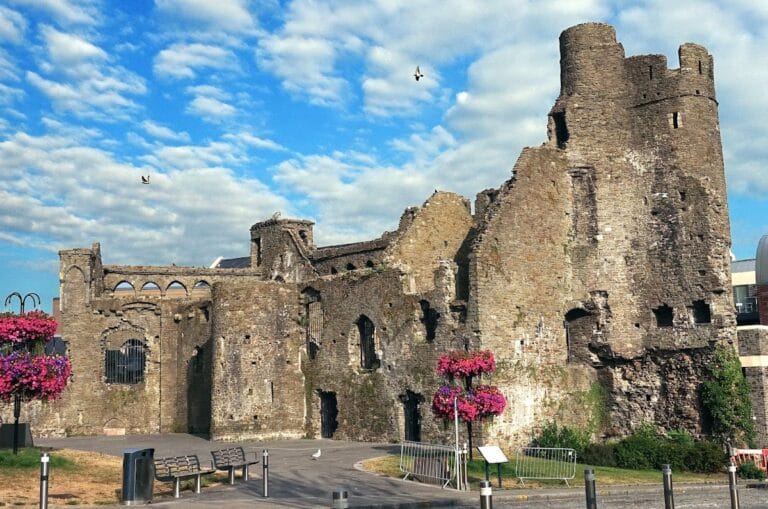
The best-preserved feature is the western gatehouse, a powerful dark-sandstone structure with a facade flanked by two semicircular towers. Its entrance passage was protected by a drawbridge and by openings through which objects could be dropped onto attackers. The town wall joined the right-hand tower, and that junction survives with the gatehouse.
Enclosing walls and wall tower
A ruined D-shaped wall tower stands in the north-east of the castle. The curtain wall enclosed the inner castle, and several buildings were formerly attached to its inner face. Their surviving remains consist of foundations, leaving the courtyard represented by the gatehouse, portions of the enclosing walls, the tower, the town-wall junction, and the foundations of the internal buildings.