Parc le Breos Chambered Tomb: A Neolithic Burial Monument in Wales
Site at a Glance
- Popularity
- Medium
- Country
- United Kingdom
- Primary era
- Stone Age
- Eras represented
- Stone Age
- Civilizations
- Unclassified
- Site type
- Burial
- Remains
- Tomb
On this page17 sections
History
Parc le Breos Chambered Tomb is an early Neolithic burial monument in Parkmill, Wales, United Kingdom, built in the fourth millennium BC. The Neolithic was the later Stone Age. The tomb belongs to the Severn-Cotswold tradition, a group of chambered tombs characterized by long stone mounds, retaining walls, passages, and burial chambers. It is one of six chambered tombs on Gower and one of 17 in the area commonly known as Glamorgan. Such tombs are comparatively rare in this part of Wales and represent an outlying extension of a tradition more common farther east. The tomb predates the completion of Stonehenge and the Great Pyramid by roughly 1,300 to 1,500 years.
Early Neolithic construction and use
Radiocarbon-dated samples indicate that the tomb served successive generations over a period estimated at roughly 300 to 800 years. Evidence also points to use during the Late Neolithic by people associated with Bell Beaker culture, a community tradition identified in part through distinctive bell-shaped pottery.
The medieval deer park
The tomb later stood within Parc le Breos, an enclosed deer park of about 2,000 acres established around 1221–1232 by John de Braose, a Marcher lord whose lands lay along the Anglo-Welsh border. The park gave the tomb one of its names.
Discovery and archaeological work
Workmen seeking stone for road building uncovered the tomb in 1869. John Lubbock and Hussey Vivian excavated it that year and initially interpreted it as a round mound. Glyn Daniel’s 1937 excavation identified it as a chambered long barrow. R. J. C. Atkinson led another excavation in 1960. The site then came under the guardianship of the Ministry of Public Building and Works and was partly restored in 1961. A detailed archaeological report followed in 1998. Cadw, the Welsh Government’s historic environment service, maintains the tomb.
Remains
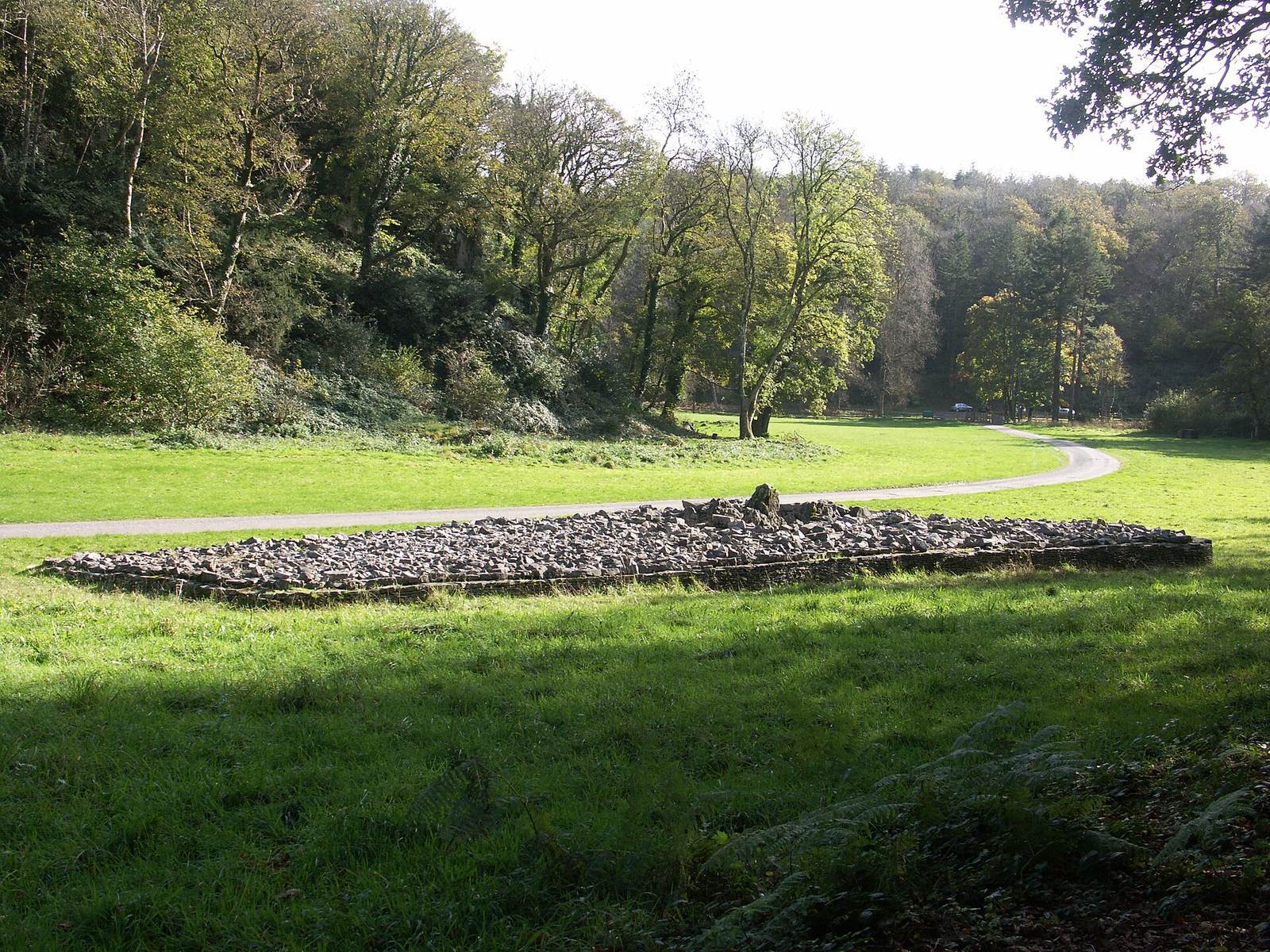
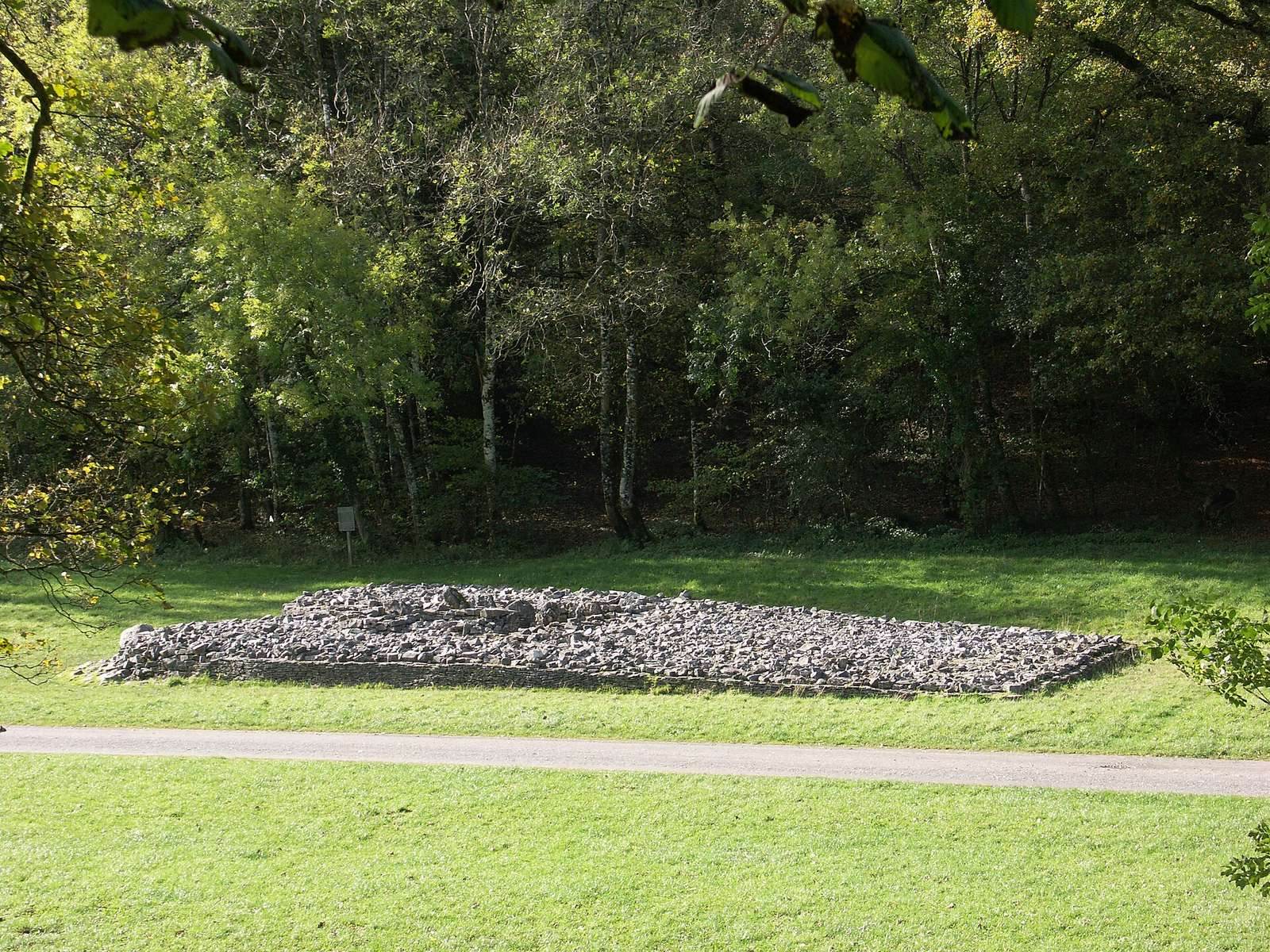
The tomb lies on the floor of a narrow limestone gorge at Coed y Parc, on the Gower Peninsula, at about 15 metres above sea level. Woodland covers roughly 200 hectares around the site, which stands within the remains of the former deer park. Its principal feature is a north–south limestone cairn, trapezoidal in plan, with a southern entrance, central passage, and four side chambers.
Cairn and entrance
The cairn
The mound measures about 22 metres long, narrowing from roughly 12–13 metres at its southern end to about 6 metres at the north. Its rubble is mainly local limestone rocks and cobbles, held by two dry-stone retaining walls, built without mortar. The inner wall uses heavier stones. The upper part and earth covering have been removed, exposing the passage and chambers. Stones on the eastern side are rounded and eroded, a condition attributed to silt-laden floodwater. Atkinson considered that a stream, now flowing underground, may once have run beside the tomb.
The forecourt
At the southern entrance, the retaining walls curve inward and project as two horns, forming a bell-shaped forecourt open to the south. Part of the front wall on the right has collapsed or been lost, leaving displaced rubble and an exposed orthostat, a large stone set upright.
Passage and chambers
Central passage
A straight passage about 6 metres long and 1 metre wide runs north–south from the forecourt into the cairn. Upright limestone slabs, reaching about 1.5 metres high, form its sides, with courses of dry-laid stone filling the spaces between them.
Side chambers
Four rectangular chambers open at right angles from the passage in two pairs. Each is about 1.6 metres long and 1 metre wide. Shallow limestone sillstones mark the entrances to three chambers. The original chamber covering is uncertain; suggested forms include one large capstone, several smaller stones, or a roof made of successive inward-projecting stones.
Burial evidence
Burial treatment
The excavated human remains represent at least 40 people, including adults, adolescents, children, and infants, revising an earlier estimate of 20–24. Cremated remains were found in the southeast chamber, which held people of all ages and sexes and nearly three times as many individuals as each of the other chambers. Some bones show weathering and animal gnawing, consistent with bodies decomposing before their bones were placed in the chambers. Some remains in the passage were partly articulated, suggesting bodies may have been deposited there before decomposition. One possibility is that bodies were first left in nearby caves and bones later transferred to the tomb. Most human remains were reburied in clay pots beneath their original contexts; some human, animal, and pottery remains are held at the Ashmolean Museum.
Diet and physical evidence
Skeletal, dental, and isotope analyses suggest that the people buried here relied little on cereal cultivation. Most dietary protein came from animals, possibly through meat, milk, or blood, alongside a small contribution from plants. This pattern has been interpreted as consistent with continued hunting and gathering or, more probably, pastoral herding. Male remains show more developed leg muscles than female remains, perhaps reflecting hunting, herding, and a mobile way of life. The male skeletons were described as robust, while the female remains were shorter and more lightly built. Teeth show substantial wear but little tartar, and only one tooth was lost before death.
Animal remains and forecourt finds
Animal bones
Animal remains include bones from eight dogs, a cat, red deer, pig, sheep, and cattle. A red deer bone was dated to 2750–2150 BP (before present), indicating that at least some material entered the tomb long after its abandonment.
Forecourt finds
Excavation of the forecourt recovered 32 flint pieces, including flakes from toolmaking, cores, a small blade, and a leaf-shaped arrowhead; some were burnt. Other finds included quartz, stalactite fragments, Neolithic pottery sherds, and cremated bone. Atkinson suggested that the stalactite fragments came from Cathole Cave, about 180 metres north of the tomb. The quartz may have come from Cathole Cave or Tooth Hole Cave, about 1.4 kilometres to the north-northwest.