Suwa taisha: A Shinto Shrine Complex in Japan


Site at a Glance
- Rating
- 4.4
- Popularity
- Medium
- Country
- Japan
- Primary era
- Early Modern
- External website
- Open
- Eras represented
- Medieval, Early Modern, Modern
- Civilizations
- Ashikaga shogunate, Japanese, Tokugawa
- Site type
- Religious
- Remains
- Sanctuary
On this page18 sections
History
Suwa taisha is a Shinto shrine complex in Japan, located around Lake Suwa in Nagano Prefecture and formed within Japan’s indigenous religious tradition. Its four principal sanctuaries are the Upper Shrine, or Kamisha, with Honmiya and Maemiya, and the Lower Shrine, or Shimosha, with Harumiya and Akimiya. The foundation date is unknown, but the complex is regarded as one of Japan’s oldest shrines. Suwa was the chief shrine, or ichinomiya, of former Shinano Province, the head shrine of the wider Suwa network, and one of approximately 25,000 Suwa shrines in Japan.
Early traditions and religious identity
The earliest documentary reference to Suwa appears under the year 691 in the Nihon Shoki, which records imperial envoys being sent to worship the gods of Suwa and Minochi in Shinano. The early deity associated with Suwa may have been understood locally as a power of water, wind, hunting, or serpents before later traditions identified the principal god as Takeminakata.
Fune Kofun, a burial mound built during the first half of the fifth century near Kamisha Honmiya, provides earlier evidence of an elite ritual landscape. Excavated in 1959, it contained weapons, bronze mirrors, bracelets, and a deer-antler implement. The location and contents suggest that the person buried there may have been connected with authority or religious traditions later associated with the Upper Shrine, although the relationship remains uncertain.
Imperial mythology presents Takeminakata as a son of Okuninushi who fled to Suwa after losing a conflict with Takemikazuchi during the transfer of earthly rule to the heavenly deities. This episode appears in the Kojiki and the Sendai Kuji Hongi, but Takeminakata does not appear in the corresponding account of the Nihon Shoki. The story is therefore treated as an origin tradition rather than a direct record of the shrine’s foundation.
Local traditions give the deity a different history. They describe Takeminakata, also called Suwa Myojin or Suwa Daimyojin, as an outsider who conquered the region after defeating the indigenous deity Moriya, or Moreya. Another tradition says that the deity gave his clothing to an eight-year-old boy and declared that he possessed no physical body but would use the boy as his body. The boy became the ancestor of the Upper Shrine’s Ohori lineage. These stories have been interpreted as memories of earlier local groups, including the Moriya and Kanasashi lineages, being incorporated into a new political and religious order, although that interpretation remains debated.
The principal deities are Takeminakata, Yasakatome, and Kotoshironushi. Takeminakata is the principal deity of Kamisha Honmiya, Yasakatome is associated with Kamisha Maemiya and is the principal deity of Shimosha, and Kotoshironushi, described as Takeminakata’s elder brother, is also enshrined at the Lower Shrine. Earlier Upper Shrine rites preserve traces of Mishaguji worship, a regional tradition involving sacred powers linked with fertility, agriculture, local nature, and ritual possession. The gods of Suwa were also understood as water and wind deities, and in some traditions as serpents or dragons. Medieval and later legends connecting Suwa Myojin with Koga Saburo and other serpent or dragon figures reinforced this identity.
Rise of the provincial shrine
The name Takeminakata appears in the Kojiki and in later records including the Shinsho Kyakuchoku Fusho and the Sendai Kuji Hongi. The Engishiki, a tenth-century register compiled in 927, lists two Minakatatomi Shrines as eminent shrines in Suwa District. These are traditionally identified with the Upper and Lower Shrines. Suwa had been recognized as Shinano’s ichinomiya by the late Heian period, giving it the chief ritual rank within the former province.
The imperial court raised the rank of Takeminakata several times. He received junior fifth rank in 842, junior third rank in 851, junior second rank and then senior second rank in 859, and junior first rank in 867. He held senior first rank by 893, or, according to the Suwa Daimyojin Ekotoba, during the years 938 to 946. Yasakatome also rose from junior fifth rank in 842 to junior first rank by 867.
Suwa was revered as a martial deity. A tradition says that Sakanoue no Tamuramaro prayed there during campaigns against the Emishi, a people living in northeastern Japan who resisted the imperial state. The Ryōjin Hisho, compiled in 1179, lists Suwa among the eastern shrines of warrior deities. Hunting and fishing rites further connected the shrine with protection in warfare and with the livelihood of hunters and fishers.
Medieval institutions and expansion
By the late Heian period, Suwa was both an estate of the retired empress Hachijoin and a powerful local institution with holdings in Shinano. The Upper Shrine’s Ohori, Suwa Atsumitsu, is said to have prayed for the Minamoto cause during the conflicts of 1180 to 1185. In the Kamakura period, lands confiscated from the defeated Heike were granted to Minamoto no Yoritomo. Yoritomo donated a sacred horse and required warriors of Shinano to perform duties at the May Festival and the Misayama Festival.
A document from 1329 records fourteen rotating groups of land stewards and warriors from Shinano who served as festival sponsors, or oto. Their contributions supported the shrine and could bring exemptions from certain taxes, duties, and military obligations. The festivals drew warriors from Shinano, Kai, and neighboring regions, helping the Suwa cult spread beyond its original province.
The Upper and Lower Shrines are first clearly distinguished in 1180. Although they were officially regarded as equal, each developed its own rituals, priestly families, and religious institutions during the medieval period. The Upper Shrine’s records survive in much greater quantity than those of the Lower Shrine. The Suwa and Kanasashi priestly families became connected with warrior groups, the Kamakura shogunate, and the Hōjō clan. Branch shrines spread widely through the movement of Shinano warriors, the shrine’s exemption from a 1212 ban on falconry, and the work of itinerant preachers who distributed Suwa talismans.
Buddhism became closely integrated with the shrine. This medieval combination rested on the idea that local kami could be manifestations of Buddhist figures. The Upper Shrine was associated with Fugen, or Samantabhadra, while the Lower Shrine was associated with Kannon, or Avalokiteshvara. Buddhist temples and facilities, including Fugen-do, Shingon-affiliated institutions, and the Tetto stone pagoda, stood within or beside the shrine precincts. The Upper Shrine also issued deer-meat permits and ritual chopsticks that authorized the eating of venison despite Buddhist restrictions on killing and meat consumption.
Warfare and reconstruction
The fall of the Hōjō in 1333 weakened the Suwa priestly house and its network. In 1335, Suwa Yorishige and his son Tokitsugu supported the failed attempt by Hōjō Tokiyuki to restore the Kamakura shogunate. Yorishige and Tokitsugu died after the rebellion, and the succession to the Upper Shrine’s Ohori office was disrupted. Suwa Enchu commissioned the Suwa Daimyojin Ekotoba, a major account of the shrine’s history and rites, which was completed in 1356. Its original illustrated scrolls were later lost.
The Suwa and Kanasashi priestly houses and their allied clans fought during the Muromachi and Sengoku periods. In 1483, forces of the Upper Shrine burned the Lower Shrines, and Kanasashi Okiharu, the Lower Shrine’s high priest, was killed. Takeda Shingen invaded Shinano in 1542 and brought the Suwa region under Takeda control. From 1565, he ordered the revival of discontinued rituals at both shrine groups, partly to reinforce his authority in Shinano. His banners used a syncretic name for the Suwa deity, and tradition associates him with the Suwa Hossho helmet and with prayers for victory at the Upper Shrine.
In March 1582, forces led by Oda Nobutada invaded Takeda-controlled Shinano and burned the Upper Shrine. Reconstruction followed two years later. Traditions from the same period say that priests carrying the shrine’s sacred palanquin took refuge on Mount Moriya.
Early modern and modern transformation
During the Edo period, the Tokugawa shogunate confirmed land grants of 1,000 koku to the Upper Shrine and 500 koku to the Lower Shrine in 1648. The Takashima domain and Hoshina Masayuki of Aizu also granted land to the two shrine groups.
Before 1871, each shrine group was headed by an Ohori, the highest hereditary priest. At the Upper Shrine, the Ohori of the Suwa clan was regarded as a descendant of Takeminakata and, in ritual terms, as the deity’s living body. The Jinchokan, or chief ritual officer, belonged to the Moriya clan and controlled rites associated with Mishaguji. Other Upper Shrine offices were held by the Koide, Yajima, Ito, and Nagasaka families. The Lower Shrine’s Ohori belonged first to the Kanasashi family and later to the Takei family, while other offices were held by the Imai, Shizuno, Momoi, Yamada, and related families.
The hereditary priestly system was abolished in 1871. The former Upper and Lower Shrines were placed under government control as one institution called Suwa Shrine. It was ranked a National Shrine of Medium Rank in 1871, an Imperial Shrine of Medium Rank in 1896, and an Imperial Shrine of Major Rank in 1916. After the Second World War, it became a special-class shrine within the Association of Shinto Shrines and adopted the name Suwa taisha in 1948.
The Meiji separation of Shinto and Buddhism ended the former combined religious system. Shrine temples and Buddhist rites were abolished or dismantled, Buddhist images and implements were transferred to nearby temples, and hereditary priests were replaced by government-appointed priests. The Upper Shrine’s Tetto was moved to Onsenji, while the image of Fugen and other Buddhist images were secretly transferred to Buppo Shoryuji. A repair of the Fugen image in 2015 found an inscription identifying it as Suwa’s principal image.
Ritual traditions
Suwa taisha remains the setting for major rites, including the Onbashira Festival, the Ontosai on April 15, the Ofune Matsuri on August 1, the Misayama hunting festival, and the seasonal transfer of the Lower Shrine’s sacred object between Harumiya and Akimiya. The Onbashira Festival is held every six years, in the years of the Tiger and Monkey. The Ofune Matsuri carries the sacred object from Harumiya to Akimiya.
The Upper Shrine’s Ontosai preserves elements of former hunting and sacrificial traditions. Historical descriptions list offerings of deer, boar, rabbits, fish, seaweed, and other foods. Today, deer and boar heads are represented by taxidermied specimens. The old belief that one sacrificial deer always had split ears is known as the split-eared deer tradition.
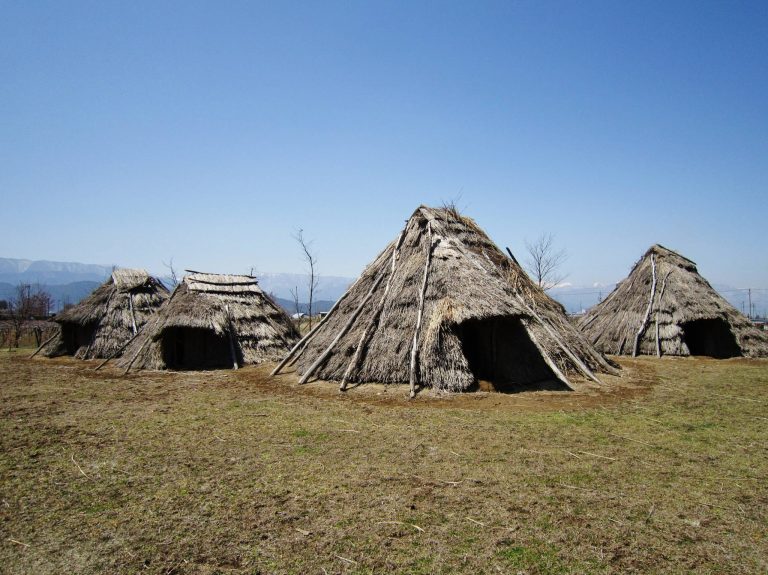
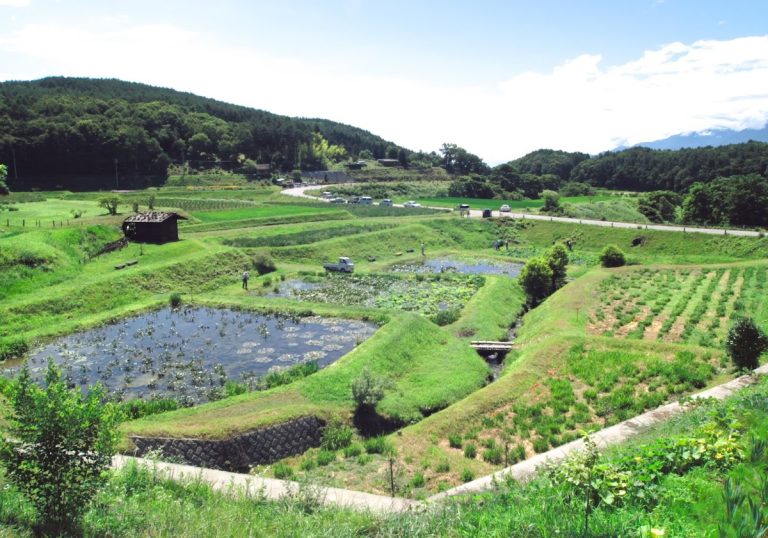
The Upper Shrine’s Misayama Festival was formerly a five-day hunting festival at the foot of the Yatsugatake range. Temporary shelters were roofed with blue reeds, and hunting symbolically recognized warriors and horses as mature. The festival is now much smaller. The Lower Shrine’s former hunting ground was Moto-Misayama in the Yashimagahara Wetlands.
At Kamisha Honmiya, the New Year Frog-Hunting Rite presents frogs as offerings after they are shot with a small bow and arrows. Its original meaning is uncertain. Explanations connect it with the serpent or dragon identity of the Suwa deity, hunting, agricultural renewal, or older sacrificial traditions. Animal-protection groups have protested the use of live frogs since 2011.
At Shimosha Harumiya, the Tube-Porridge Rite runs from the night of January 14 to the morning of January 15. Reeds are cooked in a pot, and the material inside the tubes is examined as a means of divining the year’s harvest. The rite was formerly also held at the Upper Shrine, where the remains of its porridge hall survive.
Remains
The Upper Shrine sites
The four principal sanctuaries occupy two sites rather than one enclosed compound. Kamisha Honmiya lies on the northern foothills of Mount Moriya in Suwa City, while Kamisha Maemiya is approximately 2 kilometers southeast in Chino City. The two Lower Shrine sanctuaries lie in Shimosuwa, with Akimiya at the eastern end of the town and Harumiya approximately 1.2 kilometers northwest.
Kamisha Honmiya
Honmiya follows the distinctive Suwa-zukuri arrangement. A worship hall, or haiden, stands before a hall for offerings, or heiden, with single-bay worship halls on both sides. A separate prayer area lies across the ritual courtyard. Two hōden, treasure halls that partly perform the function of a conventional main sanctuary, stand outside the worship buildings beside the Shikyaku-mon and at right angles to the approach. The buildings use undecorated natural wood, with little painted or carved ornament.
Medieval descriptions divide Honmiya into three platforms. The upper platform held the sacred rock and restricted sanctuary, the middle platform contained the two treasure halls, and the lower platform served for rites. The present worship buildings occupy a space once centered on a sacred rock marked by a gateway and fence. Honmiya’s sacred objects include the mountain behind the shrine, a sacred rock known as an iwakura, and formerly the Ohori.
Honmiya buildings and ritual objects
The two thatched treasure halls resemble the Shimmei-zukuri architectural style. One houses the sacred palanquin, or mikoshi, while the other serves as a temporary sanctuary. During the Onbashira Festival, the sacred object is transferred between them and the older hall is rebuilt. Each hall is consequently replaced every twelve years. Retired halls are reused as buildings or repair material at subsidiary and branch shrines.
Important structures include the worship hall, prayer area, Chokuganden prayer hall, eastern and western treasure halls, Shinmeisha or Komagataya stable, Bridge of Cloth, Entrance Gate, Ema Hall, Sacred Horse Stable, Five-Bay Corridor, Imperial Envoy Hall, Kagura Hall, Tenryusui Hall, and southern and front torii. The Chokuganden dates from 1690. Tradition says that it faces Mount Moriya for prayer, although another interpretation holds that it originally faced the worship hall. The Shikyaku-mon was built in 1608 on the order of Tokugawa Ieyasu by Okubo Nagayasu and opens only for important rites. The Entrance Gate dates from 1829, the Kagura Hall from 1827, and the Imperial Envoy Hall from 1690.
Suzuri-ishi, one of the Seven Stones of Suwa, stands on the highest platform. Its depression holds water, and it was revered as the rock upon which Suwa Myojin descended. Older maps and illustrations suggest that it may have been moved after the medieval period, leaving its identification with the iwakura of medieval records uncertain. Other features include Onkutsu-ishi, said to bear the hoof mark of the deity’s horse, the Ama-no-Sakahoko spear, Lotus Pond and its Frog Stone, the Sacred Offering-Hanging Zelkova, and a natural deciduous forest. Myojin-yu, a colorless alkaline hot spring of approximately 60 degrees Celsius, serves as a hand-washing basin and was approved as drinkable in 2011.
The Namiyoke Torii, also called the First Torii, stands to the northwest and is Suwa taisha’s only wooden Ryobu-style torii. Tradition says that Lake Suwa once extended to this point. The northern approach was begun during the Pacific War, interrupted at the war’s end, and later completed; its front torii was built in 2003. The treasure hall preserves or displays objects associated with the site, including iron bells traditionally linked with Takeda Shingen’s campaigns, Yaesuzuri bells, ritual sickles, paintings, votive tablets, and other offerings.
Kamisha Maemiya
Maemiya is regarded as the oldest part of the Upper Shrine and as the origin or former center of its rituals. The Suiga River flows through the precinct. Its buildings and remains include a 1932 main sanctuary built with timber received from Ise Jingu, a worship area, the Ten-Bay Corridor, Uchimitamaden, the former residence site of the Ohori, and a place traditionally identified as a sacred mound or tomb of Takeminakata.
The present main sanctuary stands on the site of the former shojin-ya, a temporary purification residence where an incoming Ohori undertook ascetic preparation. The earlier building was demolished in 1932. Its dismantled timber, including material reused from Ise Jingu, was incorporated into a shrine building elsewhere in Chino. The Ten-Bay Corridor, formerly called the Gōbara Corridor, is a separate ritual building where the Upper Shrine’s Ontosai is held. The Maemiya area also contains Keikan Shrine, associated with the Ohori’s enthronement rites, and Wakamiko Shrine and Uchimitamaden.
Maemiya’s former political and ritual center was Gōdono, the residence of the Upper Shrine’s Ohori. The surrounding area, called Gōbara or Field of the Deity, included the residence, ritual facilities, subsidiary shrines, and a settlement. The Ohori’s residence moved to Suwa City in 1601, after which much of Gōbara was converted into houses and rice fields. Maemiya is traditionally associated with thirty-nine auxiliary shrines arranged in three groups of thirteen, including Tokomatsu, Isonami, Otoshi, Aratama, Chinogawa, Wakamiko, Kashiwade, Kuzui, Mizogami, Fujishima, Uchimitamaden, Keikan, Gozaishi, and Wakamiya.
Former Buddhist complex and sacred pillars
The former Upper Shrine Jinguji complex surrounded Honmiya with Buddhist temples and lodgings. It included a Great Hall, Upper and Lower Lodgings, Hokkeji, Fugen-do, a five-story pagoda, and a Niomon gate. The buildings were removed or destroyed after the Meiji separation of Buddhism and Shinto, while the surviving site and associated objects preserve evidence of the former complex.
Four Onbashira stand at the corners of the Upper Shrine’s main buildings. The fir pillars decrease in length and thickness from the first to the fourth and are arranged clockwise when viewed from above. At the Upper Shrine their sacred streamers face toward the Yatsugatake range. Their origin is uncertain. They have been interpreted as supports for descending spirits, markers of sacred ground, or substitutes for rebuilding shrine buildings. The pillars are renewed during the Onbashira Festival.
The Lower Shrine sanctuaries
Akimiya and Harumiya have equal status and share a seasonal sacred object. It is transferred from Akimiya to Harumiya in February and from Harumiya to Akimiya in August. The two sanctuaries have similar architectural arrangements, and historical tradition says that their craftsmen competed in construction skill.
Shimosha Akimiya
Akimiya’s principal building is an important cultural property completed in 1781. It combines the offering hall and worship hall in a two-story, gate-like structure, with single-bay worship halls on either side. Its carvings are attributed to Tachikawa Washiro. The Kagura Hall dates from 1835, and its guardian dogs were made by the sculptor Shimizu Takashi.
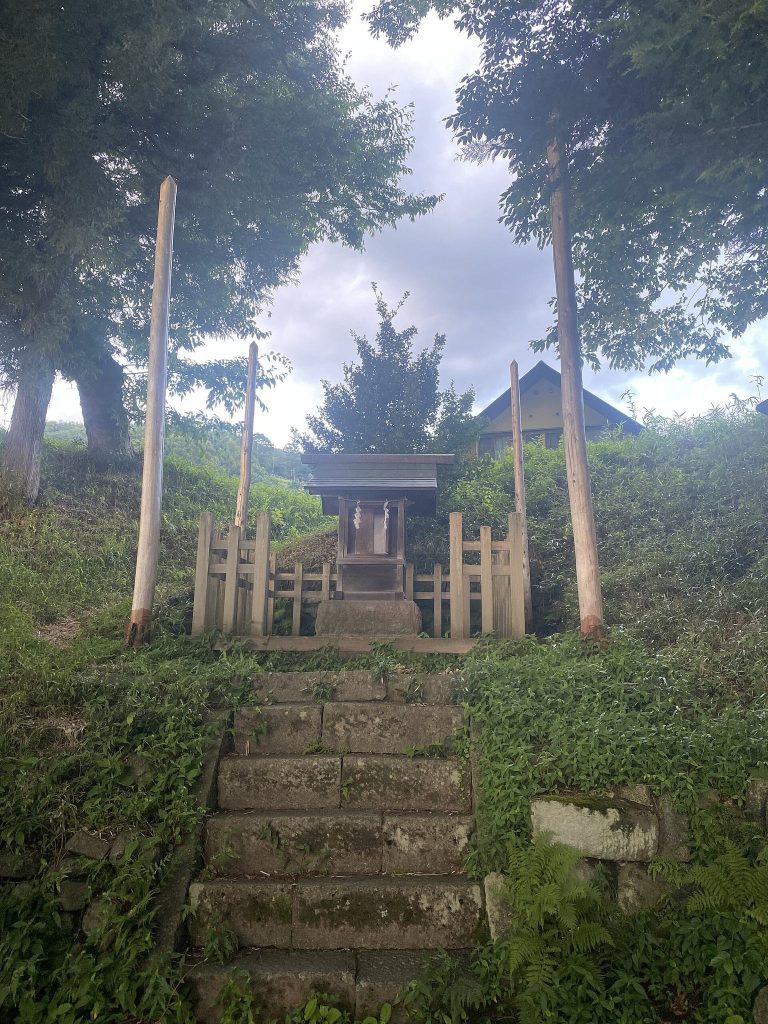
Akimiya also contains the Sacred Hot-Water Basin, the Sacred Yew called Neiri-no-sugi, and Chihiro Pond. A seal known as the Megamihori-in, now an Important Cultural Property, was reportedly found at the pond. Aozuka Shrine stands on Aozuka Kofun nearby. The Lower Shrine has twenty-seven subsidiary shrines, including Wakamiya, Koyasu, Kashima, Yasaka, Kamo Upper and Lower, Inari, Kotaijingu, Akimiya Ebisu, Hachiman, Kamisuwa, Ukishima, Misakuda, and Aozuka. Akimiya Ebisu Shrine was established in 1948.
Shimosha Harumiya
Harumiya’s principal building was completed in 1780 and has the same combined offering-hall and worship-hall design as Akimiya, flanked by two single-bay worship halls. Its Kagura Hall dates from approximately 1681 to 1684. The Shimobabashi, a bridge on the approach, is the Lower Shrine’s oldest surviving structure and dates from the Muromachi period. During the transfer rite, only the sacred palanquin is permitted to cross it.
Harumiya contains the Tube-Porridge Hall, where reeds are cooked for the harvest-divination rite, and the Musubi-no-sugi cedar, whose trunk divides into two branches. The Togawa River flows west of the sanctuary. Its position beside the river has led to the interpretation that the site may originally have been associated with worship of a water spirit.
The rice-planting rite at Misakuda Shrine takes place on June 30. Tradition says that rice planted there could be harvested and offered on August 1, only one month later, as the early rice of Misakuda, one of the Seven Wonders of Suwa. Aozuka Shrine stands on the nearby Aozuka Kofun.
Burial mounds, forests, and sacred landscapes
Aozuka Kofun was formerly within the land of Akimiya. It is the only known keyhole-shaped burial mound in the Suwa region, with a mound approximately 57 meters long. The identity of the person buried there and the relationship between the mound and Suwa taisha remain uncertain.
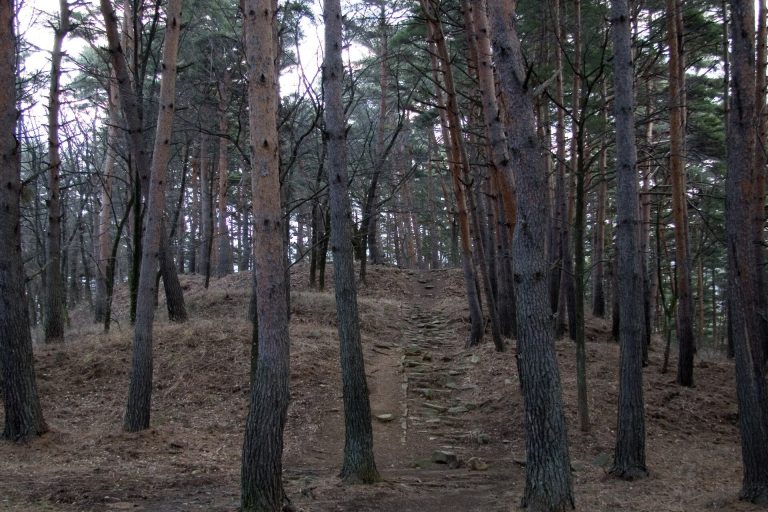
Other associated features include the former Lower Shrine Jinguji site, the Moto-Misayama ritual and hunting-ground remains in the Yashimagahara Wetlands, the sacred forest of the Upper Shrine, the sacred forests of Akimiya and Harumiya, and the mountain from which the Upper Shrine’s Onbashira are cut. An inner sanctuary is also located on that mountain.
The sacred focus of the Upper Shrine has been interpreted in several ways. Mount Moriya became increasingly identified as the go-shintai, the natural feature or sacred object through which a kami is worshipped, from the Meiji period onward, although earlier records do not clearly make that identification. Other interpretations connect the sacred mountain with the Yatsugatake range and the Upper Shrine’s Misayama hunting ground. Suzuri-ishi and the former Tetto pagoda have also been proposed as the iwakura, or sacred rock, and principal focus of worship.
Material evidence and preservation
The material record includes the weapons, bronze mirrors, bracelets, and deer-antler implement from Fune Kofun. Objects excavated from the Akimiya sutra mound include a boat-shaped water vessel, Japanese mirrors, a flower-shaped bowl, a yellow-Seto incense burner, and glazed objects. Shrine treasures include mirrors, a boat-shaped lock, and a sickle. Documents preserve evidence of land grants and protections, while the Lower Shrine’s seal records another aspect of its institutional history. Some of these objects are preserved in local museums or other institutions rather than at the shrine.
The Suwa Shrine Upper Shrine ancient map, traditionally dated to the late sixteenth century but sometimes considered an early Edo-period work, records the former arrangement of the precincts. The original is kept at the Suwa City Museum, and a copy is displayed at the Jinchokan Moriya Historical Museum.
The principal shrines and numerous associated buildings are Important Cultural Properties of Japan. Other protected features include the Upper Shrine grove, the Maemiya residence-site remains, Aozuka Kofun, the Harumiya Shimobabashi, the Onbashira Festival, and the Upper Shrine’s Fifteenth-Night Sumo. The four shrine sites, their forests, archaeological remains, ritual objects, and associated buildings also hold prefectural and municipal designations.