Shimosuwa Aozuka Kofun: A Late Kofun-Period Keyhole Burial Mound in Japan


Site at a Glance
- Rating
- 3.6
- Popularity
- Very Low
- Country
- Japan
- Primary era
- Classical
- External website
- Open
- Eras represented
- Classical
- Civilizations
- Yamato
- Site type
- Burial
- Remains
- Burial Mound
On this page6 sections
History
Shimosuwa Aozuka Kofun is a late Kofun-period burial mound in Japan, generally dated to the second half of the sixth century. A kofun is an ancient burial mound for members of the elite. The person buried here is unknown, but the site is regarded as the only keyhole-shaped mound in the Suwa region and the only known kofun there to have yielded haniwa, clay objects placed on or around burial mounds.
Late Kofun-Period Development
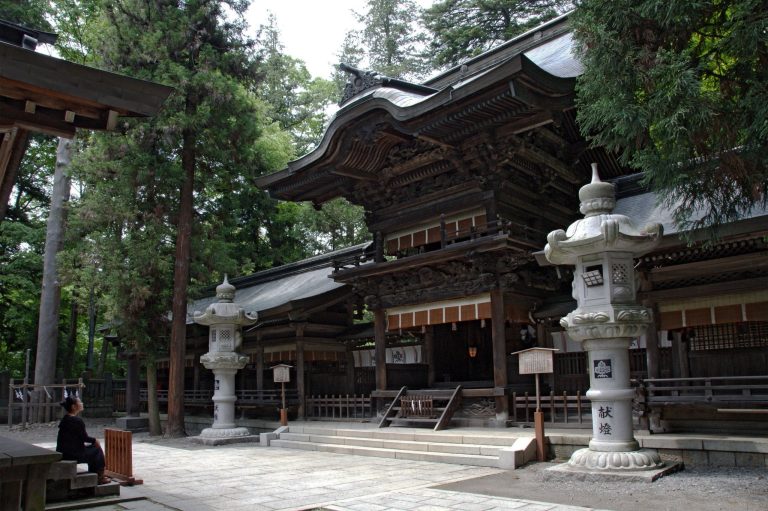
The mound has been associated with the ritual clan of the Lower Shrine of Suwa Taisha, a major Shinto shrine complex whose Lower Shrine had a hereditary priestly tradition represented by the Kanazashi clan. The Kanazashi are considered descendants of the Kanazashi toneri group. A toneri was an imperial retainer or attendant, and the group was associated with local elites in Shinano.
Shimosuwa Aozuka Kofun forms part of a distribution of late keyhole-shaped mounds along the Tosan-do, an ancient route and administrative corridor crossing central and eastern Japan. Other mounds in this distribution include the Iida Kofun Group, Matsushima Ōbo Kofun, and Futagozuka Kofun. Their arrangement has been considered in connection with the development of the original route and the organization of sons of local Shinano elites as imperial retainers. The site has also been interpreted in relation to the early political centralization of the area and possibly the establishment of Suwa Taisha. Another interpretation connects it with keyhole-shaped mounds distributed along the Tenryu River.
Records, Designation, and Investigation
By the late Edo period, the stone chamber had already been opened and looted. The local antiquarian Matsuzawa Gisho described the mound and chamber in Suwa Kofunki, a record that also noted the discovery and reburial of a warrior figurine haniwa. Almost no grave goods are known as a result of the earlier disturbance.
The mound was designated a Nagano Prefecture Historic Site on February 25, 1965, and stands on land owned by Suwa Taisha. A mound survey and internal cleaning investigation of the chamber followed the designation, with results reported in 1966. A further survey measured the mound and the chamber’s ceiling stones in 1984, and its findings were reported in 1986. Finds from the kofun are exhibited at the adjacent Hoshigatō Museum Yanonem, within the Shimosuwa Konjaku-kan Oideya.
Remains
Mound Layout and Exterior
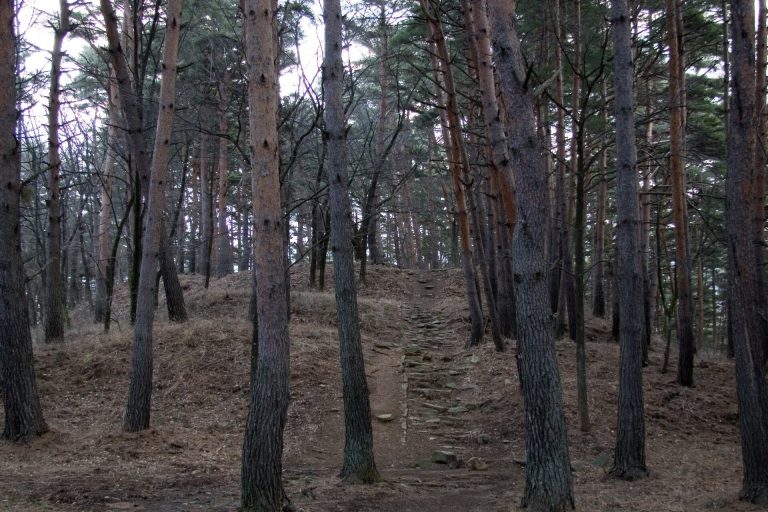
Shimosuwa Aozuka Kofun is a keyhole-shaped mound, combining a circular rear section with a projecting front section, whose front has a developed form. It measures about 67 meters from end to end, and both the rear and front sections rise about 6 meters high. The rear circular section is approximately 33.4 meters in diameter, while the front section is about 42.8 meters wide. The mound stands at the tip of a hill projecting west in the Shimosuwa area north of Lake Suwa, near the former Nakasendo post town of Shimosuwa-juku and the Lower Shrine’s Akimiya. Its orientation is north-northwest.
Later development cut away parts of the mound, especially on the east side. Aozuka-sha, an outlying shrine of Suwa Taisha, occupies the west side of the narrowed middle section. Cylindrical haniwa were placed on the mound’s exterior. Recent investigations identified no haniwa other than these cylindrical examples, although the Edo-period record describes a warrior figurine.
Horizontal Stone Chamber
The burial facility is a double-sleeved horizontal stone chamber in the rear circular section. This type of chamber is entered from the side through a passage, while a double-sleeved plan has projecting side sections at the entrance. The chamber runs across the mound’s main axis and opens westward, with its entrance near the middle section on the western side of the rear mound. It is approximately 5.5 meters long, has a rear wall about 2.15 meters wide, and its floor lies roughly 5 meters above the mound’s foot.
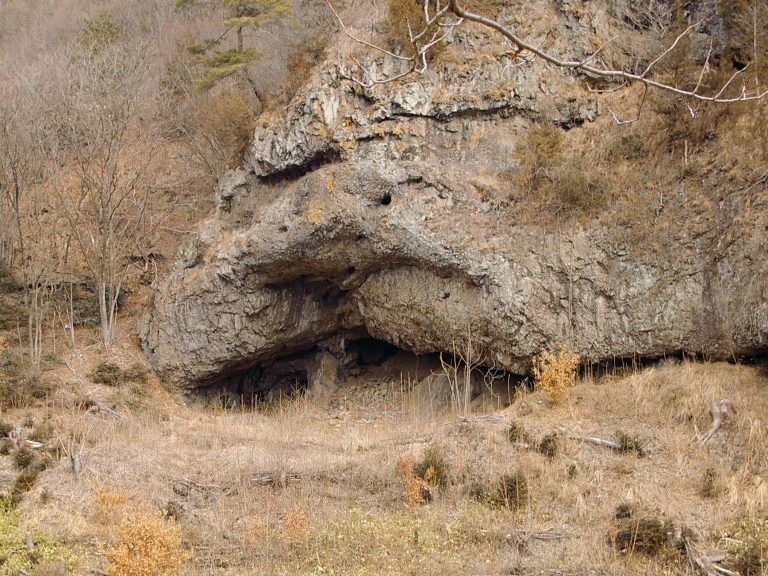
Natural andesite forms the chamber’s irregular stone masonry, and the upper parts of its side walls slope inward. Flat ceiling stones made of pyroxene andesite cover the chamber. Erosion of the mound fill has exposed these stones, while the passage has suffered damage. The chamber is considered to have had a double-sleeved arrangement. Its grave goods remain largely unknown because it had been opened and robbed by the Edo period.