Idojiri Site: A Middle Jōmon Settlement in Japan


Site at a Glance
- Rating
- 4.1
- Popularity
- Low
- Country
- Japan
- Primary era
- Bronze Age
- External website
- Open
- Eras represented
- Bronze Age
- Civilizations
- Jomon
- Site type
- Domestic
- Remains
- House
On this page14 sections
History
Idojiri Site is a prehistoric Middle Jōmon settlement in Japan, located near Fujimi in Nagano Prefecture, on the southern foothills of Mount Yatsugatake. Dating from approximately 2500 to 1500 BCE, it belonged to the Jōmon period, a long prehistoric era associated with hunter-gatherer communities, cord-marked pottery, pit dwellings, and enduring settlement traditions. Idojiri formed part of the wider Idojiri Site Group, a concentration of Middle Jōmon settlements in the Central Highlands.
The Middle Jōmon settlement landscape
The settlement developed among ridges and terraces where numerous springs supplied water and the land descended gently toward the Kamanashi River. These environmental conditions helped support communities in the area. More than 50 Middle Jōmon sites have been identified in the surrounding region, including Akyū, Sori, Tounai, Kyuubee-one, Idaira, Todonomiya, and Mukohara. Together, they show that the southern foothills of Mount Yatsugatake were an important area of settlement during the period.
Postwar investigations and preservation
Archaeological investigations in the region began during the postwar period, with work recorded from 1949 onward. Land reclamation and farming brought pottery and stone tools to the surface. In 1953, archaeologist Eichi Miyasaka guided excavations at the Tounai site. Idojiri itself was investigated in 1958 under Miyasaka and archaeologist Eiichi Fujimori. Local residents of the Sakai Historical Society, high-school students, and other participants joined the work, including Yuroku Muto, who later became the first director of the Idojiri Archaeological Museum.
An Idojiri Site Preservation Association was established after the excavations. During the 1960s, Idojiri, as part of the Idojiri Site Group, received designation as a National Historic Site, a Japanese legal status protecting places important to the understanding of the country’s history. The surrounding land was subsequently developed as Idojiri Historic Site Park, preserving the archaeological area and providing a setting for reconstructed Jōmon buildings and museum interpretation.
Debates about Jōmon subsistence
Research at Idojiri and other Central Highland Jōmon settlements also influenced interpretations of prehistoric food production. Fujimori proposed the theory of “Jōmon agriculture,” which considers whether some communities practiced limited cultivation or managed plant resources rather than depending entirely on hunting, fishing, and gathering. He suggested that groups making extensive use of acorns, chestnuts, and other plant foods might have developed rudimentary cultivation using slash-and-burn methods. The evidence has not clearly demonstrated cultivated plants, but research into ancient environments and the origins of cultivation has kept the theory under discussion.
The wider Site Group has also attracted attention through finds from neighboring settlements. Seven pottery vessels excavated from Building 4 at Sori were designated Nagano Prefectural Treasures in 1975. One deep vessel, decorated with a spiral motif interpreted as water vapor, was displayed at the Japanese Ancient Art Exhibition at the Petit Palais in Paris in 1963. Its design was later used for the denomination imprint on a Japanese postal card in 1972.
Modern interpretation
Idojiri’s history is presented through the Idojiri Archaeological Museum and the adjacent Fujimi Town History and Folklore Museum. The archaeological museum displays excavated material and explains Jōmon pottery and daily life through three-dimensional screens. The neighboring museum presents locally collected agricultural and domestic implements from the Meiji and Taishō periods, equipment associated with sericulture and silk production, a relocated and reconstructed period house, and materials from experiments reconstructing ancient iron production.
Remains
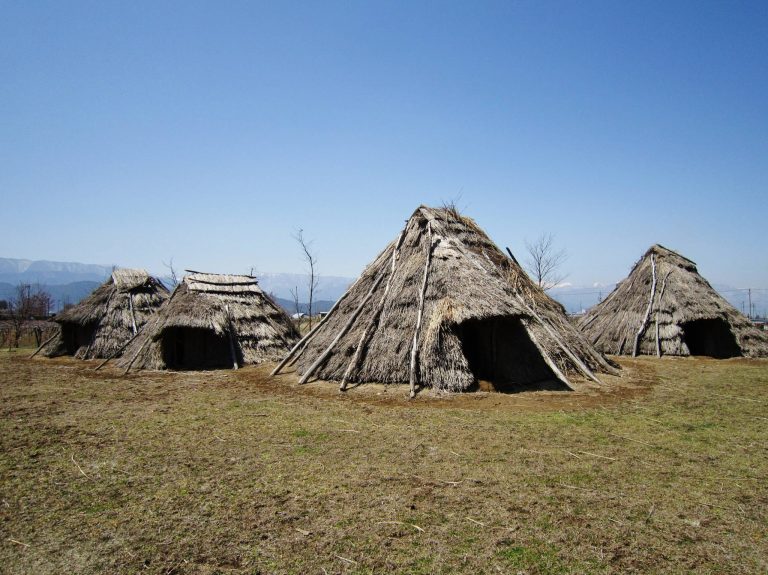
Idojiri occupies ridges and terraces approximately 800 to 1,000 meters above sea level on the southeastern foothills of Mount Yatsugatake. The ground slopes toward the Kamanashi River, and springs occur throughout the vicinity. The settlement contains the foundations of more than 200 pit dwellings. A pit dwelling is a house formed by excavating a shallow hollow and covering it with a roof supported by posts. Several dwellings have been reconstructed outdoors in the archaeological park as interpretive replicas.
Settlement structures
The surviving dwelling foundations provide the principal physical evidence of the settlement’s scale and organization. Their distribution across the ridges and terraces reflects the broad setting in which Middle Jōmon households lived. The reconstructed buildings in the park convey the form of these excavated houses while the archaeological museum presents the associated finds.
Pottery and household activities
Ceramic vessels
Pottery from Idojiri includes vessels classified within the Tounai and Idojiri styles, archaeological categories used for distinctive Middle Jōmon forms and decoration in the Central Highland region. Large deep bowls carry bold abstract designs, including motifs interpreted as animals and human heads. Twelve complete vessels were recovered from building remains. Eleven are bowl-shaped, nine of them deep vessels. The bowls were probably used for boiling food, while the unusually large deep vessels were probably used for storage.
Hearth remains
Hearths contained carbonized plant material interpreted as remnants of burned bread. These remains, together with the pottery vessels, provide evidence for food preparation within the settlement and contribute to the continuing discussion of how Jōmon communities used plant resources.
Stone tools and plant processing
Stone tools form a substantial part of the excavated material. Concave stones, chipped stone axes, and stone plates make up most of the assemblage. Their uses are interpreted to include clearing woodland, digging for roots and bulbs, and processing acorns and other nuts that required preparation before consumption. Building 3 produced 43 chipped stone axes and 10 concave stones, while a broader inventory records 54 stone axes together with stone plates and concave stones.
Museum displays and reconstructed surroundings
Idojiri Archaeological Museum
The Idojiri Archaeological Museum preserves and displays artifacts excavated from the site. Its three-dimensional explanatory screens present Jōmon pottery and reconstructions of Jōmon life. The outdoor museum area includes reconstructed Jōmon buildings, a waterwheel hut, and seasonal plantings that include Ōga lotus. The grounds also provide views toward Mount Kaikoma, the Hōō Three Mountains, and Mount Fuji.
Fujimi Town History and Folklore Museum
The adjacent Fujimi Town History and Folklore Museum extends the interpretation from prehistoric archaeology to local history. Its collections include Meiji- and Taishō-period agricultural and domestic implements, sericulture and silk-production equipment, and a relocated and reconstructed period house. The museum also exhibits four original drawings by animator Hayao Miyazaki depicting the ancient southern foothills of Mount Yatsugatake and Jōmon life.
Nearby sites