Myōren-ji Temple: A Principal Temple of Honmon Hokke-shū in Kyoto


Site at a Glance
- Rating
- 4.1
- Popularity
- Low
- Country
- Japan
- Primary era
- Early Modern
- External website
- Open
- Eras represented
- Early Modern
- Civilizations
- Tokugawa
- Site type
- Religious
- Remains
- Temple
On this page9 sections
History
Myōren-ji Temple is a major temple of Honmon Hokke-shū, a school of Nichiren Buddhism, in Kyoto, Japan. Founded in 1294 by Nichizō, it holds the rank of daihonzan, meaning a principal temple within its Buddhist school. Its origins lie in Nichizō’s effort to preach in Kyoto under Nichiren’s dying injunction.
Foundation and early development
In 1294, Nichizō came to Kyoto to transmit Nichiren’s teachings. The sake merchant Yanagiya Nakakō and his wife, Myōren Hōni, established a Hokke hall on their estate at Gojo Nishinotōin. They later gave their residence to Nichizō, turning the property into a temple. It was first called Yanagi-dera and later received the name Myōhō-renge-ji in honor of Myōren Hōni. The foundation is also dated to 1295 in some traditions.
Muromachi transformations
The temple declined during the Muromachi period. During the Eikyō era, from 1429 to 1441, Nizon, Nichidō, Nichiryū, and Nichikei moved it to the Shijō-Ōmiya area and reorganized its precincts. The institution then took the name Ubokusan Myōren-ji, with its mountain name recalling the earlier name Yanagi-dera.
Nichiō, the son of the court noble Niwata Shigeari, became abbot. Under his leadership, the temple received visits from members of the imperial family and Ashikaga Yoshihisa, the ninth shogun of the Muromachi shogunate.
Conflict, exile, and return
In 1536, the Tenmon Hokke Disturbance, a Kyoto conflict in which Hokke temples were attacked and burned, destroyed Myōren-ji. The temple took refuge in Sakai. Emperor Go-Nara issued an edict in 1542 allowing Hokke temples to return to Kyoto, and Myōren-ji was rebuilt that year after its buildings were transferred to the area around Ōmiya and Moto Seiganji-dōri. The former place-name Moto-Myōrenji-chō remains associated with that vicinity.
Relocation and institutional status
Toyotomi Hideyoshi ordered Myōren-ji’s relocation to its present site in 1587. In 1870, the temple became the head temple of Honmon Hokke-shū.
Fires and rebuilding
Myōren-ji endured the Nishijin Fire of 1730, during which its main hall, Founder’s Hall, three-story pagoda, and other principal buildings survived. The Great Tenmei Fire of 1788 then destroyed almost the entire complex, including all 27 subtemples. The bell tower and treasure storehouse remained, and the main hall was rebuilt in 1789 using the Founder’s Hall of the branch temple Honmyō-ji in Tsuruga, which was moved to Myōren-ji.
Eight subtemples were rebuilt after the fires and continue as part of the complex: Eikō-in, Gyokuryū-in, Honkō-in, Enjō-in, Kenju-in, Jisen-in, Honmyō-in, and Jōjū-in. Myōren-ji is also associated with the Rakuchū Hokke Twenty-One Temples pilgrimage and is known for its hibiscus flowers.
Remains
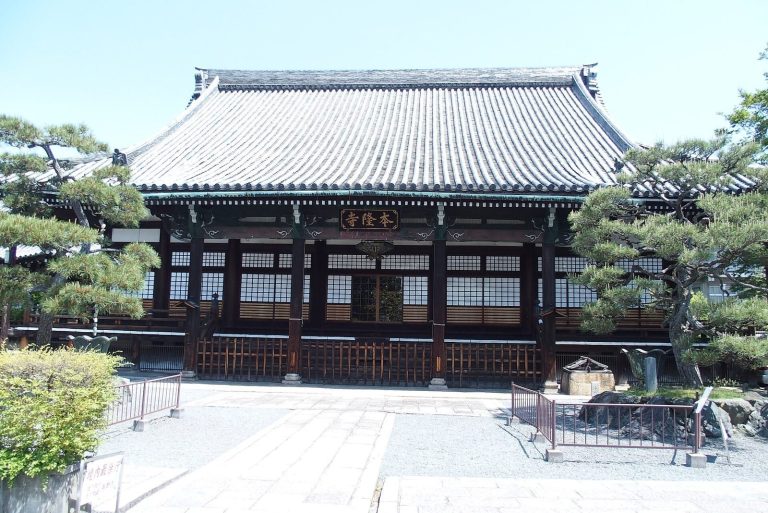
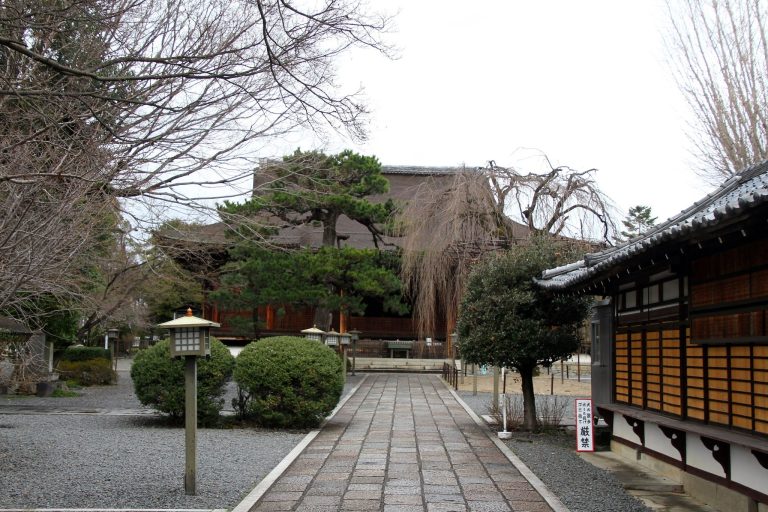
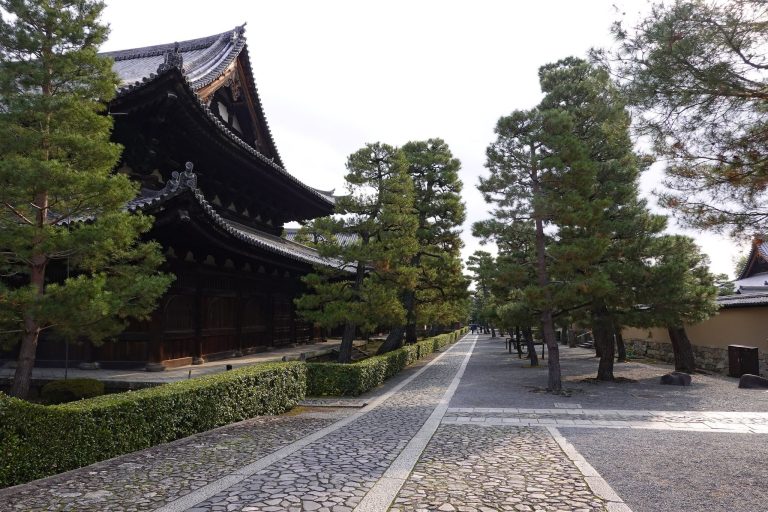
Myōren-ji occupies a precinct in the Myōrenji-mae-chō area of Kamigyō Ward, Kyoto. Eight surviving subtemples form part of the complex, whose buildings reflect repeated relocation, destruction, and rebuilding. The surviving religious and architectural features include the main hall, the large abbot’s quarters, the bell tower, the treasure storehouse, wall paintings, and objects connected with worship and temple history.
Main buildings and precinct features
The main hall, also called the Shakadō, incorporates timber said to have been salvaged from the Great Buddha Hall of Hōkō-ji, the temple known for its Great Buddha Hall, and a building using that material was completed in 1615. The present main hall dates from the 1789 rebuilding and was formed by relocating the Founder’s Hall of Honmyō-ji in Tsuruga. The large abbot’s quarters were reportedly made with a structure received from Jurakudai, the grand Kyoto residence and political complex associated with Toyotomi Hideyoshi.
The historical complex included a Founder’s Hall, a three-story pagoda, a bell tower, and a treasure storehouse. The bell tower and treasure storehouse survived the 1788 fire and remain among the physical features associated with the rebuilt precinct.
Paintings and religious objects
The Inner Study and Entrance Room contain 38 wall-painting panels recognized as Important Cultural Properties. The temple’s principal object of worship is the Mandala of the Ten Realms, a Buddhist sacred diagram representing interrelated states of existence and consciousness. Other listed cultural properties include the Matsuo Shrine Buddhist canon and Risshō Ankoku-ron.
Myōren-ji’s crest is a round emblem bearing three maple leaves.