Hiraide Ruins: A Long-Lived Settlement Site in Japan


Site at a Glance
- Rating
- 4
- Popularity
- Low
- Country
- Japan
- Primary era
- Stone Age
- External website
- Open
- Eras represented
- Stone Age, Classical, Medieval
- Civilizations
- Jomon, Yamato
- Site type
- Domestic
On this page11 sections
History
Hiraide ruins is a complex settlement site in Japan, in the Soga neighborhood of Shiojiri, Nagano, occupied by prehistoric and historic communities from the Early Jōmon period through the early Heian period. The Jōmon period was Japan’s prehistoric era of hunter-gatherer and early village societies, known especially for cord-marked pottery. Hiraide’s main flourishing phase came during the Middle Jōmon, approximately 4,500 to 5,500 years ago, when more than 110 buildings were built. The site extends along the Shibukawa River at the southern end of the Matsumoto Plain and also includes three kofun, or Japanese burial mounds.
Jōmon settlement
Hiraide’s history covers almost the entire Jōmon period, from its Early phase through its Late phase. Its Middle Jōmon community was especially active, leaving 116 pit dwellings, houses with floors dug below ground level, together with pottery bearing elaborate decoration, stone tools, clay figurines, standing stones, and objects connected with ritual practice. These remains indicate a substantial settlement with both domestic and religious activities.
Later prehistoric and early historic occupation
Occupation continued through the Kofun period, which was named for the large burial mounds built for powerful elites. More than 128 house foundations from this period have been identified. They include posthole buildings, structures supported by upright posts set into the ground, interpreted as residences or storehouses. The buildings were generally large and contained one or more hearths. Their associated finds include Haji ware, an unglazed earthenware, Sue ware, a high-fired ceramic, and numerous iron implements such as spades and sickles.
Approximately 50 house sites date to the Heian period, the era from 794 to 1185 when aristocratic government was centered at Heian-kyō, present-day Kyoto. Hiraide therefore preserves evidence for long-term occupation in the same location. The excavated material includes pottery, stone tools, iron implements, agricultural equipment, carbonized cereals such as rice and millet, and cattle and horse bones, presenting a picture of a prosperous settlement with farming and animal use.
Investigation and preservation
Systematic investigation began after a green-glazed water bottle was found in a field in 1947. The discovery drew the attention of a professor at Kokugakuin University and a teacher at Soga Elementary School. Local elementary-, middle-, and high-school students excavated at the site in 1949, followed by a comprehensive investigation led by Soga Village in April 1950 and four major excavation campaigns through November of that year.
Hiraide ruins was designated a National Historic Site on March 29, 1952, covering 154,958 square meters. Its approximately 5,000 years of archaeological evidence and insights into the settlement’s former way of life supported the designation. The site was once counted among Japan’s three major archaeological sites, alongside the Togariishi Site in Chino and the Toro Site in Shizuoka.
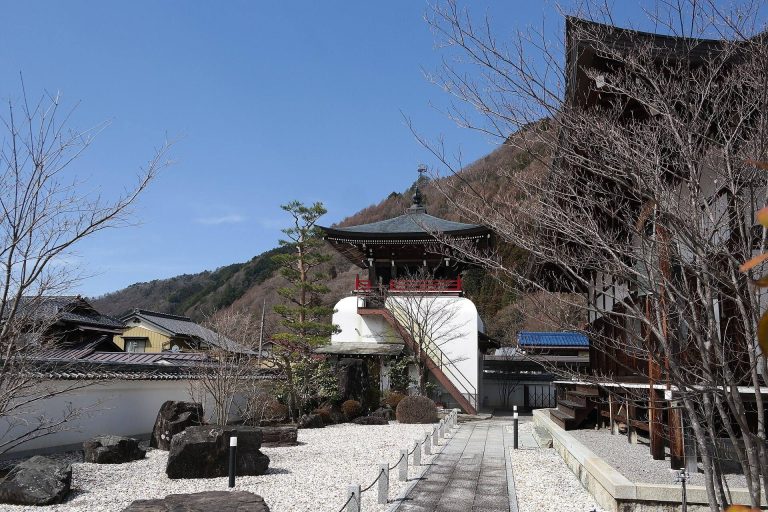
A reconstruction of Kofun-period Building 3 was completed in 1951. From 1981, a five-year project developed a historic-site park that included Building 62. The Shiojiri City Hiraide Archaeological Museum opened in 1954, followed by a History and Folklore Museum in 1979 and the Tile Tower Museum in 1992. The Jōmon Village opened in 2006, the Hiraide Ruins Park Guidance Center in 2008, and the Ancient Rural Village area in 2010. In 2008, a large reconstructed pit dwelling was destroyed by fire, and two high-school students were arrested on suspicion of arson.
Remains
Hiraide ruins is spread in strips along the Shibukawa River for approximately 1 kilometer from east to west and 300 meters from north to south. The site contains more than 290 pit dwellings and posthole buildings, three kofun burial mounds, and numerous pottery, stone, and iron artifacts. Hiraide Ruins Park covers approximately 56,450 square meters and organizes reconstructed buildings and presented landscapes around the Jōmon, Kofun, and Heian-period environments.
Jōmon settlement remains
The Middle Jōmon area contains 116 pit dwellings dating to approximately 4,500 to 5,500 years ago. Their associated decorated pottery, stone tools, clay figurines, standing stones, and other ritual objects provide material evidence of domestic life and religious practice. Seven thatched-roof buildings have been reconstructed, and a plaza with a standing stone has been established as a representation of a place where such an object was venerated.
Kofun-period buildings
Elite residence
The park includes a reconstruction of a large Kofun-period building interpreted as the residence of a local elite. The period’s excavated buildings had substantial forms, indoor hearths, and associations with Haji ware, Sue ware, and iron agricultural implements. Orchards, including peach trees, and surrounding woodland recreate the setting of a rural settlement dating from the late sixth to early seventh century.
Raised-floor granary
A raised-floor granary, elevated above the ground on posts to protect stored crops, is also reconstructed in the Kofun-period area. It forms part of the presentation of the settlement’s buildings and cultivated landscape, alongside the elite residence, orchards, and woodland.
Heian-period rural village
Four buildings and a shed have been reconstructed as the houses of several families during the first half of the eleventh century. Fields and plantings represent food crops, dye plants, ornamental vegetation, and screening plants, creating a physical presentation of a Heian-period rural settlement. The wider site has approximately 50 Heian-period house sites, linking these reconstructions to the long sequence of occupation at Hiraide.
Artifacts and museum remains
A roughly two-meter-high tower made from roof tiles dates to the Nara period and is displayed in the Tile Tower Museum. Hiraide’s green-glazed water bottle, believed to date to the early Heian period, is designated by Nagano Prefecture as a prefectural treasure and archaeological cultural property. Fourteen Jōmon pottery artifacts from Hiraide are among 158 vessels recognized by Nagano Prefecture as characteristic Jōmon pottery of Shinshu. A Hiraide Type III-A vessel is preserved by the Shiojiri City Hiraide Museum and is designated by Shiojiri City.