Jufuku-ji Temple: A Rinzai Zen Temple in Kamakura


Site at a Glance
- Rating
- 3.9
- Popularity
- Very Low
- Country
- Japan
- Primary era
- Early Modern
- Eras represented
- Medieval, Early Modern
- Civilizations
- Ashikaga shogunate, Kamakura shogunate, Tokugawa
- Site type
- Religious
- Remains
- Monastery
On this page15 sections
History
Jufuku-ji Temple is a Rinzai Zen temple in Kamakura, Japan, founded in 1200 by Hōjō Masako, the widow of Minamoto no Yoritomo, with the monk Myoan Eisai as its founding priest. It was established to commemorate Yoritomo and Masako’s father, Minamoto no Yoshitomo, during the early Kamakura period. The temple is traditionally regarded as Kamakura’s oldest Rinzai temple and was ranked third in the Five Mountains system, the official hierarchy of major Zen temples.
A Minamoto family estate
Jufuku-ji occupies Kamegaya, a traditional Minamoto family estate backed by Mount Genji. Yoshitomo’s former residence stood on this ground. When Yoritomo entered Kamakura in 1180, he considered placing his residence and government here. He changed the plan because Okazaki Yoshizane had already built halls for Yoshitomo’s repose and because the site was too small for the intended settlement.
The new temple initially had a seven-hall monastic compound and fourteen subtemples. Its complete institutional form as a Zen monastery is estimated to have taken shape around 1278. Jufuku-ji also became the twenty-fourth temple on the Thirty-Three Kannon pilgrimage and the eighteenth on the Kamakura Twenty-Four Jizo pilgrimage. Its principal object of worship is Shaka Nyorai, the Japanese name for Shakyamuni, the historical Buddha.
Growth, fire, and religious connections
The temple flourished with high temple status during the early Kamakura period. Its religious practice was syncretic for a time, combining Rinzai Zen, a tradition centered on disciplined monastic practice, meditation, and koan study, with esoteric Buddhist elements. Several prominent monks were associated with the institution, including its second abbot, Taiko Gyoyu, as well as Kakushin Shinchi, Enni Bennen, Rankei Doryu, and Daikyu Shonen.
Enni Bennen received esoteric teachings from Anin, then abbot of Jufuku-ji, in 1228, and became the temple’s abbot in 1257. In 1265, the Chinese Chan master Rankei Doryu was accused of spying for Mongol authorities in China. After appealing the accusation, he was allowed to reside at Jufuku-ji for a period.
Jufuku-ji suffered fires in 1247 and 1258, with the later fire destroying every building. The complex was probably rebuilt during the Northern and Southern Courts period. This interpretation is associated with a five-ring funerary monument traditionally identified with Minamoto no Sanetomo, Yoritomo’s son.
Institutional continuity and protection
The temple’s position as third among the Kamakura Five Mountains continued under the classification system established during the rule of Ashikaga Yoshimitsu. That system organized parallel groups of five major temples in Kyoto and Kamakura. Medieval travel works such as Kaido-ki and Tōkan Kikō nevertheless did not mention Jufuku-ji.
Jufuku-ji was designated a national historic site in 1966. The designation expanded in 2008 to include groups of yagura, horizontal rock-cut burial or memorial chambers, together with cut cliffs and related remains at the foot of the quarry mountain behind the precinct. The temple became a component of Japan Heritage in 2016. Its present institutional affiliation is the Kencho-ji line of the Rinzai tradition.
Remains
The surviving compound includes a main gate, middle gate, Buddhist hall, kuri service and residential building, and bell tower. Wood, brick, and stone are used across the complex. Behind these buildings, the cemetery extends toward groups of yagura and cut cliffs at the foot of the quarry mountain, forming part of the protected archaeological landscape.
Main temple compound
Gates and service buildings
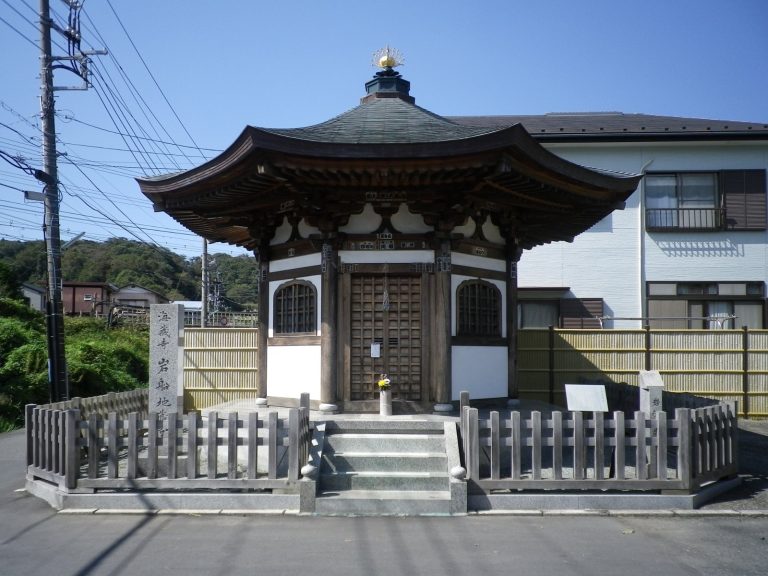
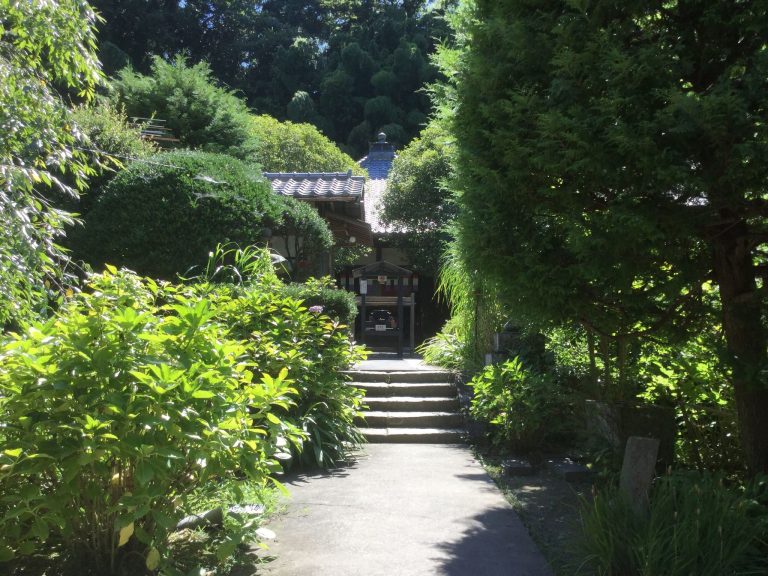
The entrance sequence is formed by the main gate and middle gate, leading into the central temple compound. The kuri serves as a service and residential building, while the bell tower forms another element of the surviving group of buildings. Together, these structures preserve the basic organization of a Buddhist monastic precinct.
Buddhist hall
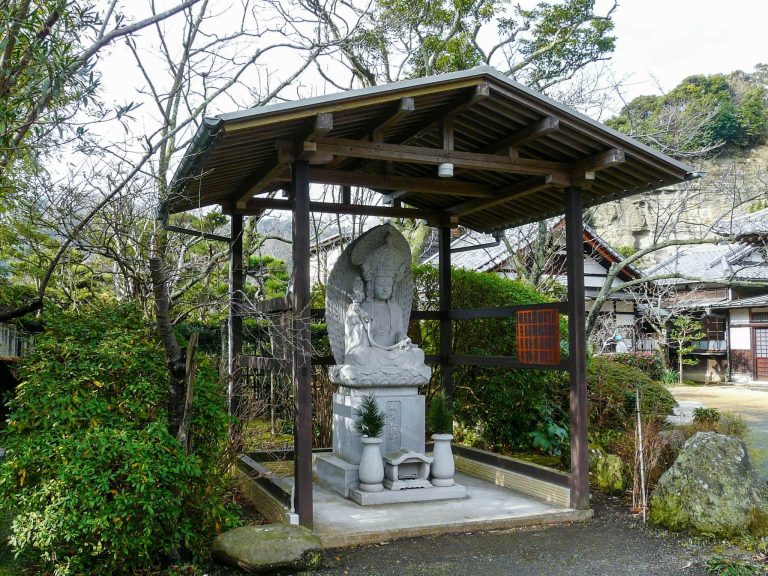
The Buddhist hall is a reconstruction dated to 1664. It has burned and been rebuilt repeatedly over the centuries. Inside are three images of Shaka Nyorai, which make up the temple’s principal object of worship, together with an image of Eleven-Headed Kannon, the bodhisattva associated with compassion.
Guardian figures
Two large wooden Deva King statues, or Niō, stand among the temple’s associated religious images. Niō are paired guardian figures traditionally placed at Buddhist temple entrances. The statues were transferred to Jufuku-ji from Tsurugaoka Hachimangu in 1872, during the government-ordered separation of Shinto institutions and practices from Buddhism.
Cemetery and rock-cut tombs
Yagura groups
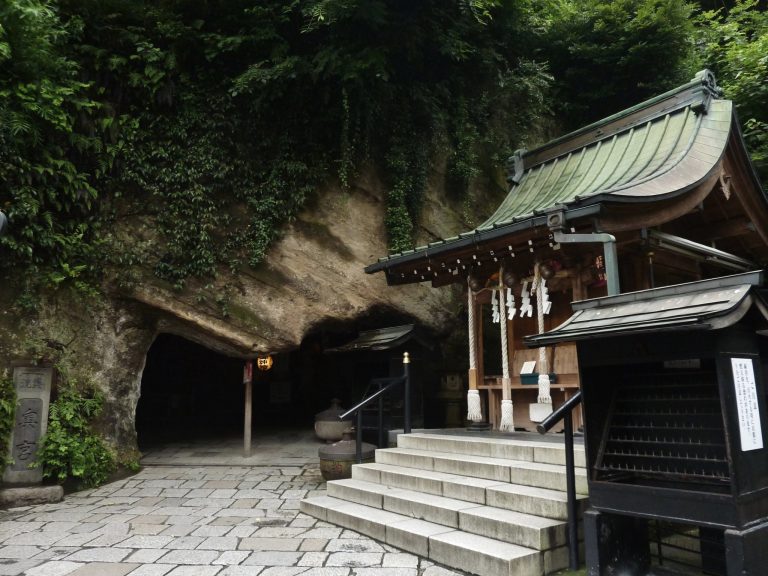
The rear cemetery contains horizontal cave tombs known as yagura, a form of rock-cut burial facility characteristic of medieval Kamakura. The groups of yagura, the adjoining cut cliffs, and the quarry mountain’s foot preserve an archaeological landscape behind the main precinct.
Memorial monuments and graves
Two yagura contain five-ring monuments traditionally identified as the graves of Hōjō Masako and Minamoto no Sanetomo. A five-ring monument is a stone funerary structure made of five symbolic elements. The cemetery also contains the graves of the temple’s chief priests, the haiku poet Takahama Kyoshi, the poet Hoshino Tatsuko, the novelist Osaragi Jiro, and the British Countess Iso Mutsu.
Religious images and natural features
Sculptures and paintings
Several religious images associated with Jufuku-ji are deposited at the Kamakura Museum of National Treasures. They include a wooden standing Jizo, a bronze seated Yakushi Nyorai traditionally associated with Tsurugaoka Hachimangu, and a seated wooden image of Eisai. Other images include a seated wooden Daruma, three figures representing the monastery’s guardian deities, and a Shaka triad whose central figure uses dry-lacquer technique while the attendants are wooden. The associated paintings include a silk image of the Shaka triad with the Sixteen Benevolent Deities and an ink painting of White-robed Kannon.
Juniper trees
Four Japanese juniper trees within the precinct are designated natural cultural properties, adding living features to the surviving religious and archaeological landscape.