Sukuh: A Fifteenth-Century Hindu Temple Ruin in Central Java
Site at a Glance
- Rating
- 4.6
- Popularity
- Medium
- Country
- Indonesia
- Primary era
- Medieval
- Eras represented
- Medieval
- Civilizations
- Unclassified
- Site type
- Religious
- Remains
- Temple
On this page14 sections
History
Sukuh is a fifteenth-century Hindu temple ruin on the western slope of Mount Lawu in Central Java, Indonesia. Built during the late East Javanese period and the final phase of the Majapahit Kingdom, it belongs to the last major phase of temple construction in Java before the conversion of the island’s courts to Islam in the sixteenth century.
A sacred mountain sanctuary
The founders of Sukuh treated the slope of Mount Lawu as a sacred landscape connected with ancestor worship, nature spirits, and fertility rituals. The unusual imagery at the site makes its religious meaning difficult to establish with certainty, since contemporary Javanese ceremonies and beliefs are only partly understood. The temple’s irregular design and distinctive sculptures have therefore prompted several interpretations rather than a single accepted explanation.
Inscriptions from Sukuh date from approximately 1416 to 1459, while construction is generally placed around 1430. A chronogram, an inscription whose words or images encode a date, appears in the western gateway. Its imagery is understood as indicating the foundation or consecration of the temple in 1437. Some archaeologists have interpreted reliefs showing a feud between two aristocratic houses as an allusion to internal conflict within Majapahit and possibly to the kingdom’s decline, but that reading remains speculative.
Later history and restoration
By the time Sir Thomas Raffles visited Sukuh in 1815, during his administration of Java from 1811 to 1816, the temple was in poor condition. Many statues lay on the ground, and most figures had been decapitated. The large lingga, a phallic symbol associated especially with Shiva, had been broken into two pieces and then joined together. The destruction of statues and the sexually explicit imagery have sometimes been connected with Muslim incursions into Java during the sixteenth century, although this explanation is not certain.
Archaeological investigation and study expanded during the nineteenth century. Conservation began under Dutch colonial rule, with the first recorded restoration taking place in 1917. Further restoration was carried out by Indonesia’s Ministry of Education and Culture in the late 1970s, helping preserve the surviving structures and sculptures.
Bhimaswarga and the worship of Bhima
A shrine called Bhimaswarga was added for the worship of Bhima in association with Shiva, one of Hinduism’s principal deities. A statue of Bhima and a Shiva lingga placed on a yoni-like base were consecrated there in 1443. A yoni is the complementary female form traditionally paired with the lingga, and together the two represent generative or cosmic principles.
Remains
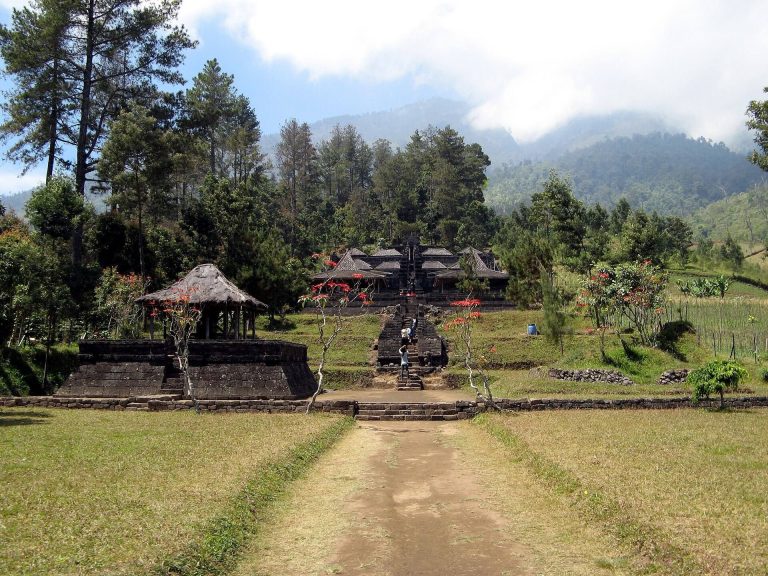
Sukuh occupies a three-level, trapezoidal enclosure on the western slope of Mount Lawu, at about 910 metres above the surrounding area and near the boundary between Central and East Java. The terraces extend for roughly 100 metres, rising from the lowest western level toward the highest eastern level. Narrow stone gateways along the central approach connect the terraces, while the principal shrine stands at the rear of the uppermost level.
The terraces and principal shrine
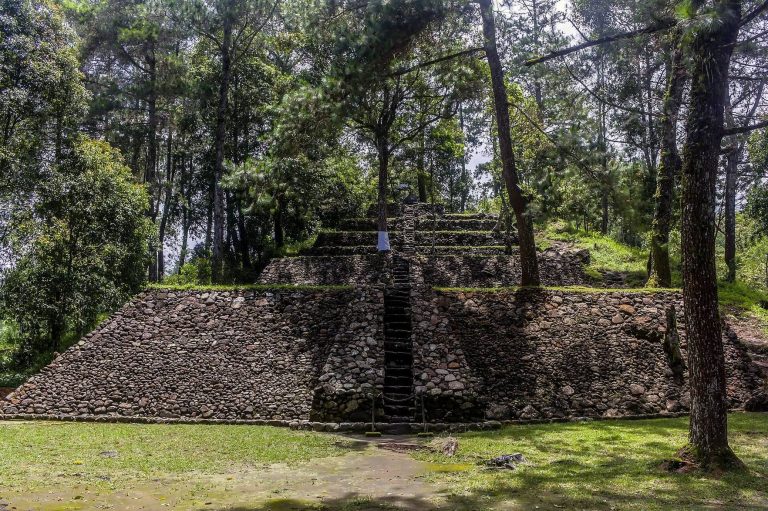
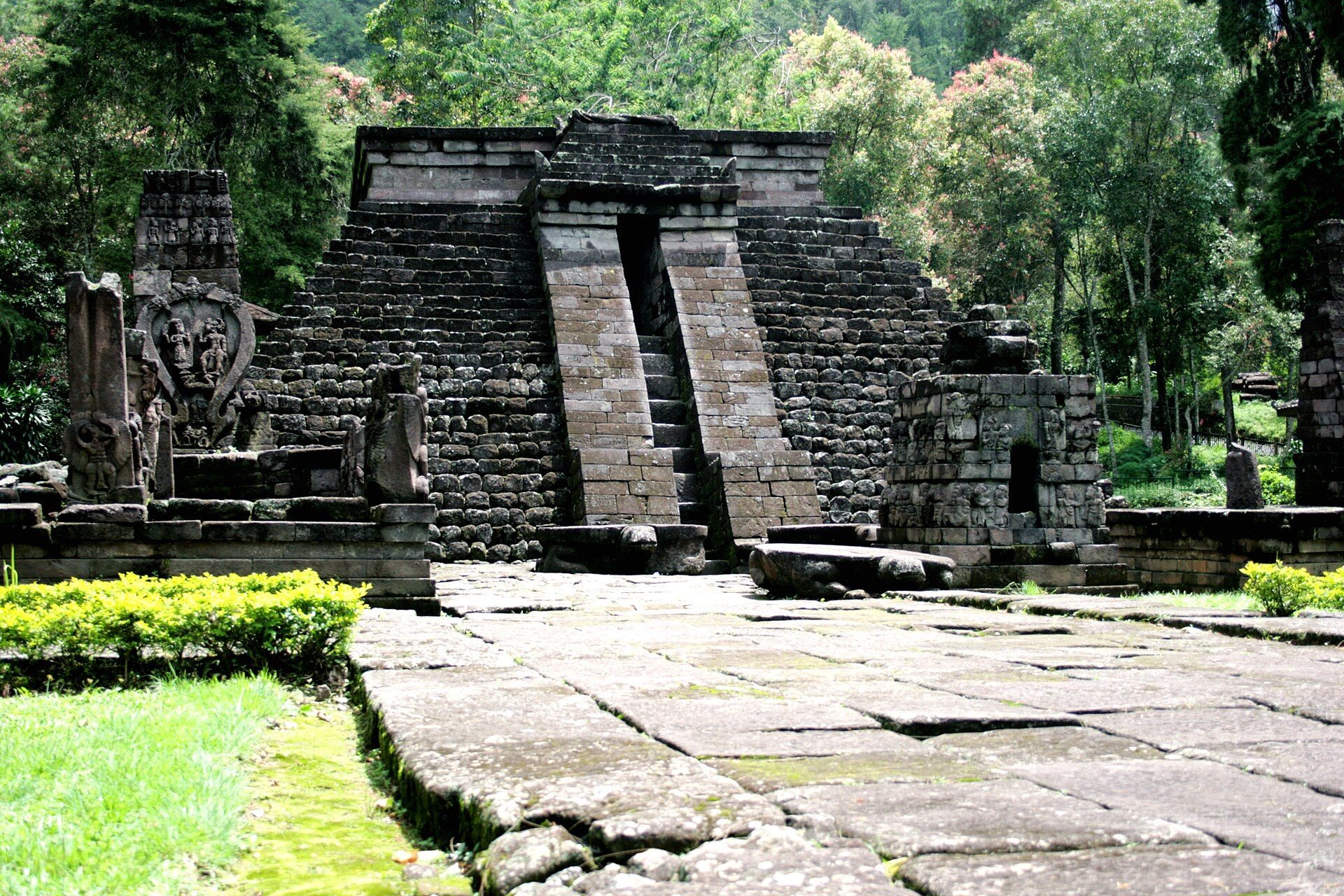
The central shrine is a truncated pyramid built from andesite stone. Its square base measures about 16 metres on each side, and the structure is approximately 7 metres high, with an overall height also described as about 8.7 metres. A stairway climbs through the front beneath a gabled pediment and leads toward the summit. Small shrines, monoliths, and carved figures are grouped around the front of the monument.
The pyramid shrine
The pyramid form differs from the rectangular or square plans commonly associated with Hindu temples and does not follow Vastu Vidya, a traditional South Asian system of architectural planning. Its meaning is uncertain, although one interpretation sees the structure as a representation of a mountain. The eastward orientation has likewise been associated, speculatively, with solar worship and reverence for Mount Lawu behind the shrine.
The western gateway
The western gateway provided the original entrance from the lowest terrace. Reliefs on its two sides show monsters linked with phrases translated as “the gate monster eats a person” and “the gate monster bites a snake’s tail.” Their images are interpreted as the chronogram for 1437. Descriptions of the gateway also include a man-eating monster, birds in a tree, and a dog.
Ritual imagery and sacred water
Lingga and yoni imagery
An andesite relief on the floor of the western entrance depicts sexual intercourse through paired lingga and yoni forms. Similar genital imagery appears on several other statues. A large carved lingga measuring 1.82 metres was recovered from the summit of the main shrine and is now held by the National Museum of Indonesia. It may originally have stood on a platform above the stairway.
The lingga bears a vertical inscription carved in a vein-like pattern. Its chronogram corresponds to 1440, and the text refers to the consecration of the sacred Ganggusudhi, a name whose precise interpretation remains uncertain. It also describes the male sign as the essence of the world. The sculpture carries a kris blade, an eight-pointed sun, and a crescent moon as additional carved elements.
Water channels and ritual use
Stone water channels were arranged around the temple and appear to have drawn water from springs or a catchment area on the mountain slope behind the main shrine. One channel led into a sacred pool, while others supplied water for rituals at altars and shrines.
Sculptures of craft, deity, and animals
The smithy and Ganesha relief
A relief on the main monument shows two men forging a weapon in a smithy, a workshop for shaping metal by fire and hammering. In Javanese-Hindu belief, metalworking could carry both practical and spiritual power. Smithies were treated as sacred places, while the kris was associated with fire, ritual authority, and the legitimacy of Hindu-Javanese kingship.
The same sculptural program includes a dancing Ganesha, the elephant-headed Hindu deity traditionally associated with removing obstacles. The figure has a human body, exposed genitalia, demonic features, an unusual dancing pose, a necklace resembling bones, and a small animal, probably a dog, in one hand.
Tortoises and other figures
Other surviving sculptures include a life-sized male figure grasping his own penis, three flattened-shell tortoises, a Garuda, and numerous additional reliefs and figures. Garuda is the divine bird-like figure traditionally associated with Vishnu. Two large tortoises face west as though guarding the entrance to the pyramid, while a third stands farther in front.
The flattened tortoise shells may have served as altars for purification rituals and ancestor worship. Their form has also been associated with Kurma, the tortoise avatar of Vishnu, whose mythological role includes supporting the world.