Stollburg: A Medieval Hilltop Castle in Germany


Site at a Glance
- Rating
- 4.6
- Popularity
- Low
- Country
- Germany
- Primary era
- Medieval
- Eras represented
- Medieval
- Civilizations
- Holy Roman Empire
- Site type
- Military
- Remains
- Castle
On this page7 sections
History
Stollburg is the ruined remains of a noble hilltop castle in Germany, probably built in the twelfth century by the Lords of Stollberg. It stands in Handthal, within the municipality of Oberschwarzach, and later became part of the Würzburg prince-bishopric, a territory ruled by a bishop as both secular prince and religious authority.
The Lords of Stollberg
In 1151, Stollburg passed by donation from the Würzburg prince-bishopric to Ebrach Abbey, a Cistercian monastery. A document dated 17 September that year records King Conrad and his son Friedrich confirming the abbey’s acquisition of the estate at Oberschwarzach and the associated Steigerwald from the knight Walter, while excluding a small area near Stollburg. The castle’s men retained rights to cut wood and graze livestock there.
Walter of Stollburg witnessed two documents issued by Emperor Frederick I in 1172. Conrad of Stollburg, probably Walter’s son, witnessed a document of Henry VI in 1195 and another issued for King Philip in 1200. The latter also names Conrad’s brothers Heinrich and Ludwig. Ludwig was married to Hedwig, the widow of Hartwig of Zabelstein, the imperial master of the kitchen. Her ancestral castle stood only a few kilometres from Stollburg.
It remains unresolved whether the Lords of Stollberg developed into the noble comital family of the same name. A theory put forward by the local historian Gerhard Wagner places the birth of the minnesinger Walther von der Vogelweide, a medieval German poet and singer of courtly love poetry, at Stollburg around 1170.
Transfer to Würzburg and destruction
During a feud with Hermann of Lobdeburg, Bishop of Würzburg, Ludwig von Stollberg was killed by Würzburg cavalry in 1236. The castle passed to the Würzburg prince-bishopric in 1237 and served as the seat of a Würzburg official by 1303.
Stollburg was destroyed and burned on 2 May 1525 during the German Peasants’ War, a widespread revolt of peasants and other lower-status groups in the Holy Roman Empire in 1524 and 1525. Its official, Wolfgang I, Count of Castell, had been summoned to Würzburg to help defend Marienberg Fortress against the insurgents. The ruins are recognized as both a cultural monument and an archaeological monument.
Remains
Stollburg occupies a spur at about 443 metres above sea level on the 476-metre Stollberg in Handthal. The site lies within the municipality of Oberschwarzach in Lower Franconia, on a mountain described as Franconia’s highest vineyard site. The castle was separated from the ridge by four neck ditches, defensive cuts across the narrow land connection between a castle spur and the surrounding ridge, while the ground falls away on its other three sides.
Keep and surviving masonry
Octagonal keep fragment
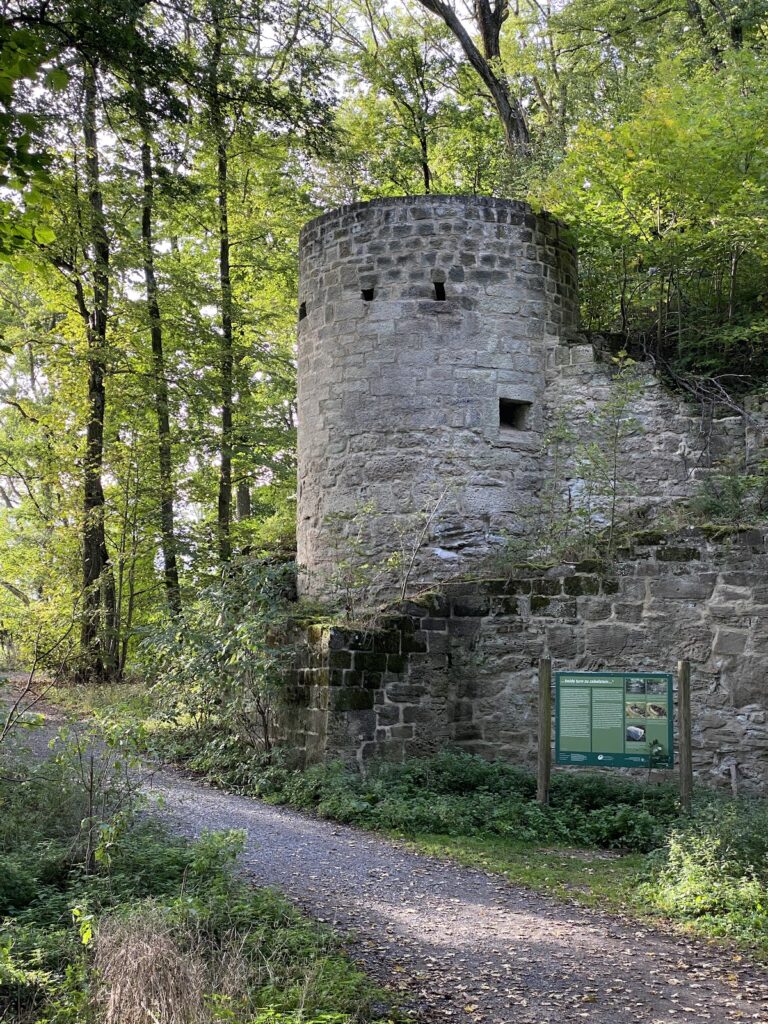
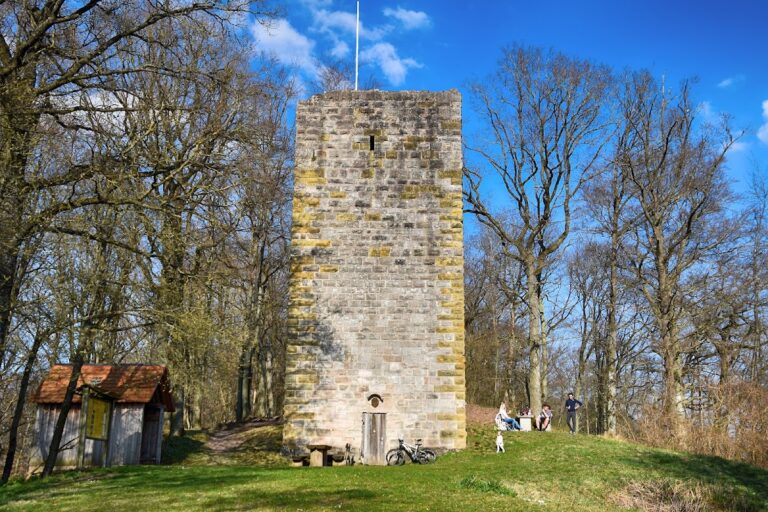
The principal surviving feature is an octagonal fragment of the keep, the castle’s main defensive tower. It rises 14 metres and has walls up to 2.5 metres thick. This substantial masonry forms the clearest surviving element of the medieval stronghold.
Wall, vault, and cellar remains
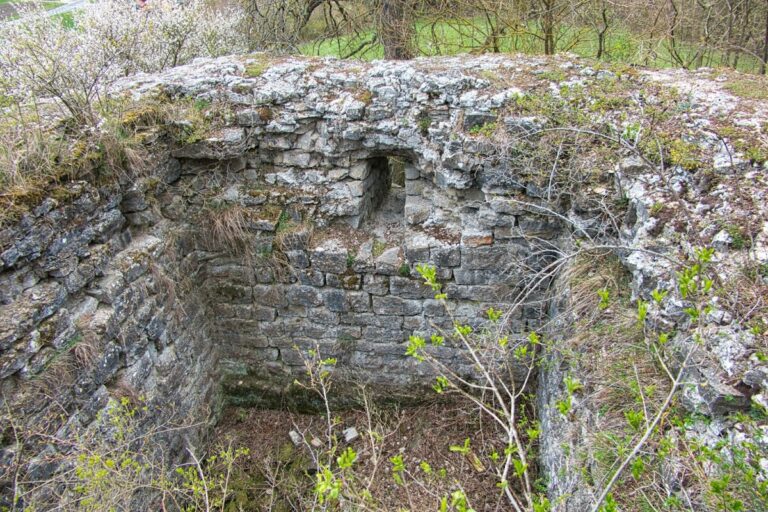
Smaller sections of wall survive around the ruin, together with remnants of vaulted construction and a partly filled-in cellar entrance. These fragments preserve elements of the castle’s defensive and internal structures alongside the standing keep fragment.