Burgruine Zabelstein: A Medieval Castle Ruin in Germany


Site at a Glance
- Rating
- 4.7
- Popularity
- Very Low
- Country
- Germany
- Primary era
- Medieval
- Eras represented
- Medieval, Early Modern
- Civilizations
- Holy Roman Empire
- Site type
- Military
- Remains
- Castle
On this page9 sections
History
Burgruine Zabelstein is the ruin of a noble castle in Germany, founded around 1000 on a high spur near Hundelshausen. Its surviving masonry points to an early medieval origin, and the probable builders and owners were the Zabelsteiner noble family, who were related by blood to the Scherenberg ministerial family. The Zabelsteiners died out in 1303, after which the castle passed to the Bishopric of Würzburg, a territorial principality governed by a bishop as both ecclesiastical and secular ruler.
Würzburg Rule and Administrative Importance
Under the Würzburg prince-bishops, Zabelstein became one of the most powerful fortresses in the lands along the Main. It was regarded, together with Marienberg Fortress in Würzburg, as one of the safest fortresses in the bishopric. Valuable documents and the episcopal treasury were kept there, while the castle’s administrative role also expanded.
Zabelstein became the seat of the Zabelstein district. It provided refuge for the bishops and served as a place for hunting and recreation, combining governmental, defensive, and residential functions. This role continued until 1652, when the Bishopric of Würzburg moved the district administration to Traustadt. Zabelstein then became the seat of a forest office, which administered woodland and related forestry matters.
Destruction, Rebuilding, and Decline
The castle was destroyed in 1525 during the Peasants’ War, a major uprising in the German lands against aspects of territorial and social authority. The destruction took place under the leadership of Hans Jüst. Prince-Bishop Julius Echter ordered the castle rebuilt in 1586, after which it resumed its administrative function.
A fire destroyed Zabelstein in 1689. The ruined complex subsequently fell into decay and became a quarry. Stone from the castle was used in the construction of the church in Donnersdorf. The surviving remains are protected as an architectural monument, described as a late-medieval castle complex preserved in masonry. Subsurface parts and foundations of demolished buildings from the medieval to early modern periods are also treated as an archaeological monument by the Bavarian State Office for Monument Protection.
Remains
Castle Layout and Defensive Works
Burgruine Zabelstein occupies a 475-metre-high spur plateau in northern Zabelstein, in the unincorporated area of Hundelshausen near Michelau im Steigerwald. The castle was a spur castle, a fortress built on projecting high ground and defended partly by the surrounding slopes. Its layout comprised an outer bailey and a main castle. Entry to the main castle crossed a neck ditch, a defensive ditch cut across the narrow connection between the spur and the higher ground behind it.
Outer Bailey
The outer bailey, the castle’s outer fortified section, survives in a wall remnant. Additional wall sections run along the castle ditch, preserving parts of the defensive boundary. The remains are fragmentary, while subsurface features and the foundations of former buildings continue beneath the ground.
Main Castle
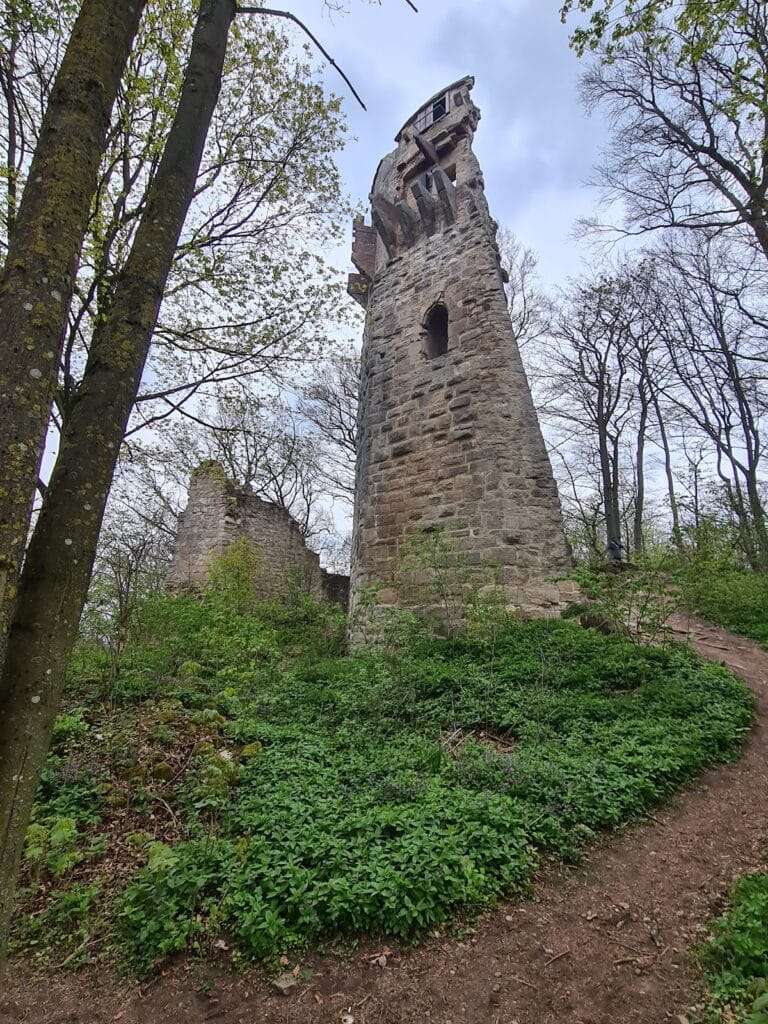
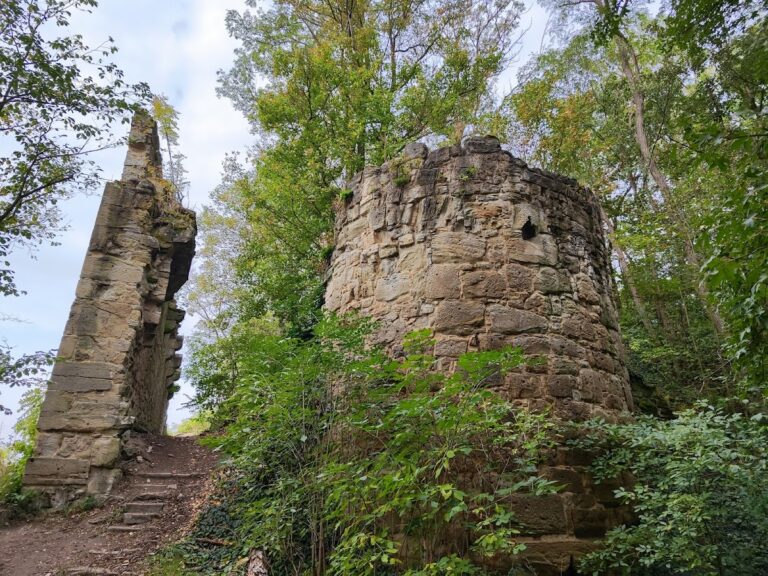
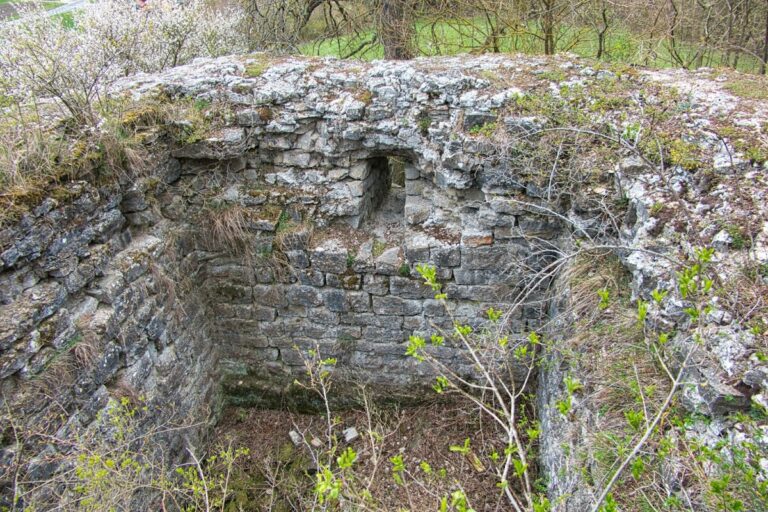
The approach to the main castle was secured by two round towers. Remnants of both towers survive, including a southern tower remnant and a northern tower remnant. The main castle also retains southeastern and southwestern wall remnants, slight sections of additional walling, castle ditches, and parts of castle cellars, which were underground storage spaces within the complex.
Observation Tower
1999 Tower
A 19-metre-high observation tower was erected beside the castle ruins in 1999. Its stated view extends to the Rhön and Thuringia, adding a modern structure to the surviving castle landscape without forming part of the medieval or early modern complex.