St. Maria de Rosario: A Pilgrimage Church in Dimbach, Germany
Site at a Glance
- Popularity
- Low
- Country
- Germany
- Primary era
- Medieval
- Eras represented
- Medieval, Early Modern, Modern
- Civilizations
- Holy Roman Empire, Kingdom of Bavaria
- Site type
- Religious
- Remains
- Church
On this page26 sections
History
St. Maria de Rosario, the Roman Catholic pilgrimage church dedicated to Mary of the Rosary, stands in Dimbach, now part of Volkach, Germany. The present church began to take shape in the second half of the 13th century and was enlarged in Gothic form before later Baroque remodelling. Dimbach never became an independent parish, and the church remains a branch of the parish of Reupelsdorf.
Early chapel and medieval church
Excavations have identified an earlier church beneath the present building. Dating to the 11th century, it began as a small chapel and was later given a choir tower. The community of Dimbach first appears in a written record in 1113, when its church depended on the church at Gerlachshausen.
Work on the present church at its current site began in the latter half of the 13th century. In 1306, Abbot Sifrid of Münsterschwarzach received bailiwick rights over Dimbach, meaning lay guardianship and jurisdiction. The abbey retained those rights until secularization in 1803. In 1325, Prince-Bishop Wolfram Wolfskeel von Grumbach, both a bishop and a territorial ruler, commissioned the Gothic enlargement of the Romanesque chapel dedicated to Mary. A priory, a smaller dependent monastic community, was established at Dimbach by Münsterschwarzach Abbey, a Benedictine monastery, in 1334. Its three monks served the community and provided a place where some abbots could retire; monks were also sent there as a disciplinary measure. The west tower and side aisles were consecrated that year.
War, decline, and renewal
The War of the Margraves in the mid-15th century destroyed Dimbach and left the priory deserted. The church then saw little use. The priory was dissolved in 1491, and Münsterschwarzach Abbey took over administration of the village. Dimbach and its church continued to decline until Abbot Johannes Burckhardt initiated a major renovation in 1593. The work was completed in 1611–12, and the tower spire was renewed in 1617. During this period, Prince-Bishop Julius Echter von Mespelbrunn made Dimbach a branch of Gerlachshausen once more.
Rosary devotion and Baroque remodelling
A lay religious association, or confraternity, dedicated to the Rosary was founded in 1630. The Rosary is a Catholic devotion involving repeated prayers and reflection on episodes associated with Mary and Jesus. The confraternity drew on traditions of an earlier pilgrimage and encouraged devotion at Dimbach. Disruption during the Thirty Years’ War weakened the group, which was almost entirely re-established in 1661. Münsterschwarzach Abbey sent a permanent curate, a priest assigned to pastoral care, to Dimbach in 1653. Pilgrimage activity began to rise from 1667 and continued into the 19th century, although its reach remained regional.
Several traditions offered different explanations for the pilgrimage’s beginnings. The Wolf Miracle tells of a woman who took the Christ Child from a statue of Mary. After a wolf seized her own child, she returned the figure to Mary, changing the arm on which the Christ Child rested; the wolf then returned her child. The story appears in the 13th-century writings of Caesarius of Heisterbach. In 1511, the Benedictine abbot and chronicler Johannes Trithemius dated the beginning of the pilgrimage to 1020. A separate account written by Father Leopold Wolgemuth in 1684 says that Bishop Andreas of Würzburg walked barefoot to Dimbach in 1312 or 1313 and thereby averted a threatened famine. The confraternity promoted Trithemius’s version. A pilgrimage is historically attested only from the early 18th century. It first drew people from nearby villages belonging to Münsterschwarzach Abbey, grew more substantially from the 1740s, and declined from the 1790s amid the Enlightenment, an 18th-century movement emphasizing reason and critical inquiry.
The church was remodelled in the Baroque style during the 18th century. Ornamented painting was added around the windows in 1747. In 1757, Abbot Dominikus Otto of Bamberg had a flat ceiling installed and the upper windows reduced. Most of the furnishings now in the church also date from this period. The remodelling was completed in 1767. A baptismal font consecrated in 1685 had supported efforts to make Dimbach an independent parish; the church’s appearance in a newly published Diocese of Würzburg directory was another sign of those ambitions. Dimbach nevertheless remained without parish independence.
From secularization to the present
Secularization in 1803 dissolved Münsterschwarzach Abbey and affected Dimbach’s curacy. The tower was repaired in 1817, and the following year Dimbach became a branch of Stadtschwarzach. A late-19th-century effort to establish a small chaplaincy or make the church a branch of Reupelsdorf did not succeed. Emergency repairs followed in the 1920s and 1930s.
In 1950, Dimbach was detached from Stadtschwarzach and assigned to Reupelsdorf. After Münsterschwarzach Abbey was re-established, Dimbach returned to its former parish in 1962 and received pastoral care from the abbey. It became a branch of Reupelsdorf again in 1972. A comprehensive renovation of the church took place from 1972 to 1980.
Remains
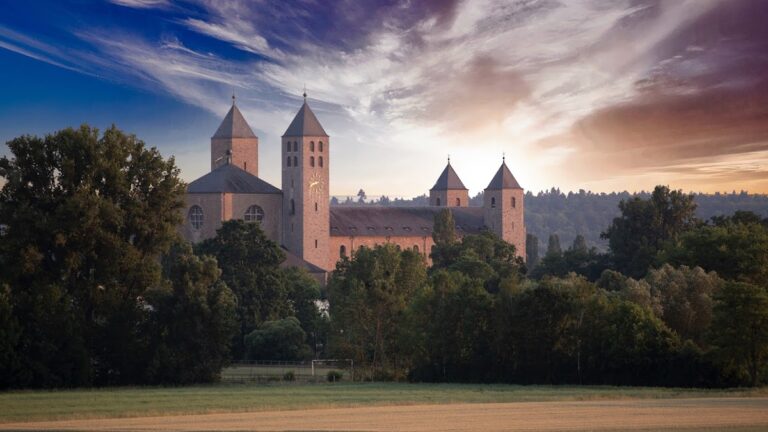
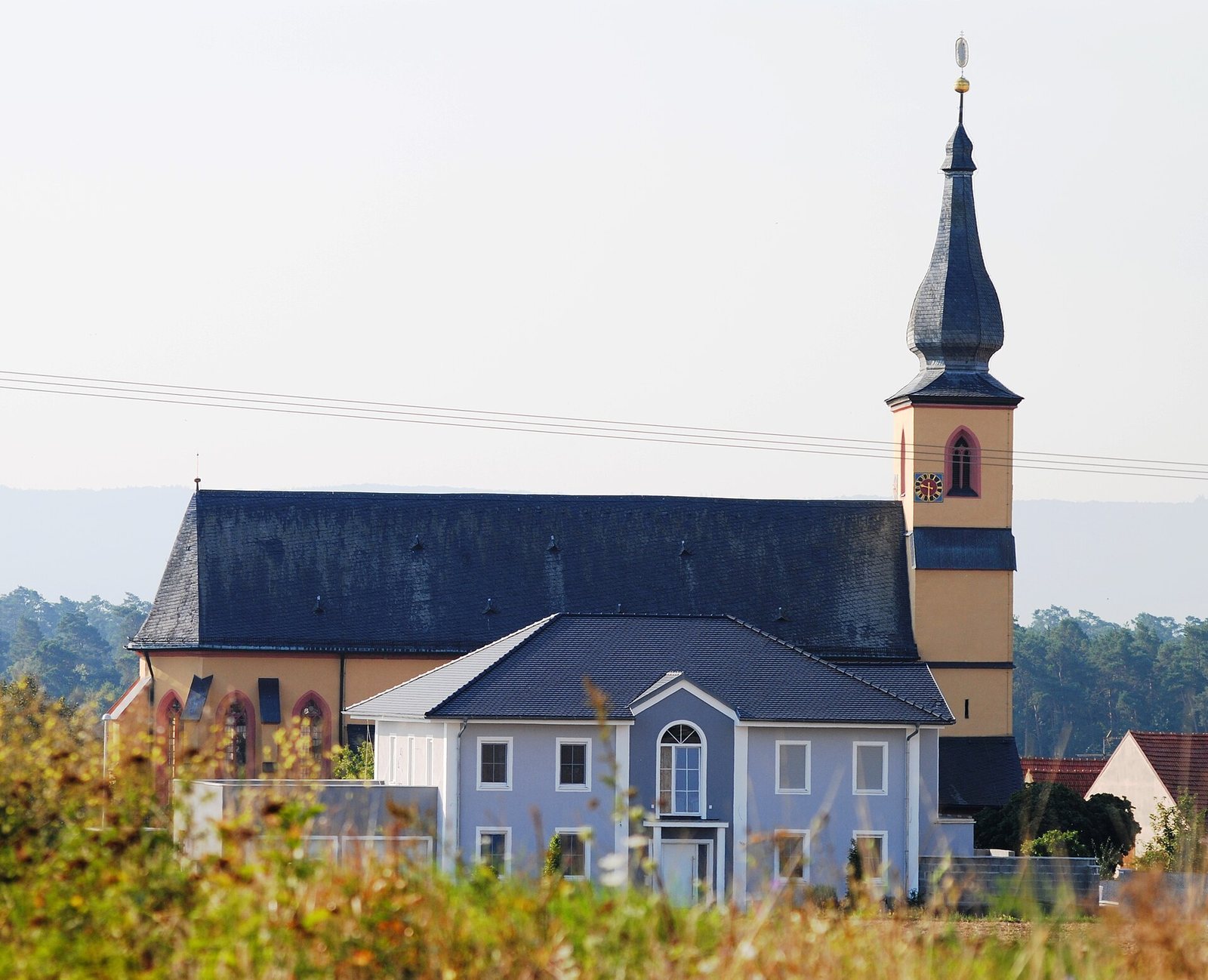
The church faces east and has a four-bay, three-aisled basilica plan, with a higher central nave and lower side aisles. A tower stands at the west end. The long roof begins with a gable at the west and slopes down over the choir to a hipped end. Gothic forms remain prominent in the tower and choir, while the interior also preserves later Baroque and Rococo work.
Medieval structure
Choir
The choir, the newest part of the medieval church, dates to the beginning of the 14th century. It has two bays and ends to the east in a polygonal form shaped from five sides of an octagon. Square extensions beside its first bay contain a chapel and sacristy. Six simple buttresses divide the exterior. Four tall, narrow pointed windows have stone tracery, the ornamental framework within a window opening, arranged in three- and four-lobed patterns. The larger east window has an asymmetrical design. Inside, a rib vault, a vaulted ceiling supported by ribs, spans the choir. Deep buttresses project into the space, and the bosses where the ribs meet are carved with foliage, a dove, and a rose in sequence from east to west. The sacristy entrance has a pointed stone surround.
West tower
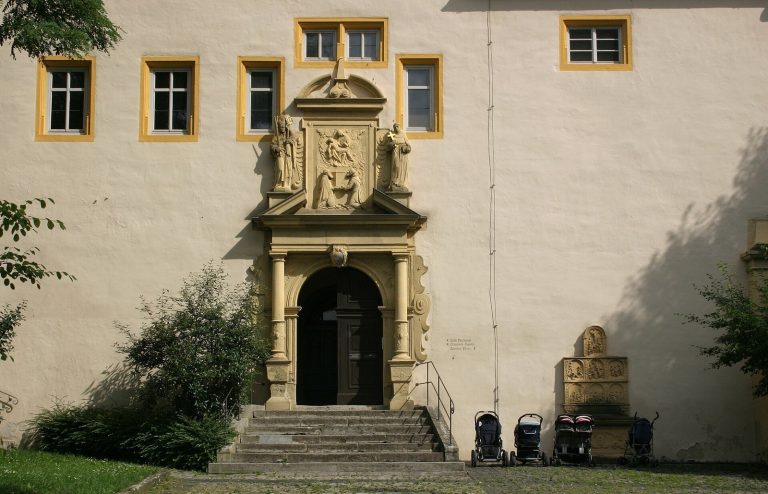
Construction of the west tower began around 1300 and was completed in 1334. Four storeys high, it is set crosswise in front of the central nave. Two rooms occupy each of its first three storeys. The northern room, long used as a mortuary chamber, was accessible only from the cemetery. Lean-to roofs cover the rooms externally. The principal entrance is a moulded Gothic portal at the centre of the lowest storey, with a plain circular window above.
A second circular window, in the next-to-top storey, has three-lobed stone tracery. Above it, the bell chamber has four arched windows with curving, fish-bladder-shaped tracery. Clock faces appear on the north, south, and west sides. The pear-shaped spire carries a finial and a figure of Mary surrounded by rays, which serves as a weather vane. Inside, a pointed arch connects the tower hall to the nave. The hall’s rib vault has pear-shaped mouldings. Carved figures serve as supports on the west wall: to the south, a man in a cap; to the north, a hooded figure with crossed legs, a purse at the belt, and a sword in the right hand. The second figure appears to support the vault ribs with its left hand.
Nave and earlier building fabric
The present nave developed from the predecessor building in the mid-13th century, and remains of earlier buildings lie beneath the church. Moulded pointed windows mark the exterior of the side aisles, each of which also has a portal with a plain surround. An inscription on the southern portal records a renovation in 1767. The upper windows above the side aisles, originally pointed, are now rectangular. Inside, octagonal piers with moulded bases separate the central nave from the side aisles, and their capitals support pointed arches. The side aisles have round-arched cross-arches. Braced rafter trusses form the roof framework.
Choir furnishings
High altar
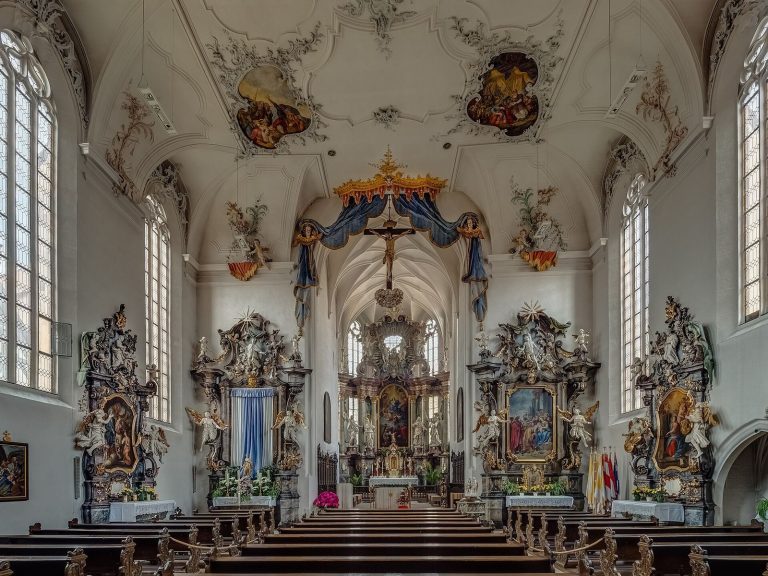
The late-Baroque high altar, completed in 1719, fills the choir. Four slightly tapering round columns with simply ornamented capitals frame life-size figures of Saint Felicitas on the left and Saint Benedict on the right. The heavy cornice bears the arms of Abbot Januarius Schwab, during whose tenure the altar was made. Above it, a group representing the Holy Trinity appears in a radiant halo among decorative childlike figures. A canopy decorated with bellflower motifs and supported by scroll-shaped ornaments frames the group. Two angels bearing symbols of Justice stand above, with a cross at the top.
Madonna of Grace
The altar’s central figure, the Madonna of Grace, has occupied its place since 1724, replacing an altarpiece. Since 1767, a glass shrine framed by shellwork and decorated with childlike figures has enclosed it; two angels crown the shrine. Marble-patterned panels at the sides conceal the bases of the inner columns. The tabernacle in front is framed by twisted columns and topped by a golden eagle.
The wooden figure is 119 centimetres tall. An inscription on its pedestal assigns it to 1398. Mary wears a red dress under a white mantle edged in brown and decorated with red carnations. Her blond hair falls beneath a circlet crown, and she looks to her left. The naked, blond, curly-haired Christ Child sits on her right arm; her left hand, probably once holding an apple, is empty. Paint on the reverse suggests the figure may originally have been used in religious processions. A second paint layer, added in the 15th century, remains visible beneath later repainting. The faces and hair eventually received a fifth layer. In 1611, the Christ Child was moved from Mary’s right knee to her right arm as part of the practice of dressing the figure, which continued until 1974. The image was restored in 1975–76. Its associated clothing and jewellery include a gold crown made by Johann Friedrich Bräuer of Augsburg in 1719, a crown for the Christ Child dated by inscription to 1736, and a sceptre added in 1745.
Other altars
Choir-side altars
Two altars stand beside the choir and rise above the arch into it. Both were made with gifts from Ignatius Brendan, a theology professor from Münsterschwarzach. Their related designs use scroll-shaped ornaments instead of columns and have a relief between two vases and a cross in place of a separate upper altarpiece.
Michael Altar
The right-hand choir-side altar, made in 1733, is dedicated to Saint Michael. Its main image shows the Fall of the Damned, with the Eye of Providence above the Archangel Michael. Two angels sit on the scroll-shaped ornaments of the altar frame. A later Rococo altar frontal shows a guardian angel guiding the lost, while the upper section depicts the Coronation of Mary.
Saint Anne Altar
The left-hand choir-side altar was installed in 1749. Its main painting shows Saint Anne teaching Mary and is darker in tone than the image on the opposite altar; two male figures flank the scene. Above it, the Adoration of the Child gathers worshippers around the Madonna in a radiant halo, while decorative figures hold cornucopias. The richly stuccoed altar frontal probably depicts the Visitation.
Side-aisle altars
The two side-aisle altars were probably made in 1694 for the abbey church at Münsterschwarzach, on the commission of Abbot Augustin Voit. They were moved to Dimbach in 1744 after Baroque rebuilding of the abbey church made them surplus. Their frames have no columns or scroll ornaments. Instead, profiled surrounds with projecting edges enclose round paintings, accompanied by fruit garlands and decorative childlike figures. Voit’s arms, crossed croziers, and a flaming heart appear on the upper frame. The left painting shows Joseph with the Christ Child; the right depicts the Immaculate Conception and was probably painted by Oswald Onghers.
Sculpture and devotional furnishings
Pulpit
The pulpit was brought to the church in 1714 with support from Abbot Bernhard Reyder, who donated timber and money. It stands in the central nave beside the first buttress on the left. Stairs wind around its eight-sided pillar. Relief medallions show early Christian theologians, followed by the Evangelists around the pulpit body, which ends in a cornice. A crucifix is attached to the railing. On the pillar, a marble-patterned panel is decorated with gilded drapery and a relief of a saint holding a chalice. Drapery also borders the sounding board, above which curved tendrils support a figure of Mary.
Crucifixion relief
The sandstone Crucifixion relief is the church’s earliest furnishing, dating to the 11th century, probably around 1070. Measuring 76 by 83 centimetres, it is regarded as one of the oldest stone sculptures from Franconia. Its origin is uncertain, though it was probably made at Münsterschwarzach Abbey and may first have been kept in the Romanesque Egbert Church there. Since Dimbach’s church did not yet exist, the relief was brought here in the 18th or 19th century. It was once mounted outside on the north nave wall, then moved inside during the 20th century, first to the south wall and later to its present place beneath the west organ gallery. It was renovated in 1964 and restored again during the church’s renovation in the 1970s.
A stylised palmette border surrounds the relief’s Crucifixion scene. Above it, three bust portraits occupy medallions in a horizontal panel. The cross has broad arms, an inscription tablet above, a footrest below, and a large disk-shaped halo. Mary and John stand beneath the crossbeam, while medallions of Sol and Luna, Roman personifications of the sun and moon, appear above it. Christ’s head inclines toward his right shoulder, but his body faces forward; his parallel legs and hands lie flat along the crossbeam. A belt holds the loincloth. Traces of the original paint survive: the outer garments of the figures beside the cross were vermilion, and John’s undergarment was oxide green.
Figures and devotional images
Figures attached to the central nave’s pillars include a 16th-century Man of Sorrows, an image of Christ emphasizing his suffering, and a large group of Joseph with the Christ Child dated to 1733. A separate figure known as the May Madonna dates to the 16th century, probably the 1520s. Originally placed on an altar, it was at one time more venerated than the Madonna of Grace. In 1776 it was moved to the northernmost pillar, and it now has a modern finish. During May devotions it was placed on the communion rail.
At the west end, a painting of Christ and the Samaritan Woman at the Well was donated in 1663 by Johannes Valentin Gottfried Haimb; a cartouche records the gift. Opposite it is a carrying pole with a Baroque Rosary Madonna, formerly carried in processions by the Rosary confraternity.
Ceiling, organ, and other fittings
Ceiling and side-aisle fittings
The ceiling has painted and stuccoed decoration. Almost-white Rococo stucco surrounds three painted, radiating halos bearing the monograms of Mary, Jesus, and Benedict. A painted coat of arms of Abbot Dominikus Otto appears above the arch into the choir. Two confessionals in the side aisles date to 1736 and were made in the Münsterschwarzach abbey carpentry workshop; Corinthian pilasters decorate them. Simple 18th-century paintings of the Stations of the Cross line the side aisles.
Organ and gallery
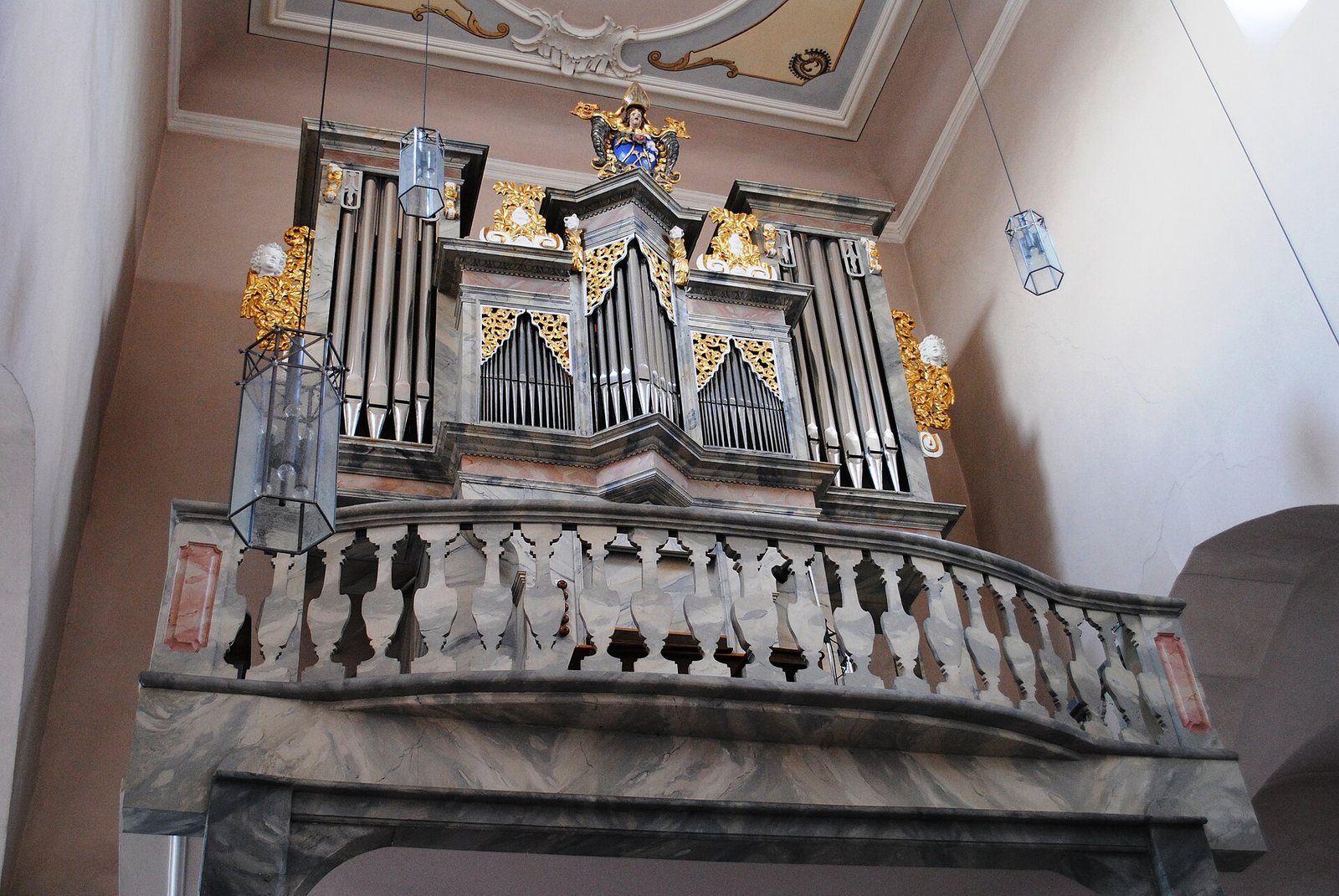
The organ stands on a gallery built for it at the west end. Mathias Tretzscher of Kulmbach made a small positive organ in 1665. Johann Adam Brandenstein built a new instrument in 1693, donated by the Schwarzach convent. The central part of its case survives and is crowned with Abbot Augustin Voit’s arms. The bellows were renewed and a two-foot Forest Flute stop added in 1737. In 1859, Balthasar Schlimbach enlarged the organ with side towers, giving it one keyboard, a pedalboard, and nine stops, controls selecting different sets of pipes.
Organbau Hoffmann reconstructed the instrument in 1980 and added a second keyboard. It now has 16 stops, including six from the main section that survive wholly or in part from the older organ. The gallery has a balustrade with board-shaped supports and two columns beneath it. Its surface was stripped and given a marble pattern in 1980.
Bells
The church has three bronze bells, all cast by the Otto firm of Bremen during the 1950s. They replaced earlier bells that were probably melted down during the Second World War.