Sternberg Palace: A Baroque Palace and Art Museum in Prague


Site at a Glance
- Rating
- 4.5
- Popularity
- Low
- Country
- Czechia
- Primary era
- Early Modern
- External website
- Open
- Eras represented
- Early Modern, Modern
- Civilizations
- Habsburg, Holy Roman Empire, Kingdom of Bohemia
- Site type
- Domestic
- Remains
- Elite Residence
On this page10 sections
History
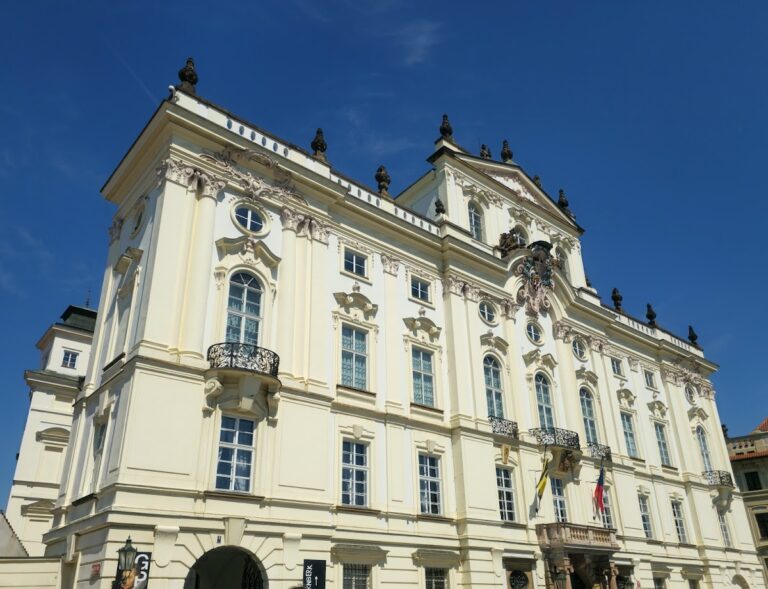
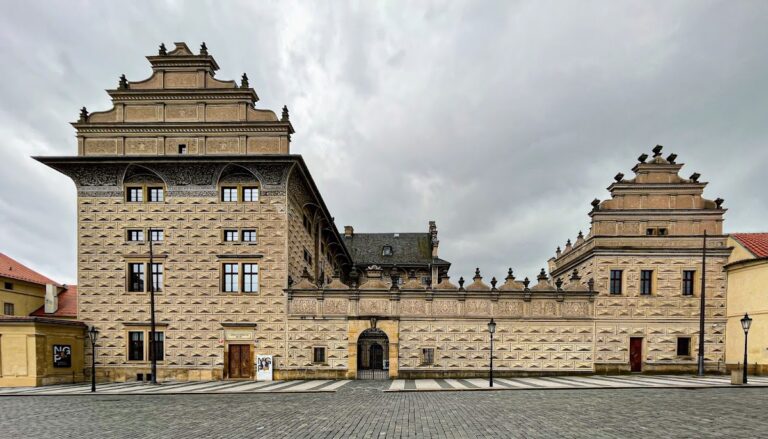
Sternberg Palace is a Baroque palace in Prague, Czechia, built between 1698 and approximately 1707–1708 for Václav Vojtěch of Šternberk. It now houses an art museum of the National Gallery Prague. The palace replaced two Gothic houses dating from the middle of the fourteenth century and became an important residence, cultural institution, and later national art museum.
Construction and design
Construction began in 1698 on the site of the earlier houses. The architect has not been established, although Giovanni Battista Alliprandi is the most probable attribution. Domenico Martinelli, Jan Blažej Santini-Aichel, Christoph Dientzenhofer, and Johann Bernhard Fischer von Erlach have also been proposed. The building combined Renaissance and Baroque forms, while its main facade was divided into two sections that reflected the separation of the earlier properties.
The original plans were not fully completed. The southern wing remained unfinished until Jan Novotný completed it between 1835 and 1842 in the more restrained style of late Classicism. This later work contributed to the mixture of periods visible in the palace today.
An aristocratic art and scholarly institution
In the early nineteenth century, the palace was acquired by the Society of Patriotic Friends of Art, an aristocratic Czech association that collected, exhibited, and administered works of art before the modern National Gallery Prague. The association had been evicted from nearby Czernin Palace after the Austrian government requisitioned that building for use as a military hospital. At Sternberg Palace, the society operated an art gallery.
Part of the palace housed the collections of the Bohemian National Museum from 1821 to 1847. The building also provided workplaces for Czech scholars and artists, including Pavel Josef Šafařík, Carl Borivoj Presl, Václav Hanka, and Antonín Mánes.
Charitable and military uses
Heliodor F. Heidl acquired the palace from the Society of Patriotic Friends of Art in 1871. The following year, he transferred it to the Saint Anna Association of Ladies and Girls. The association established the Ernestinum there, a shelter for people with mental disabilities, and remained connected with the palace until it left Prague in 1918.
From 1918 to 1947, military and related state forces used the building. It housed a military school and the Government Army of the Protectorate, the military force of the German-occupied Protectorate of Bohemia and Moravia during the Second World War. After 1945, the Castle Guard, responsible for guarding Prague Castle and associated state premises, occupied the palace.
National Gallery Prague
The palace was renovated in 1946 and 1947. In 1947, it became the property and seat of the National Gallery Prague. The institution retained ownership after the post-1989 restitution of church property because National Gallery properties were excluded from the returns. Sternberg Palace was designated a cultural monument in 1964 and received national cultural-monument status in 2026.
Its permanent exhibition presents European painting from antiquity to the Baroque. The holdings include Italian, Renaissance, Baroque, Dutch, Flemish, German, Austrian, French, and Spanish works.
Remains
Palace and courtyard
Sternberg Palace is a two-storey building with four wings arranged around a central courtyard. Its main facade is divided into two sections, preserving the visual memory of the two Gothic houses that occupied the site before construction began. The exterior reflects a combination of Renaissance and Baroque design, while the completed southern wing adds the later, more restrained character of late Classicism.
Very little of the original Baroque interior survives. The present interior brings together elements from several periods. Among the surviving decorative features is stucco, a fine plaster used for modeled architectural ornament, executed by Donato Giuseppe Frisoni.
Garden above the Deer Moat
A large garden extends outside the west wing on ground elevated above the Deer Moat, a sunken landscape corridor forming part of the grounds below Prague Castle. The garden contains a pond and sculptures, including a large stork by Jan Lauda and a bronze lion crushing a boa constrictor by Antoine-Louis Bary.
The garden’s original Baroque appearance is unknown. Its modern form was created when the palace was transferred to the National Gallery in 1947 and was reportedly maintained during the institution’s early ownership under Anna Masaryková, a Czech art historian.
European painting collection
The permanent exhibition includes Italian paintings from the fourteenth and fifteenth centuries, together with Renaissance and Baroque works by artists such as Alessandro Allori, Jacopo Bassano, and Luca Giordano. Dutch and Flemish paintings dating from the fifteenth to the eighteenth century include works by Pieter II Brueghel, Peter Paul Rubens, Anthony van Dyck, Rachel Ruysch, Gerard Ter Borch, Nicolaes Eliasz Pickenoy, and Hans Raphon.
The collection also includes German works by artists such as Hans Baldung Grien, as well as German and Austrian paintings by Georg Flegel, Paul Troger, Johann Karl Loth, and Johann Michael Rottmayr. A smaller French and Spanish group contains works by Pierre Mignard and Bartolomé Esteban Murillo.
The 1991 Picasso theft
In early 1991, four paintings by Pablo Picasso were stolen from the palace. Three men scaled a wall from the street to the raised garden, entered through an unguarded door after breaking its glass, and took Mandolin and Glass of Pernod from 1911, Port of Cadaqués from 1910, Absinthe and Cards from 1912, and Still Life with a Goblet from 1922. Police recovered three paintings from an apartment and the fourth from a railway-station locker. All four were returned to the palace.
Nearby sites