Schwarzenberg Palace: A Renaissance Palace and Art Museum in Prague


Site at a Glance
- Rating
- 4.6
- Popularity
- Low
- Country
- Czechia
- Primary era
- Early Modern
- External website
- Open
- Eras represented
- Early Modern, Modern
- Civilizations
- Habsburg, Holy Roman Empire, Kingdom of Bohemia
- Site type
- Domestic
- Remains
- Elite Residence
On this page11 sections
History
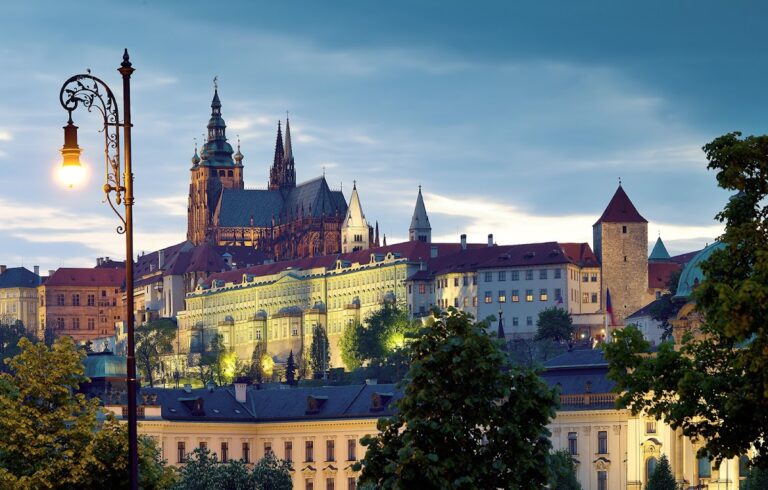
Schwarzenberg Palace is a Renaissance palace in Czechia, located on Hradčany Square in Prague opposite the gate of Prague Castle. Built for the Bohemian noble Lobkowitz family between 1545 and 1567, it was designed as a city residence after the great Prague Castle fire of 1541. The architect was Agostino Galli, also known as Augustin Vlach, an architect associated with introducing Italian Renaissance forms into Bohemia. Jan Lobkovitz, later burgrave of Prague, commissioned the project. A burgrave was a high-ranking governor or military-administrative official responsible for a major castle or its district.
Lobkowitz and Rosenberg ownership
Three houses originally stood on the site. The Lobkowitz family acquired two after the 1541 fire, while the third came into their possession after the palace had already been built. This sequence delayed completion of the west wing. The palace later became entangled in the political fortunes of Georg Popel von Lobkowicz. After he fell out of favor with Emperor Rudolf II, the Habsburg ruler whose court was based in Prague, he was imprisoned and his property was confiscated. In 1600, the palace passed to Peter Wok von Rosenberg, and it subsequently belonged to the Schwanberg and Eggenberg families.
When Marie-Ernestine von Eggenberg, a member by birth of the Schwarzenberg family, died without children, the palace and her extensive inheritance passed in 1719 to her nephew Adam Franz Karl, Prince of Schwarzenberg and Duke of Krumlov. The inheritance created the largest lordship in southern Bohemia and established the palace within the Schwarzenberg family’s extensive possessions.
Schwarzenberg residence and nineteenth-century repair
In 1811, the Schwarzenbergs purchased the neighboring building now called Salm Palace from the heirs of Prague Archbishop Wilhelm Florentin von Salm-Salm. With the imperial court based in Vienna, the family increasingly withdrew from its Prague residences. By the beginning of the twentieth century, Schwarzenberg Palace served as a military stable.
In 1870, the principal gable of the west wing collapsed. Between 1871 and 1892, the architect Josef Schulz repaired the façades and gables, replacing the earlier sgraffito designs with more modern versions. Sgraffito is a wall-decoration technique in which contrasting layers of plaster or coating are cut to reveal an underlying layer and create patterns or images.
Museum, occupation, and postwar reconstruction
From 1908, the Schwarzenbergs made the palace available without charge to the Technical Museum of Bohemia, later renamed the Czechoslovak National Museum in 1918. Its exhibitions opened there on 28 September 1910. During the 1930s, Adolph Schwarzenberg also provided part of the building to the Swiss diplomatic mission. The Swiss embassy used the ground floor for administration, while the Swiss ambassador later occupied Adolph Schwarzenberg’s former private apartment as a residence after the family had been expelled following the Second World War.
After the Nazi confiscation of Schwarzenberg property, the palace was selected for an army museum intended to celebrate the achievements of the Wehrmacht. During the occupation in 1941, the technical-museum exhibitions were moved to Invalidovna, Prague’s historic institution for invalids, and the palace became a fortified headquarters of the General Staff. It suffered severe damage during the Prague Uprising in 1945. After the war, the building was reconstructed and adapted for the Prague Military History Museum. Its first exhibition opened on 1 June 1947, and the complex continued as a military-history museum after the Communist takeover.
National Gallery Prague
The military-history exhibitions closed in 2000 so that reconstruction could proceed. The exhibitions were transferred to the Army Museum in Žižkov, while the palace passed to the National Gallery Prague in 2002. Reconstruction was completed in 2007, and the gallery opened its first permanent exhibition in the palace in 2008, devoted to Baroque art in Bohemia.
Schwarzenberg Palace functions today as an art museum of the National Gallery Prague. Its principal exhibition period extends from the sixteenth to the eighteenth centuries, with works from the Old Art Collection by artists including Hans von Aachen, Peter Brandl, Matthias Bernard Braun, Lucas Cranach, Adriaen de Vries, Albrecht Dürer, El Greco, Francisco José Goya, Hans Holbein, Rembrandt, José de Ribera, Bartholomäus Spranger, Karel Škréta, Simon Vouet, and Michael Leopold Willmann. The palace is protected as a cultural monument of the Czech Republic and is identified as a national cultural monument from 2026.
Remains
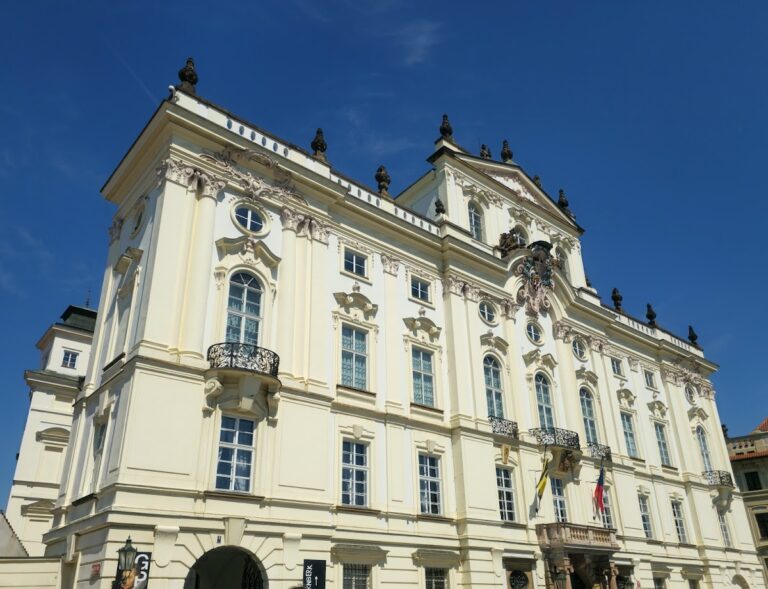
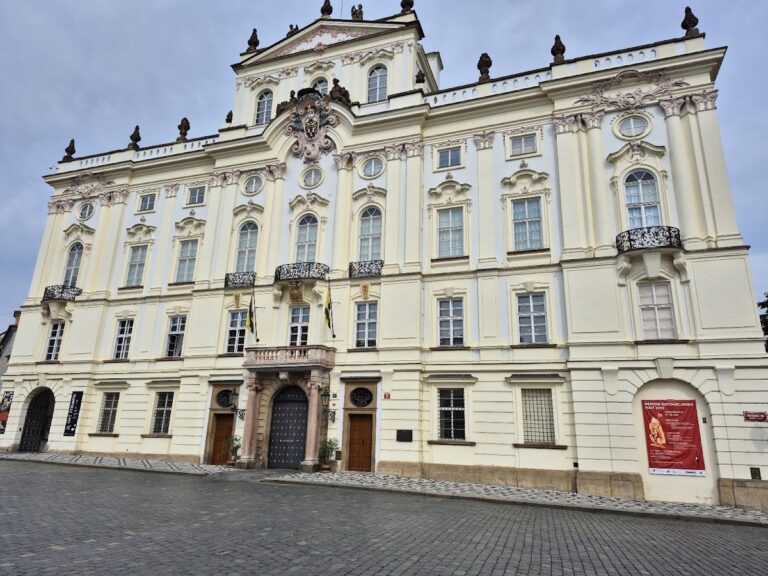
Schwarzenberg Palace is a three-winged Renaissance building with the appearance of an Italian urban palace. Its exterior combines a fortress-like character with a broad projecting eaves zone, a shallow-pitched roof, and a deep cornice at the junction of the roof and wall. The palace stands on Hradčany Square beside Salm Palace and Sternberg Palace, both also associated with the National Gallery Prague.
Exterior decoration
Sgraffito façades
The façades are covered with black sgraffito arranged to imitate regular masonry made from precisely cut diamond-shaped blocks. This diamond-quader pattern is characteristic of Bohemian Renaissance decoration, while the sgraffito treatment is Italian in style and dates to 1567. The decoration was restored several times during the twentieth century, notably in 1929, 1955, and 1957, using the original designs. Restoration teams led by Jaroslav Kabeš and A. Tintěra treated approximately 7,000 square meters of surface.
Stepped gables
The high stepped gables are richly ornamented with figural decoration and are also covered with sgraffito. Their treatment forms part of the palace’s Renaissance exterior, while the deep cornice gives a strong horizontal division between the roof and the walls.
Painted interiors
Second-floor halls
Four halls on the second floor retain painted panel ceilings dating from around 1580. Their figural Renaissance scenes draw on classical and historical subjects, including Phaethon, Jupiter and Juno, the Judgment of Paris, the Rape of the Sabine Women, the conquest of Troy, Aeneas carrying Anchises from burning Troy, and Chronos carrying Proserpina away from the underworld. Together, the ceilings preserve an important part of the palace’s original decorative program.
Nearby sites