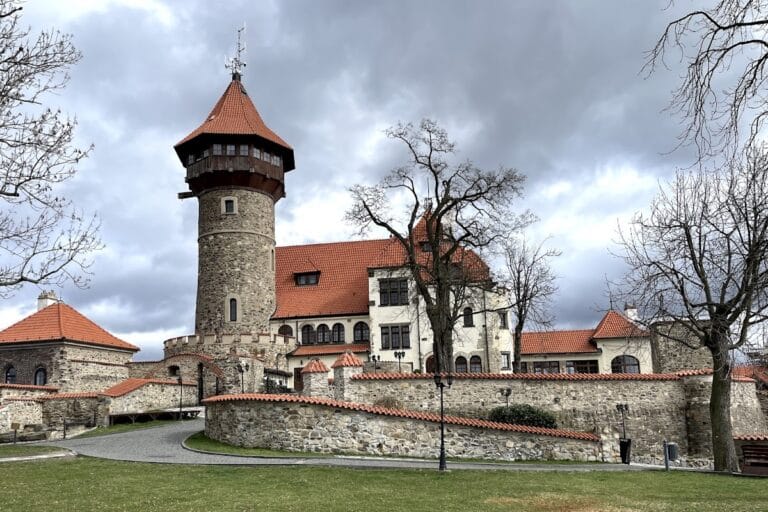
Starý Žeberk: A Medieval Hilltop Castle in Czechia


Site at a Glance
- Rating
- 4.7
- Popularity
- Very Low
- Country
- Czechia
- Primary era
- Medieval
- Eras represented
- Medieval
- Civilizations
- Holy Roman Empire, Kingdom of Bohemia
- Site type
- Military
- Remains
- Castle
On this page6 sections
History
Starý Žeberk is a ruined hilltop castle in Czechia, near Horní Jiřetín, probably built during the first half of the thirteenth century as a medieval defensive residence. The Lords of Rvenice may have founded it, and its name probably referred to its position above Kommerner Lake. The castle occupied an elevated site where steep slopes helped protect the complex.
The Lords of Seeberg
The burgraves of Leisnig later acquired the estate. A burgrave was an official responsible for administering and often defending a castle or its surrounding territory. One branch of the family adopted the name von Seeberg, and the castle was first mentioned in 1277 as the property of Albrecht von Seeberg, who was also regarded as its builder.
Albrecht held several important positions. He served as burgrave of the royal castle at Kadaň in 1272 and 1292 and was also lord of Kadaň, Tachov, and Bílina. When he died in 1321, the male line of the Lords of Seeberg ended. The lordship then passed to the Ottonian branch of the Lords of Lobdeburg-Bergow. In 1327, Otto II von Bergow of Bílina, who was married to Albrecht’s granddaughter Margarethe von Seeberg, was recorded as lord of Seeberg. The Lords of Seeberg also held Egerberg Castle for a period.
Replacement and abandonment
The old castle was difficult to reach and probably had limited access to water. During the second quarter of the fourteenth century, the Lords of Bergow therefore built a larger castle about three kilometres to the northwest, on a more favourable site. They called the new stronghold Neu Seeberg, or New Seeberg, while the earlier castle became known as Alt Seeberg, or Old Seeberg.
Otto III von Bergow was recorded as lord of the estate and patron of the churches in Göttersdorf and Bernau between 1374 and 1379. A church patron held the institutional right to support or influence the appointment of clergy and the administration of a church. Starý Žeberk was probably abandoned during this period. When Otto III sold the lordship of Seeberg to Thimo VIII von Colditz in 1383 and withdrew to Bílina Castle, the transaction referred only to the mountain called Alt Seeberg.
Remains
Setting and defenses
The ruins occupy a triangular hilltop plan on the southern slope of the Ore Mountains in northern Bohemia, at about 683 metres above sea level. They lie southwest of the summit rocks of wooded Jezeří mountain, whose summit rises to approximately 707 metres, within the Jezerka National Nature Reserve. Steep rocky slopes protected the castle on three sides, while the approach came from the north across the saddle between Jezeří mountain and Jánský vrch.
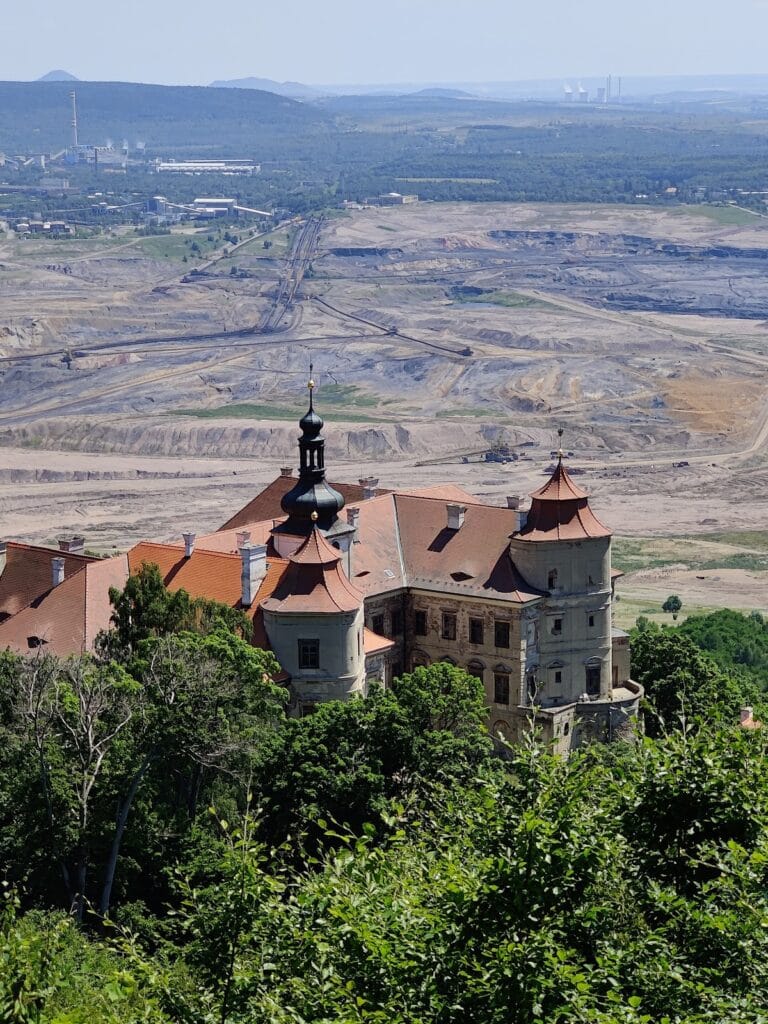
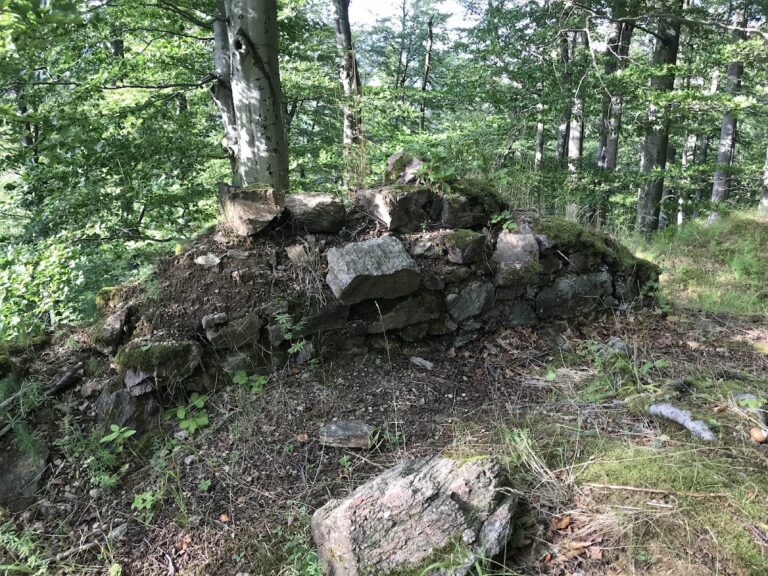
Beech forest covers the surviving earthworks and ditches. Parts of the first castle courtyard remain, including limited sections of the outer wall. The Vesnický potok valley and the Jezeří reservoir lie to the west. Jezeří Castle is about 1.5 kilometres to the northeast, while the North Bohemian Basin and the Lom ČSA brown-coal open-cast mine extend to the east, across the site of the former See Meadow.
Inner castle and courtyard
The inner castle, the central and generally most defensible part of the complex, occupied the two summit rocks. It included either a residential building or a castle tower. The courtyard lay within the wider triangular enclosure, whose earthworks, ditches, and surviving outer-wall sections preserve the basic defensive organization of the site.
Nearby sites