Hutsburg: A Medieval Hill Castle in Germany


Site at a Glance
- Rating
- 4.4
- Popularity
- Very Low
- Country
- Germany
- Primary era
- Medieval
- Eras represented
- Medieval
- Civilizations
- Holy Roman Empire
- Site type
- Military
- Remains
- Castle
On this page7 sections
History
Hutsburg is a high-medieval hill castle in Germany near Helmershausen, built on the Hutsberg as a seat of local nobility. The site is dated to around 1050, while its oldest surviving parts probably belong to the late twelfth century. An oral tradition places an earlier fortification on the Hutsberg in the fourth century.
Early castle and destruction in the thirteenth century
Hutsburg was first mentioned in 1273, by which time it had declined into a base for robber knights. Around 1275, Count Berthold of Henneberg-Schleusingen captured and destroyed the castle with support from the cities of Erfurt, Nuremberg, and Würzburg. The campaign followed an order from Rudolf I of Germany to keep the region’s roads clear. Rudolf was the medieval German king whose policy provided the political setting for action against the castle.
Henneberg stronghold
The Counts of Henneberg, a medieval German noble dynasty, rebuilt Hutsburg in 1383. It then served as an important strategic stronghold on the southwestern edge of their territory. The counts appointed their own castle officials to administer it, although the castle was later pledged several times.
Destruction and later obscurity
Insurgent peasants destroyed Hutsburg on 13 May 1525 during the German Peasants’ War, a large uprising of peasants and townspeople across the German lands in 1524 and 1525. Its position near the former border between East and West Germany later left the castle inaccessible for decades, and Hutsburg fell into obscurity.
Remains
The ruins occupy the summit of the 639.3-metre Hutsberg, a prominent basalt cone above the right bank of the Herpf near Helmershausen. The hill is one of the southeasternmost basalt elevations of the Vorder Rhön, the western part of the Rhön uplands. Its nearly equal twin, the 638.8-metre Neuberg, stands 1.8 kilometres to the south at the Rhine-Weser watershed, the drainage divide between streams flowing toward the Rhine and those flowing toward the Weser. A saddle about 558 metres high lies between the two elevations.
Castle enclosure
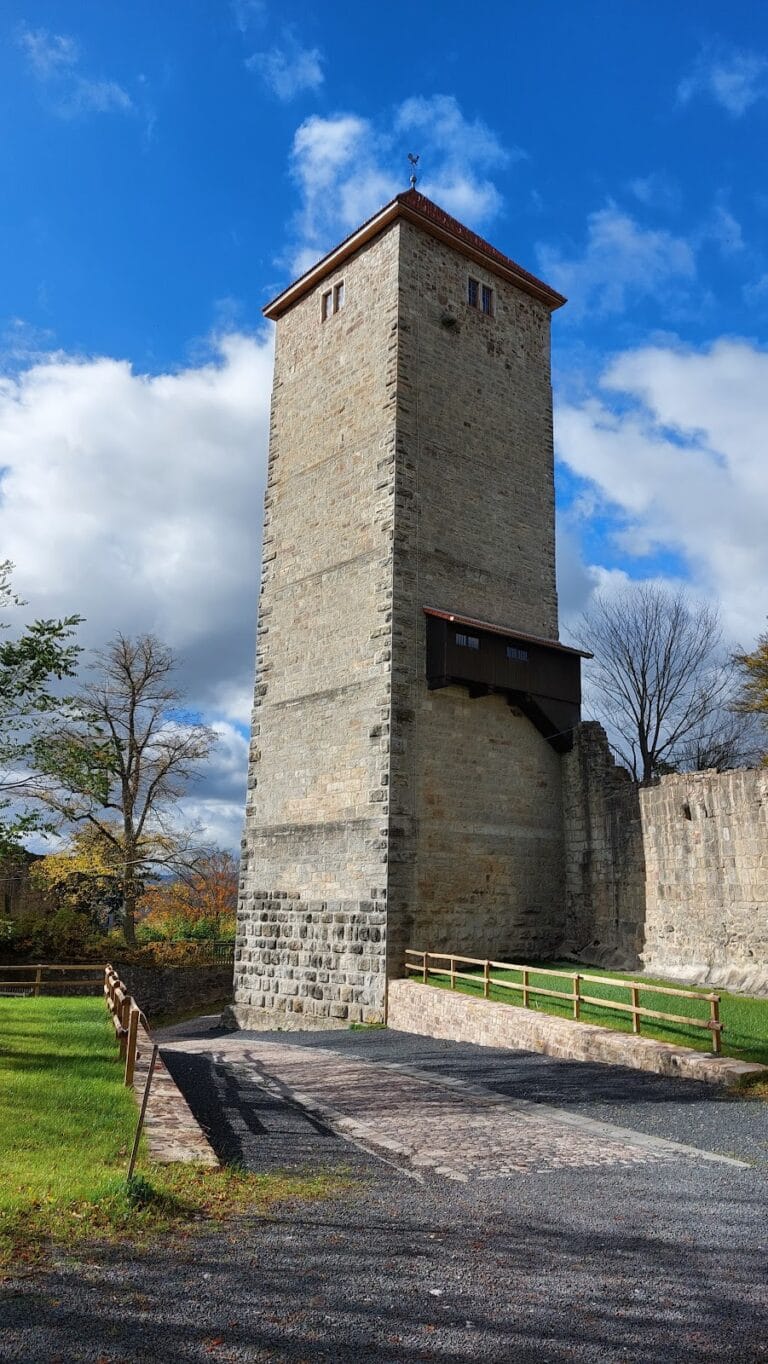
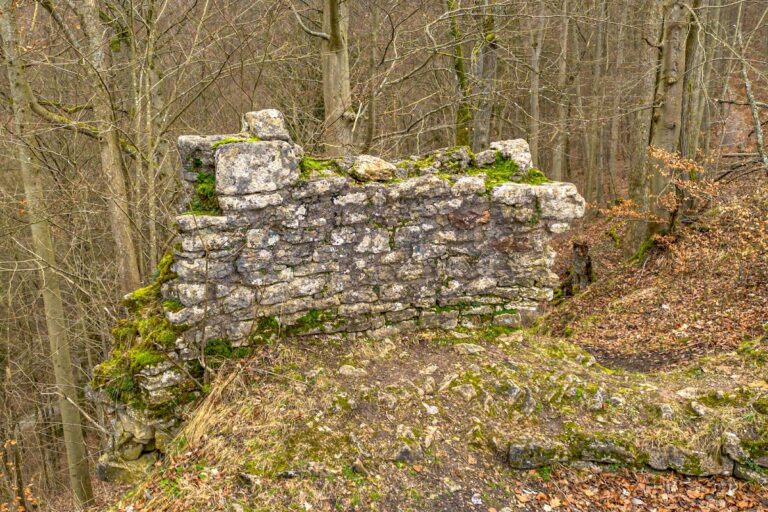
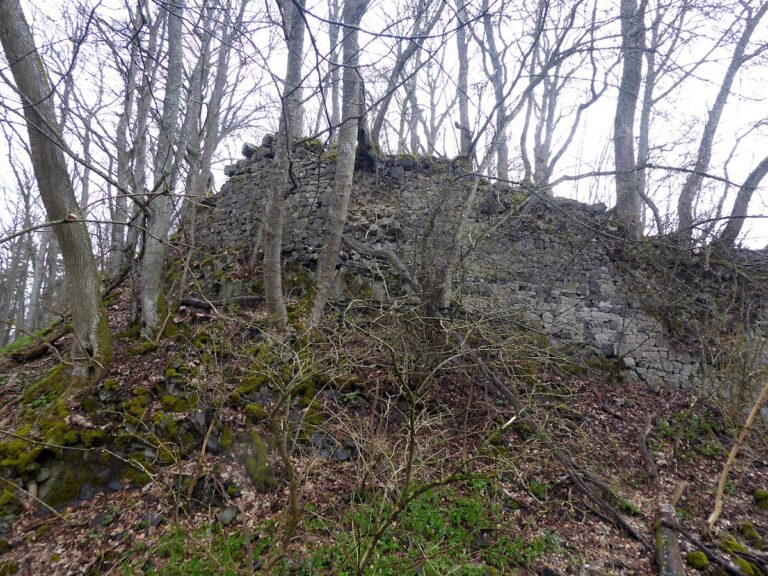
Hutsburg was a hilltop fortification built of rubble stone. Its enclosing curtain wall, the defensive wall surrounding a castle, was approximately 10 metres high and 1.7 metres thick. An outer rampart and ditch strengthened the enclosure. The plan included a northern corner tower and four shell towers, whose rear sides were open toward the interior. Considerable sections of the ring wall survive, together with the castle gate, an upper hinge stone for a gate leaf, a tower corner in the courtyard, and the ditch between two castle walls.
Residential and courtyard remains
The large rectangular palas, the principal residential and representative building of a medieval castle, dates from the fourteenth century. A projecting garderobe, or medieval latrine built into or extending from a wall, remains on the western side. The courtyard is overgrown, while the surviving complex is generally formed by wall and ditch remains.