Gräfgenstein Castle: Medieval Hilltop Castle and Noble Residence


Site at a Glance
- Rating
- 3.8
- Popularity
- Very Low
- Country
- Germany
- Primary era
- Medieval
- Eras represented
- Medieval
- Civilizations
- Holy Roman Empire
- Site type
- Military
- Remains
- Castle
On this page8 sections
History
Gräfgenstein Castle is a partially preserved medieval hilltop castle in Ratingen, Germany, whose establishment is generally placed in the thirteenth century. Built above the Anger valley, it served as a former noble residence and probably functioned as both a ministerial residence and military strongpoint of the Counts of Berg.
Medieval origins and the Eggerscheidt family
The castle stood above a ford of the Anger and near the historically important Hilinciweg. The river sometimes marked the boundary between the sphere of influence of the Counts of Berg and the territory ruled by Cologne, giving the site a strategically useful position. A ministerial was a dependent medieval noble or administrative official who served a ruler or church institution and could hold a fortified residence or administrative post.
A 1254 record has sometimes been interpreted as showing that Count Adolf of Berg transferred the castle to Aleydis of Eggerscheidt and her three sons. The record instead states that Adolf IV of Berg released Aleydis and her sons Heinrich, Hermann, and Lupert from his service and transferred them to Gerresheim Abbey as wax-paying dependants. Such dependants owed the abbey an annual payment in wax, commonly used for religious purposes such as candles.
Gräfgenstein probably served for an extended period as the manor of the knightly Eggerscheidt family. A fifteenth-century reference calls the castle Griffgenstein. Earlier forms of the name included Greifenstein, Grevenstein, and Grevensteyne.
Ownership from the sixteenth century
At the beginning of the sixteenth century, the property belonged to Count von der Recke, who sold it to Johann Gogreve, the official administrator of Angermund. Through inheritance and marriage, ownership then passed to Gogreve’s daughter Agnes, Johann von Binsfeld, Binsfeld’s daughter, and her husband Johann Arnold von Wachtendonk zu Hülsdonk.
The property was later sold to Wirich Gaddum of Ratingen. His heirs sold it in 1750 to Ferdinand von Hochstaden, who used the title “Lord of Gräfgenstein.” In 1860, the castle passed to the Counts of Spee, who leased it to farmers. It was operated as a farm, continuing the property’s agricultural use.
Private ownership and present use
By 1949, Gräfgenstein Castle was privately owned by a citizen of Mönchengladbach. The property was offered for sale between 2016 and 2021. The Scheulen family of Willich subsequently acquired it, began renovating the castle, and moved into the property in May 2022. Gräfgenstein Castle is an architectural monument, remains privately occupied, and continues to function as a farm.
Remains
Setting and surviving layout
Gräfgenstein Castle stands about 700 metres southeast of Eggerscheidt at an elevation of approximately 100 metres above sea level. It occupies a steep slope around 30 metres above the valley floor and the former Anger ford. The fortification was built on this elevated ground, using the slope to make access more difficult. Only the buildings erected along the slope side have survived.
Residential tower and farm buildings
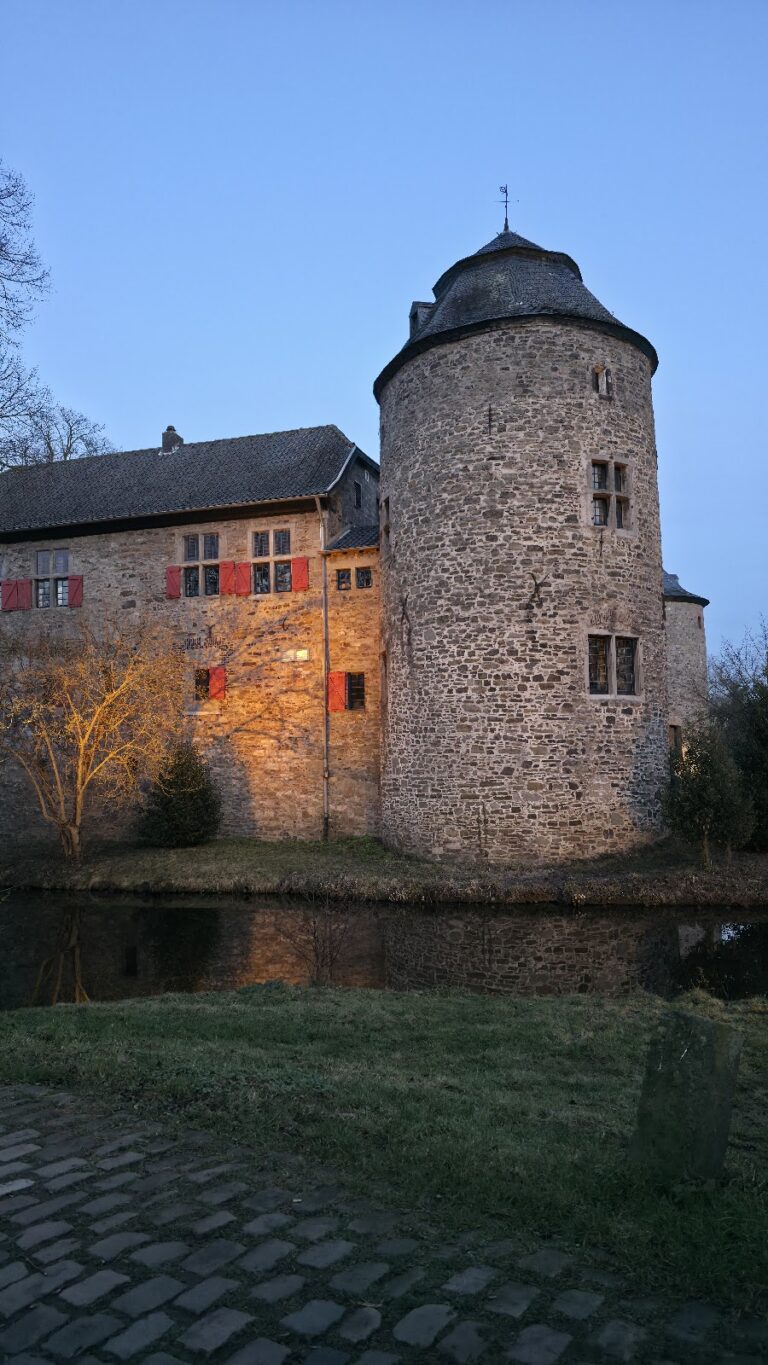
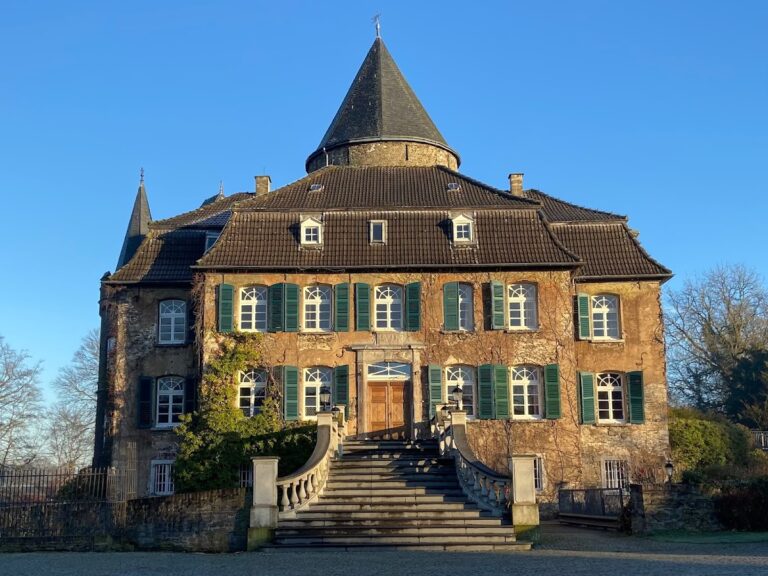
The centre of the surviving group is a four-and-a-half-storey residential tower. It is built of unplastered rubble stone, and its eaves reach 13.30 metres above the ground. The adjoining buildings are massively constructed only at basement level and now serve as ancillary buildings for the agricultural operation.
Lost and uncertain defensive features
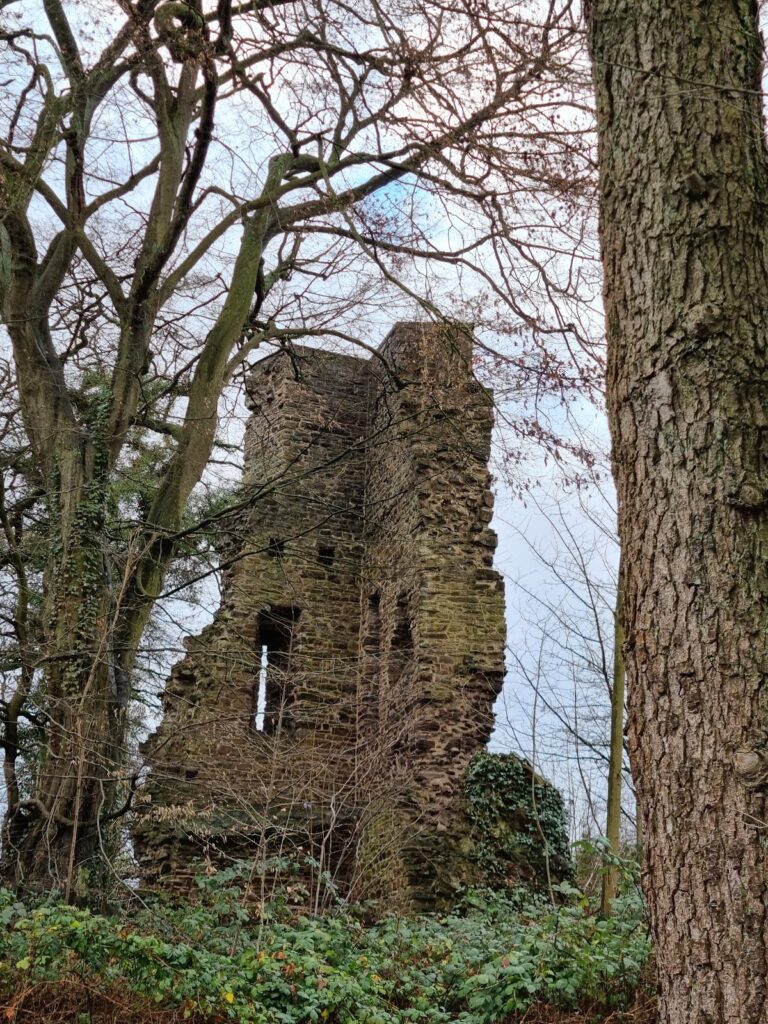
The defensive walls, gate, and approach-side ditches on the northern side have disappeared. A low, small hill west of the surviving buildings may represent the remains of a second tower, although this feature has not yet been archaeologically investigated.