St. Nicolai: A Brick Gothic Parish Church in Lüneburg


Site at a Glance
- Rating
- 4.6
- Popularity
- Low
- Country
- Germany
- Primary era
- Medieval
- External website
- Open
- Eras represented
- Medieval, Modern
- Civilizations
- German, Holy Roman Empire
- Site type
- Religious
- Remains
- Church
On this page8 sections
History
St. Nicolai is a historic Lutheran parish church in Lüneburg, Germany, built by the city in the North German Brick Gothic style between 1407 and about 1440. It is the youngest and smallest of Lüneburg’s three main historic churches and was originally dedicated to Saint Nicholas of Myra, a fourth-century Christian bishop traditionally associated with charity and the protection of sailors, merchants, and children. The church stands in the Wasserviertel, Lüneburg’s historic waterside district, where a chapel for local inhabitants developed into one of the city’s principal religious buildings.
From waterside chapel to parish church
The chapel was consecrated in 1409 and was the first religious building initiated by Lüneburg’s town government. In 1420, the town council decided to enlarge it into a church. The work continued until around 1440, producing a three-aisled Brick Gothic basilica, a church whose central nave rises above lower side aisles. St. Nicolai was Catholic during its medieval foundation and early use, with a church interior that eventually contained eighteen altars.
The Reformation, the sixteenth-century movement that reshaped Western Christianity and established Protestant churches across much of northern Europe, reached Lüneburg in 1530. The first Lutheran sermon in the town was preached at St. Nicolai, and Lutheran services have continued there since that time. The church is now an active parish within the Evangelical Lutheran Church of Hanover.
Tower failure and nineteenth-century rebuilding
A tower was begun about twenty years after the church was completed, but financial difficulties stopped the work. The unfinished structure soon became unstable. A spire was added in 1587, yet the tower was demolished in 1831 because of its poor condition. The nave also suffered serious damage, partly as a result of foundation problems.
An association formed in 1843 to save St. Nicolai. Stabilization and repairs to the nave began in 1869, followed by the construction of a new tower in the Gothic Revival style, which deliberately reused medieval Gothic forms in nineteenth-century architecture. The tower was completed in 1895-96. These interventions secured the church’s survival but substantially changed its original appearance.
Later history and continuing use
St. Nicolai, together with St. Johannis and St. Michaelis, belongs to the European Route of Brick Gothic. It is also regarded as one of Lüneburg’s important surviving Brick Gothic buildings. Its furnishings reflect both the losses suffered by historic churches and the transfer of objects from other religious buildings in the city. The principal altar came from St. Lamberti, parts of another high altar came from the dissolved Cistercian monastery of Heiligenthal, and the baptismal font came from St. Cyriacus, demolished in 1651.
The church’s bells were affected by confiscations during the Second World War. Only the large Marienglocke remained at St. Nicolai. A confiscated bell from Fischhausen was later transferred from the Hamburg-Veddel bell cemetery to the church as a loan bell. On 24 July 2009, the Rincker foundry cast a new Peace Bell, also called the Schifferglocke. On 4 October 2009, the three principal ringing bells sounded together for the first time in an A-minor triad.
Remains
Church structure and interior vault
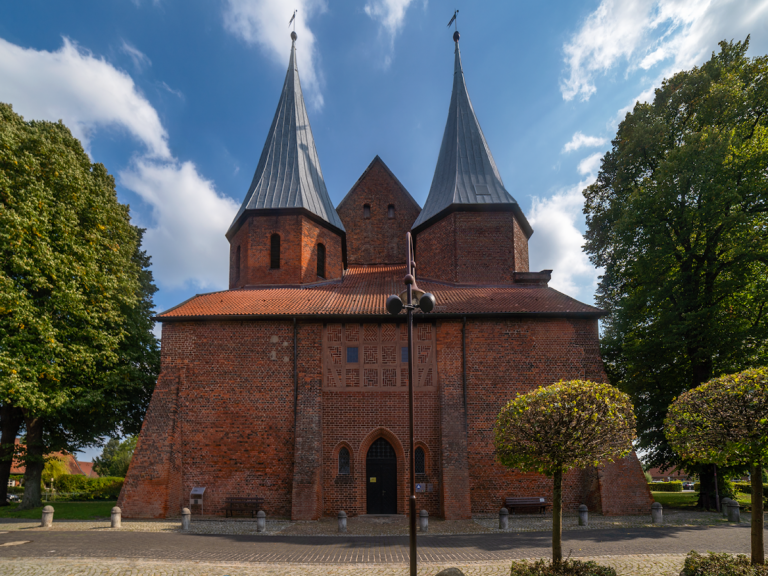
St. Nicolai is a pillar basilica without a transept, built principally of brick. Its plan has a four-bay nave, a choir bay, and a three-sided choir termination. The central nave is approximately 7.2-7.5 metres wide and rises about 28.5-28.7 metres. Its eight-pointed star-rib vault, a ribbed ceiling whose intersecting ribs form star-shaped patterns, is described as unique in Northern Germany. The vault is the principal part of the interior that retains a medieval character, while extensive nineteenth-century restoration shaped much of the rest of the church. The interior design draws on solutions used at St. Mary’s Church in Lübeck.
The present brick tower is 92.7 metres high and is among the highest church towers in Lower Saxony. Clock faces appear on three sides. The north side has no fourth face because the staircase to the upper part of the tower occupies that area.
Altarpieces and medieval furnishings
The principal double-winged altar dates from around 1440 and was transferred from St. Lamberti after that church was demolished in 1860-61. Each of its inner and outer wings is hinged and can be closed. Hans Snitker the Elder, a Lüneburg woodcarver, made the oak carving on the inner side, while the wing paintings are attributed to Hans Bornemann, a Hamburg painter associated with late-medieval North German panel painting.
The carved inner panels show the life of Jesus in twenty scenes arranged in two registers, beginning with the Annunciation and ending with Pentecost. The Crucifixion occupies the center. The predella, the lower section of an altarpiece, contains six prophets dressed as medieval merchants. Bornemann’s tempera panels, made around 1447, depict the apostles Simon and Judas Thaddaeus with Lüneburg in the background and include scenes from the life of Saint Lambert. They are displayed during the Passion season, when they cover the carvings. The outer-wing paintings, showing the Sacrifice of Isaac and the Crucifixion of Jesus, are displayed during Holy Week.
Parts of a winged high altar from Heiligenthal are installed in the ambulatory, a passage running around the back or sides of a church choir. Its surviving panel paintings date from around 1450 and are also attributed to Hans Bornemann. They show four scenes from the life of Saint Lawrence and four from the life of Saint Andrew, with one panel containing an early view of Lüneburg. The carved reliefs from Lüneburg date from about 1425.
Two wrought-iron grilles in the choir ambulatory came from a screen donated to St. Lamberti in 1625. The baptismal font, made by the master Ulricus around 1325, stands in the altar area before the principal altar. It is the last surviving witness to St. Cyriacus, the demolished church from which it came. Modern stained-glass windows were created by Johannes Schreiter in 1987.
Organ and bells
The organ was built in 1899 by Furtwängler & Hammer. Emil Hammer of Arnum altered its disposition, the arrangement of its stops, in 1930, 1946, and 1955. E. F. Walcker & Cie. electrified the instrument in 1979. The Lenter company restored it in 2002, renewed its pneumatic action, and largely returned it to its 1899 configuration. It has 49 stops on three manuals and a pedal. The restoration added a transmission of the Hauptwerk trumpet to the pedal and a register prolongement, a mechanism that preserves a selected registration until it is released.
The tower contains five bells. The Katharinenschelle, cast in 1445, and the Franziskusschelle, cast in 1516, serve as clock bells rather than as part of the main peal. The approximately 4,200-kilogram Marienglocke was cast in 1491 by Gerhard van Wou, a prominent late-medieval bell founder from the Low Countries. It has the striking note A0 and came from St. Lamberti.
The Leihglocke was cast in 1674 by David Dornmann and has the striking note E1. It originally came from the church at Fischhausen in former East Prussia. The Schifferglocke, cast by the Rincker foundry on 24 July 2009, has the striking note C1 and carries an artistic frieze based on Psalm 107. A reproduction of the frieze is displayed on the exterior west side of the tower. The three principal ringing bells produce A0, C1, and E1, forming an A-minor triad, while the Schifferglocke hangs in the vacant position of the massive wooden bell frame.