Lüne Abbey: A Medieval Benedictine Nunnery and Women’s Foundation in Germany


Site at a Glance
- Rating
- 4.5
- Popularity
- Medium
- Country
- Germany
- Primary era
- Medieval
- External website
- Open
- Eras represented
- Medieval, Early Modern
- Civilizations
- Holy Roman Empire
- Site type
- Religious
- Remains
- Monastery
On this page16 sections
History
Lüne Abbey is a former Benedictine nunnery and present-day Evangelical-Lutheran convent for women in Lüneburg, Germany, founded in 1172 by a medieval Christian community and rebuilt in the Brick Gothic style after fires in the thirteenth and fourteenth centuries. Its historical development reflects the changing organization of women’s religious life, the wealth of the Lüneburg saltworks, the Reformation, and the later transformation of the convent into a foundation for unmarried women of the landed nobility.
Foundation and Benedictine Development
The abbey began with a community of no more than ten noblewomen from Nordborstel, led by Hildeswidis von Marcboldestorpe. They were permitted to occupy a vacant chapel built in 1140 as a hermitage for a monk from Lüneburg. The foundation charter was signed by Hugo, Bishop of Verden, Henry the Lion, Duke of Saxony and Bavaria, and Berthold II, abbot of St. Michael’s Monastery in Lüneburg.
The new foundation was dedicated to the Apostle Bartholomew and received part of the apostle’s robe as its principal relic. It initially followed no particular monastic rule, but adopted the Rule of Saint Benedict during the thirteenth century. This code regulated communal prayer, discipline, work, obedience, and shared religious life. By 1272, the community was described as Benedictine.
The original buildings burned in 1240 and again in 1372. Following these disasters, the abbey was rebuilt closer to Lüneburg. A major campaign began in 1380 and employed the Brick Gothic style, a form of medieval architecture that used brick for large religious and civic buildings in northern Europe.
Growth, Learning, and Economic Power
During the thirteenth century, the community expanded to as many as 60 nuns. Most came from noble families in the surrounding region or from Lüneburg’s influential patrician families. The abbey maintained its own school, where the women studied Latin, the liberal arts, theology, Christian doctrine, and liturgy. Education supported both their religious responsibilities and their correspondence with families, officials, and other convents.
Since 1229, Lüne Abbey had held a salt-pan lordship over the Lüneburg saltworks. Its annual income provided the main support for the community’s general living expenses. Control of this income gave the abbey wealth and influence, making it an autonomous power in the Lüneburg Heath region.
The community also defended its right to govern its own affairs. In 1367, the nuns rejected their papally appointed provost, Giles of Tusculum, a powerful cardinal bishop, and elected Conrad of Soltau instead. The dispute ended with the appointment of Johannes Weigergang. Pope Urban V then granted the community the privilege of choosing its own provost. In 1395, the provost received full sacramental responsibility for the nuns, giving the abbey practical independence in both secular and spiritual matters.
Bursfeld Reform and Late Medieval Life
In 1481, Lüne joined the Bursfeld Congregation, a reform association of Benedictine monasteries in central and northern Europe. The movement promoted stricter discipline, communal worship, and reform of convent administration. The reforming provost Matthias von dem Knesebeck arrived with seven nuns from the already reformed Ebstorf Abbey. He deposed the prioress Bertha Hoyer and her subprioress, then installed Sophia von Bodenteich, a former Ebstorf nun, as prioress.
The reform increased instruction in Catholic doctrine and required seven daily choral offices. It also imposed stricter communal practices, including shared meals and more rigorous abstinence from meat on Fridays and during Lent. The kitchen and refectory were rebuilt to meet these requirements. Scholarly activity and handwork were encouraged as well. Textiles made between 1492 and 1508 survive as evidence of this work, while the continuation of embroidery traditions reaches back to the thirteenth and fourteenth centuries. By 1519, the community had grown to 87 nuns.
War and the Reformation
The Hildesheim Diocesan Feud of 1519, a conflict involving competing territorial powers in northern Germany, brought severe disruption. Raids by the princes of Brunswick-Wolfenbüttel and Calenberg affected the convent so badly that the nuns were temporarily forced to leave the abbey and move into Lüneburg. The resulting indebtedness of Brunswick-Lüneburg weakened the region’s convents.
In 1525, Duke Ernest I demanded more than 28,000 guilders from the convents of Brunswick-Lüneburg and threatened to enforce payment by military means. After publicly supporting the Reformation, the movement that divided Western Christianity and established Protestant churches in many European territories, he also targeted the Roman Catholic convents. Lüne and the other reformed women’s convents resisted his demands, producing a stalemate that lasted four years.
On 26 April 1528, at the duke’s direction and despite the nuns’ opposition, a service was celebrated in German for the first time. In late 1529, Provost Johannes Lorber resigned. He was replaced by the ducal administrator Johannes Haselhorst and the Protestant preacher Hieronymus Enkhusen. The provost’s estates passed into ducal administration, and a new ducal provost was appointed to enforce Lutheran teaching.
A new monastic ordinance written by Urbanus Rhegius, a German theologian and Protestant reformer, radically changed the liturgy and abolished the religious vows. In 1531, a ducal tax collector destroyed one of the abbey’s chapels, which was dedicated to Saint Gangulphus of Burgundy, a medieval Christian saint associated with Burgundy.
After Prioress Mechthild von Wilde died in 1535, resistance to the Reformation weakened. The nuns independently elected Elisabeth Schneverding as her successor but accepted incorporation into the duke’s Protestant territorial authority. The community did not fully accept the Reformation until 1562. Under the Lüneburg monastic ordinance, however, it retained its institutional independence.
Women’s Foundation and Modern Administration
From 1535, the abbey was outwardly treated as a secular retirement institution, although its community continued a devoted spiritual life in the Benedictine tradition. In 1711, at the initiative of Duke George Louis of Brunswick-Lüneburg, it was formally converted into an Evangelical women’s foundation. Its principal purpose became the provision of a residence and support for unmarried daughters of the Lüneburg landed nobility.
In 1793, during the First Coalition War, Abbess Artemisia von Bock feared that a nearby French army would occupy the abbey. She sold a large quantity of artworks, manuscripts, and library books. Some entered private collections, while others went to larger archives and repositories. The Hanover Monastic Chamber, a state institution in Lower Saxony that administers former monastic properties, has managed the foundation’s landholdings since 1803.
During the Second World War, Allied bombing raids destroyed many of the archives that had received material from Lüne. Further artworks and manuscripts disappeared during the collapse of German administrative structures at the end of the war. The convent’s connections with the wider world are nevertheless preserved by approximately 1,800 letters in Latin and Middle Low German, the principal commercial and administrative language of much of northern Germany during the late Middle Ages.
The late medieval letters were found in a chest in the abbey archive at the beginning of the twenty-first century and have been studied since about 2016. A digital edition has been produced since that year by Eva Schlotheuber, Henrike Lähnemann, and others. The correspondence describes the nuns’ relationships with their biological families, Lüneburg, and the abbey’s estates. It also provides detailed evidence for convent life, education, religious practice, and the effects of the Reformation. Letters to secular contacts were written mainly in Middle Low German, while correspondence between convents often combined that language with Latin.
Lüne also became known for wool-on-linen knitting and embroidery. A textile museum opened on the abbey grounds in 1995, presenting valuable embroidery, altar cloths, fasting cloths, and carpets. The oldest displayed textiles date from around 1250. The Easter carpet was sold to Hamburg’s Museum of Arts and Crafts in 1948.
Remains
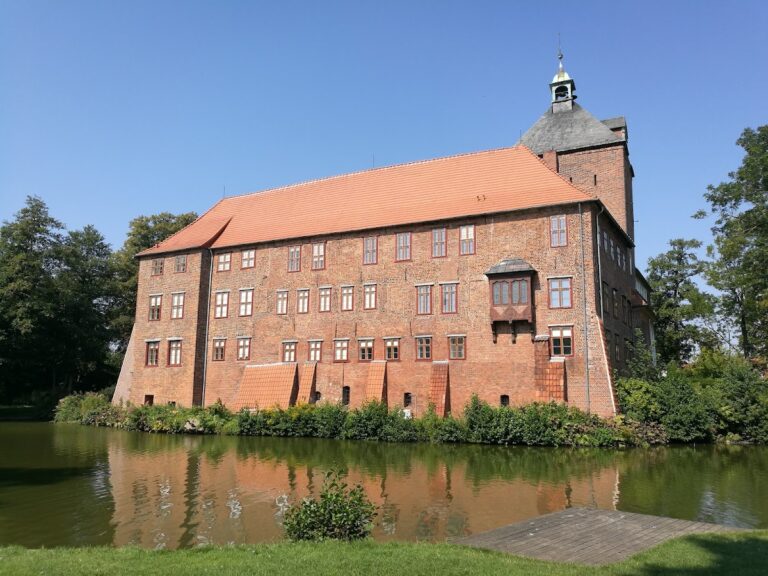
Lüne Abbey’s predominantly brick buildings are arranged around a quadrangular enclosure with cloisters. The surviving complex includes the abbey church, cloisters, the former dormitory, the nuns’ choir, refectories, the chapter house, and associated furnishings. Together, these spaces preserve the physical organization of a women’s religious community and its later development as a foundation.
Abbey Church
Church of St. Bartholomew
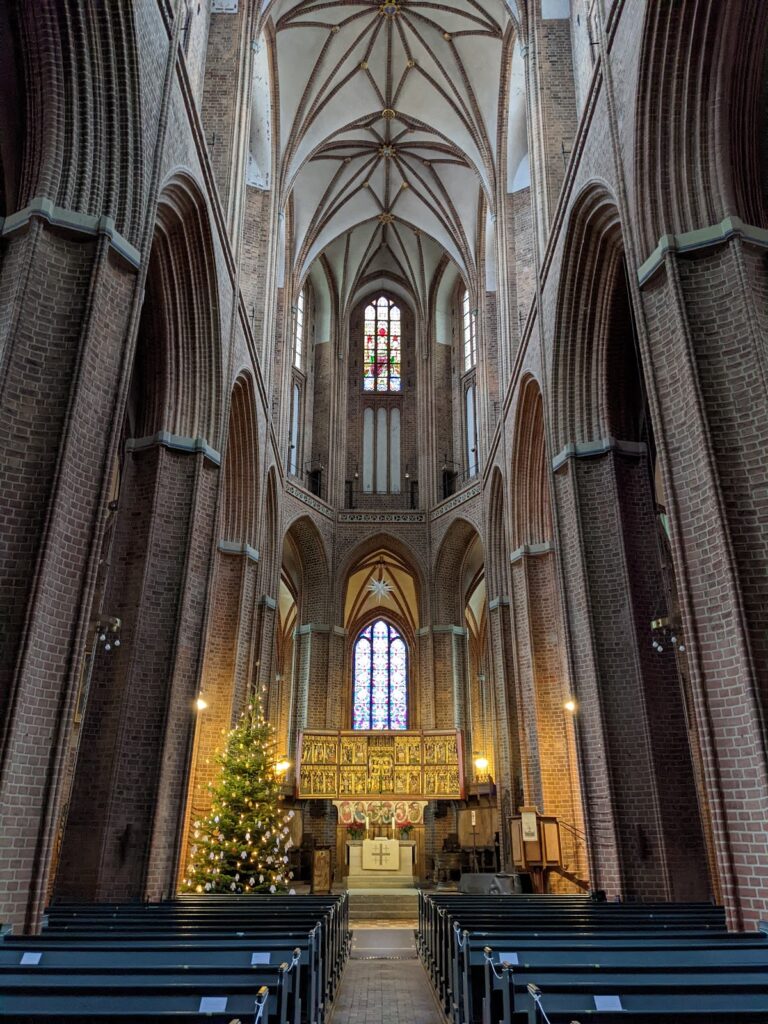
The Church of St. Bartholomew belongs to the abbey and also serves as a parish church. It is an east-facing Gothic brick single-nave church adjoining the abbey and cloister on the north. Built in stages between 1373 and 1479, it measures 32.71 metres in length, 7.01 metres in width, and 14.16 metres in height. The building has five bays, with cross-ribbed vaults in the four eastern bays. Its choir ends in a polygonal five-eighths termination. Two-stepped buttresses articulate the exterior, while tall pointed-arch windows illuminate the walls. The eastern windows are probably two-light windows with circular tracery above, and the western windows are three-light windows with stepped lancet tracery.
Between 1481 and 1497, the westernmost bay received a star vault with decorative rib bosses. This enlargement followed the growth of the community to 87 members and the resulting need for a larger nuns’ choir. After the convent was reduced during the Reformation, the church received new choir seating with 60 places. The western nuns’ choir is 17 metres long, with an eastern extension of about 4 metres for the abbess. Foliage-covered bosses decorate the vault apexes, and all the vaults were covered with flat stucco scrollwork ornament in 1648.
Altars and Religious Furnishings
At the east side of the nuns’ gallery altar is a Lamentation from the workshop of Lucas Cranach the Elder, a leading German Renaissance painter and printmaker. Above it stands a polychromed wooden Madonna with a lantern, dating from around 1500.
The richly carved Holy Cross Altar, dated 1524, is a gilded Gothic oak triptych with two registers. Its central panel presents the Crucifixion beneath an Ascension scene added in the seventeenth or eighteenth century. Four Passion scenes show the Arrest of Christ and Christ before Annas, Caiaphas, and Pilate. Each wing contains eight saints and apostles. The upper section of the two-part predella, the lower part of an altarpiece, contains three-quarter-length figures of nine female saints: Elizabeth of Thuringia, Euphemia of Chalcedon, Barbara of Nicomedia, Apollonia of Alexandria, Agnes of Rome, Odilia, Catherine of Alexandria, Ursula of Cologne, and Dorothea. The lower section contains carved scenes from the Christmas story, beginning with the Annunciation.
A predecessor altar from 1410 was transferred in 1655 to St. Mary’s Church in Gudow by Domina Catharina Margarita von Estorff of the Bülow family. The church also contains an early Baroque organ prospect made between 1645 and 1651. Its organ pipes, made in 1645, are decorated with gilded dolphins. The organ was renewed in 1969, and its painted prospect was renewed in 1970.
The eight-sided wooden pulpit dates from 1608 and has a sounding board. Its stairway depicts the four Evangelists with their attributes. The pulpit basket contains scenes of the Nativity, Baptism, Crucifixion, Resurrection, and Ascension of Christ.
Communal Rooms
Main Refectory
The ground-floor refectory adjoining the western cloister contains an air-heating system. Wall paintings from around 1490 cover its east wall and are attributed to the Lüneburg painter Hinrik Levenstede the Younger. The central image shows Saint Anne with the Virgin Mary and the Christ Child, an artistic motif known as Saint Anne with the Virgin and Christ Child. Seven male saints appear on the left and seven female saints on the right, including Catherine of Alexandria and Barbara.
After the Reformation, the paintings were concealed beneath a coat of plaster. In 1720, following the conversion of the abbey into a women’s foundation, storage cupboards were fitted along the east and south walls. Their grisaille decoration depicts foliage, strapwork, fruit garlands, and animals. Johann Caspar Kegemantel painted the beam ceiling with foliage and inscriptions in 1667.
Summer Refectory
A representative summer refectory was built north of the main refectory in 1466, standing at a right angle to it. Its beam ceiling has zigzag decoration from the second half of the fifteenth century. The building was later restored in a sixteenth-century style.
Dormitories and Ulenflucht
The dormitory in the upper storey of the west wing was divided into conventuals’ cells around 1575. A boarded central passage with a trapezoidal cross-section ran between them and was known as a coffin passage. Its wooden coffered panelling dates from 1578.
The dormitory called Ulenflucht occupies the upper storey adjoining the south cloister. It was laid out in 1418 as an undivided three-aisled room. Around 1500, it was divided into cells and given a central passage covered by a wooden pointed-arch barrel vault. The corridor is 30 metres long and is lit at its eastern end by a three-part tracery window. Parts of the boarded cell walls survive. Around 1700, some cells received ceiling paintings and large Arcadian landscapes, biblical scenes, and allegorical scenes on canvas-covered walls.
Chapter House and Cloisters
The chapter house adjoining the south cloister was remodelled in a representative manner during the eighteenth century. At its western end stands an abbess’s throne and baldachin from 1708. The structure is decorated with garlands and a putto and is crowned by a statue of Saint Bartholomew. The rear wall carries a painting of the anointing of King David.
The opposite end wall bears a life-size portrait of King George II of Great Britain. Portraits of the abbesses and other heads of the foundation since 1590 hang between the two ends of the chapter house. The entrance hall contains the early fifteenth-century running fountain known as the Handstein, while the cloister includes Gothic stained-glass windows from the fourteenth and seventeenth centuries.
Textile Collections
The textile museum on the abbey grounds contains wool-on-linen works, including the Sibyl and Prophets Carpet, the Jesse Tree Carpet, and the Resurrection Miracle Carpet of 1503. Its displays also include white embroidery, altar cloths, fasting cloths, and other carpets dating from around 1250 onward. These works preserve the material tradition of textile production associated with Lüne’s religious community and its later foundation.