St Nicholas Church Wismar: A Brick Gothic Church of Sailors and Fishermen


Site at a Glance
- Rating
- 4.7
- Popularity
- Medium
- Country
- Germany
- Primary era
- Medieval
- External website
- Open
- Eras represented
- Medieval, Modern
- Civilizations
- German, Holy Roman Empire
- Site type
- Religious
- Remains
- Church
On this page20 sections
History
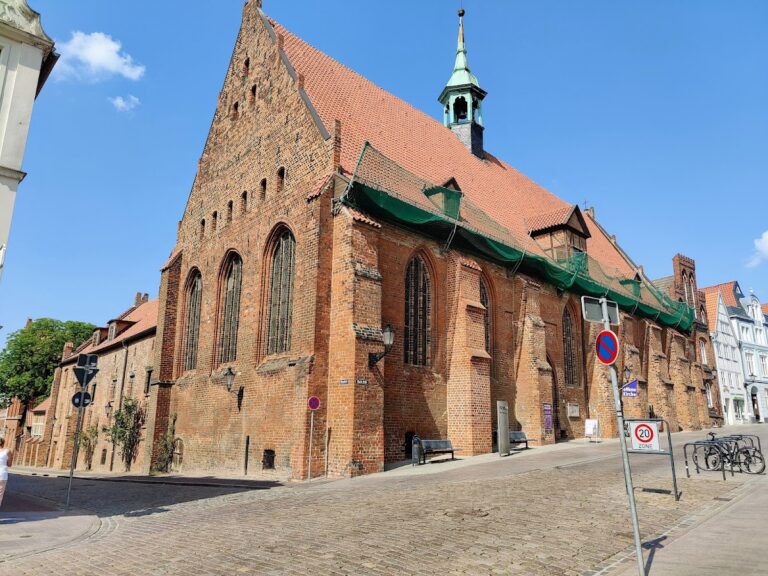
St Nicholas Church in Wismar, Germany, is a North German Brick Gothic church built for the city’s sailors and fishermen and dedicated to Saint Nicholas, the fourth-century bishop traditionally associated with seafarers, merchants, and generosity. The present building was begun around 1370, although the parish existed before the mid-thirteenth century and may have been connected with an earlier church near the Grube.
Early parish and medieval construction
A church dedicated to Saint Nicholas may have stood near the Grube in Wismar’s earlier merchants’ settlement, but this possibility remains unproven. The parish itself predates the middle of the thirteenth century. Its first documentary mention dates from 1255, while a reference from 1270 speaks of new construction. The parish was probably associated with the early foundation of Wismar around 1230.
Construction of the present church began around 1370. In 1381, Wismar’s council commissioned Heinrich von Bremen to complete the choir. Mayor Johann Dargetzow served as church warden when the commission was made. Heinrich continued working on the building until 1415, and the high altar was consecrated in 1403.
The side aisles were completed in stages. Work on the northern aisle took place in 1434, followed by work on the southern aisle in 1437. Under the master builder Peter Stolp and the builder Hermann von Münster, the church advanced far enough for consecration in 1459. Hans Mertens and Hans Schröder built the two upper stages of the tower between 1485 and 1487, and a spire was added in 1508.
The church’s principal architectural model was Wismar’s St Mary’s Church, whose form in turn followed St Mary’s Church in Lübeck. Its dedication reflected the community it served. Saint Nicholas was widely regarded as a patron of sailors and merchants, making the dedication especially appropriate for Wismar’s maritime population.
Reformation and Swedish rule
The Protestant Reformation, the sixteenth-century movement that established Lutheran and other Protestant churches across parts of Europe, reached Wismar in the early 1500s. Heinrich Never is associated with its introduction in the city in 1523. St Nicholas subsequently became Lutheran. It now serves the Evangelical Lutheran St Nicholas congregation within the Wismar provostry and Mecklenburg church district, while the city of Wismar owns the building.
Wismar was captured by Sweden in 1632 and remained under Swedish control until 1803. This period of Swedish rule forms part of the church’s later historical setting and is also reflected in the memorial culture preserved within the building, including the epitaph of David Mevius, vice-president of the Swedish Wismar Tribunal.
Storm destruction and rebuilding
On 8 December 1703, an exceptional storm destroyed the pointed tower spire. Falling fragments pierced the nave’s roof and vaults and destroyed or damaged much of the medieval interior furnishing. The tower was subsequently given a transverse gabled roof, while the nave received a flat ceiling. The furnishings were renewed during the second half of the eighteenth century.
The nave was vaulted again in 1867. A comprehensive renovation followed in 1880 and 1881, including an interior treatment based on medieval models and the restoration of surviving medieval figural paintings. The eastern roof turret, called the Steigerturm, was erected in 1890.
War, conservation, and modern history
Air raids during the Second World War caused comparatively little damage to St Nicholas Church. Furnishings from the heavily damaged St George’s and St Mary’s churches were later transferred into the building. Repairs to wartime damage took place between 1946 and 1948. Later security work concentrated on the roofs in 1963 and on the flying buttresses and rising masonry.
In 1989, the church served as a platform for political protest in Wismar. The historic centre of Wismar, including St Nicholas Church, was inscribed on the UNESCO World Heritage List in 2002. The church is also protected as an architectural heritage monument in Mecklenburg-Western Pomerania.
The church’s musical history extends back to the fifteenth century. An inscription states that the priest Andreas Hagelsten of Braunschweig completed an organ in 1463. It reportedly had two manuals covering two octaves and a one-octave pedal, and may have been the first North German organ with a smaller division positioned behind the organist. Hagelsten was also associated with an organ made in 1478 and was buried beneath it in 1480.
Henning Kröger built a new organ between 1617 and 1619. After the high vault collapsed, Hans Hantelmann repaired it in 1706 or 1707. Christian Erdmann Vogel altered the instrument and added a new rear organ division in 1737. Friedrich Wilhelm Winzer rebuilt it in 1862 and 1863, and Ernst Röver altered it again around 1900. Its condition later deteriorated, and it was declared largely unusable in 1973 before failing completely at Christmas 1974.
Remains
St Nicholas Church is a three-aisled basilica in North German Brick Gothic. A basilica has a higher central nave flanked by lower aisles. The building includes side chapels, a passage around the choir, and a ring of chapels around that passage. Its northern and southern aisles each have a transept-like entrance hall, although these halls neither open directly into the nave nor rise to the nave’s full height.
Structure and exterior
Dimensions and brick construction
The church is approximately 85 metres long and reaches 58 metres at its greatest width. The nave is 37 metres high and 10.5 metres wide, while the side aisles are 18.5 metres high and 5.5 metres wide. The tower walls are 4.5 metres thick, the chapel walls 1.2 metres thick, and the main nave piers have a circumference of 8 metres. Approximately three million bricks were used in the construction.
The present tower is 64 metres high. Before the storm destroyed its spire in 1703, the tower reached approximately 120 metres. Together with St Mary’s and St George’s churches, it forms a major element of Wismar’s skyline.
Buttresses, chapels, and gables
Sixteen prominent flying buttresses stabilize the high nave. A flying buttress is an external arched support that transfers the outward pressure of a vault to a pier outside the main wall. At St Nicholas, the buttresses are separated by the side chapels and do not project visibly beyond them.
The recesses between the choir chapels were straightened so that one continuous roof covers the polygonal choir. The transept-like halls have lean-to roofs set apart from the main roof, preserving the uninterrupted sequence of flying buttresses and clerestory windows. A clerestory is the upper windowed level of a nave.
The southern hall gable has particularly rich brick-Gothic decoration. Motif friezes show the Virgin Mary, Saint Nicholas, dragons, lions, and human heads, with a brick rose window above them. The northern gable also contains a rose window, but its decoration is simpler.
Interior architecture
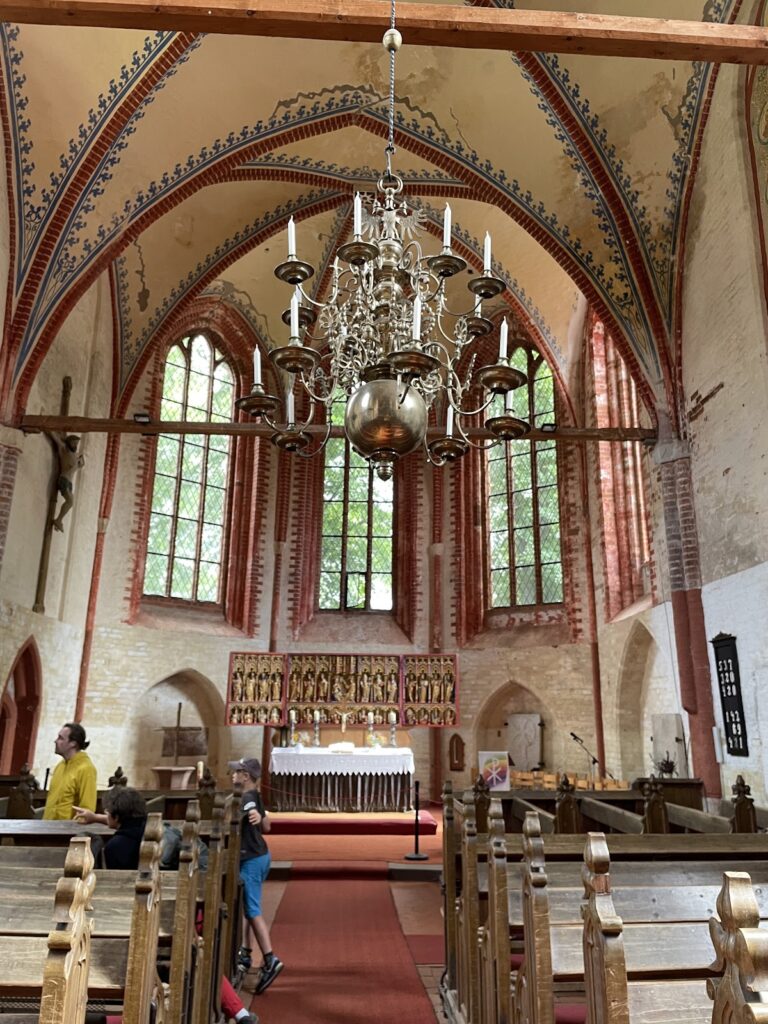
The choir and the seven bays of the nave form a visually continuous interior without a dividing barrier. High, closely spaced arcades and shorter clerestory windows strengthen the vertical effect. The reveals of the three-light clerestory windows extend down to the string course, where small pointed openings evoke a triforium, a narrow gallery or arcaded zone below the clerestory.
Rib vaults cover the nave, side chapels, and entrance halls. The five choir chapels connect with the ambulatory through six-part vaults. The choir ends in a five-eighths termination, a polygonal form based on five-eighths of an octagon. Inside the tower is a mural of the Dance of Death dated 1616, although the painting is no longer recognizable.
Altars and medieval sculpture
High altar
The late Baroque high altar dates from 1774. Its strictly architectural composition includes a cartouche painting of the Last Supper at the base and an older painting by Benjamin von Block, who copied a celebrated Deposition by Rubens in 1653. Columns frame the principal painting. Above it are a clock, the Tetragrammaton in a radiant frame, and a statue of the risen Christ carrying a victory banner. The Tetragrammaton is the four-letter Hebrew form of the divine name, conventionally represented in English as YHWH. Side portals carry a donor portrait and coats of arms. The altar was probably made in the workshop of Johann Heinrich Bülle of Wismar.
Mariners’ Altar
The Mariners’ Altar was made in a Wismar workshop at the beginning of the sixteenth century for the sailors’ brotherhood. It is the only surviving medieval altar shrine in the church’s collection. Its central figure is a Virgin of the Crescent Moon, accompanied by Saint Nicholas and Saint James the Greater. The outer pair of wings and the lower horizontal section, or predella, are missing.
Eight figures occupy the two box wings. Catherine of Alexandria carries a wheel and sword, Elisabeth of Thuringia a martyr’s palm and chalice, Ursula of Cologne an arrow, and Margaret of Antioch a processional cross. Four male saints complete the group. John the Evangelist and Erasmus of Antioch are securely identified, while the identities of the other male figures remain uncertain because of severe damage.
The outer wings contain scenes from the life of the Virgin, including the Visitation, the Nativity, the Annunciation to the shepherds, the Presentation in the Temple, and Herod’s massacre of the children of Bethlehem. C. C. Michaelsen extensively reworked these paintings in the nineteenth century. Their present colouring also dates from that period, and the paintings are in poor condition.
Merchants’ guild retable
The former altar of the merchants’ guild was probably carved in Wismar around 1430 to 1440. It stood for centuries in a purpose-built chapel in St Mary’s Church. After the chapel was demolished in 1832, the retable’s location was unknown until the guild restored it in 1910 and returned it to St Mary’s. Following the destruction of that church, it was moved to St Nicholas.
The retable has a central shrine containing the Virgin in a radiant halo, flanked by the archangel Michael and Saint Maurice beneath delicate tracery canopies. Two angels play music above the Virgin. The object held by the Christ Child may be a musical instrument, fruit, or a spindle, but its identification is uncertain. The wings show the Annunciation, the Nativity, the Adoration of the Magi, and the Circumcision of Jesus.
Thomas Altar
The Thomas Altar, carved and painted around 1500, originally stood in the Dominican church. The Dominican Order is a Catholic mendicant order founded in the thirteenth century and known for preaching, theological study, and university teaching. After the convent was dissolved in 1562, the altar was transferred to St George’s Church. It now stands in the fourth northern side chapel.
The double-winged triptych has a central section showing Thomas Aquinas between Thomas Becket, archbishop of Canterbury, and the apostle Thomas. A triptych has three principal sections. The closed wings present four scenes from the life of Thomas Aquinas, including his offering as an oblate at Monte Cassino at the age of five, his family’s attempt to divert him from the Dominican order, his escape from confinement in a tower, and his illness while travelling to the Second Council of Lyon. Angels, his mother’s release of him, and the care given by monks at Fossanova also appear.
With the wings open, eight further panels depict the apostle Thomas and Thomas Becket. The apostle appears in scenes of the Incredulity, his journey to India, the conversion of a wedding party, the baptism and consecration of the Magi as bishops, and the Eucharist at his tomb church in Syria. The scenes of Thomas Becket include his consecration as bishop, his dispute with King Henry II and exile in France, his return to England, disciplinary acts, and murder. Thomas Becket was the twelfth-century archbishop of Canterbury killed after his conflict with Henry II.
The fully opened altar displays a carved shrine with three principal figures beneath gilded canopies. Additional panels show Thomas Aquinas during his captivity, his association with Frederick II, his return to the Dominican order, his teaching, and his presentation of a book to Pope Urban IV. The predella depicts his body at Fossanova and its placement in a coffin. These scenes have remained permanently visible since the twenty-first century, although specialists believe they may once have been concealed by a painted predella panel.
Marian Retable
The late-fifteenth-century Marian Retable, also called the Virgins’ Retable, stands opposite the Thomas Altar in the fourth northern side chapel. This pentaptych, an altarpiece with five principal sections, was originally made for the Wismar Dominican monastery. It later passed to St George’s Church before reaching St Nicholas in the twenty-first century.
The shrine has seven large carved figures and numerous losses, including missing attributes, almost all of its original colour, and parts of the paintings on the outer wings. Its predella is modern. The congregation secured and cleaned the shrine in 1995. A Virgin of the Crescent Moon occupies the centre, surrounded by six holy virgins. Catherine of Alexandria and Catherine of Siena are identifiable on the right wing.
The figures stand within a deep frame divided by small vertical buttresses, while the original tracery canopy is missing. The painted wings show episodes from the life of Mary, including the refusal of an offering in the Temple, the Annunciation to Joachim, the meeting of Anna and Joachim at the Golden Gate, the Nativity of Mary, the Immaculate Conception, the Presentation of Mary at the Temple, the Annunciation, the Adoration of the Magi, and the Death of the Virgin. A Latin prayer to Mary remains visible on the central figure’s garment.
Retable of the Ten Thousand Martyrs
The Retable of the Ten Thousand Martyrs was probably made in a Wismar workshop around 1440 to 1450. It came from the Dominican church through St George’s Church and stands in the third southern nave chapel. The shrine is highly fragmentary. Many carved reliefs and all coloured finish are missing.
Five wooden boards joined horizontally and secured with wooden dowels form the shrine. The surviving imagery shows martyrs pierced by thorns while mounted soldiers approach from both sides. An archbishop can be recognized by his mitre. A blessing Christ with two angels may originally have appeared above the scene.
Other medieval sculpture
A mid-fifteenth-century wooden relief of the Adoration of the Magi is inserted into a wall pier in the second northeastern chapel. Its simply styled scene is surmounted by a canopy decorated with tracery.
A fifteenth-century triumphal-cross group from the secularized Dominican monastery church was moved to St Nicholas after 1880 and installed above the rood screen, the structure separating the choir from the nave. The crucifix is considered highly accomplished, while the figures of Mary and John are more roughly executed.
A second triumphal-cross group from the later fifteenth century stands in the southern hall and originally came from St George’s Church. Its cross ends bear the symbols of the Evangelists, and its edges are decorated with large, partly gilded vine leaves.
Baptismal furnishings, memorials, and fittings
The plain granite baptismal font in the fourth northern side chapel probably dates from the late thirteenth century and is the church’s oldest furnishing. Its bowl has round-arched arcading. In the third northern side chapel, a wooden baptismal enclosure from 1719 surrounds a pulley-operated baptismal angel that lowers a shell-shaped basin. Six columns support the main cornice, allegorical female figures sit above it, and Christ as the Good Shepherd crowns the richly ornamented, temple-like structure.
A bronze baptismal font made around 1335 originally stood in St Mary’s Church and came to St Nicholas after that church’s nave was destroyed. Three kneeling youths support its round, slightly conical basin. Reliefs beneath two-storey arcades show scenes from the life of Jesus, the Last Judgment, and the wise and foolish virgins. Grapes and freely hanging leaves decorate the formerly coloured lower rim. An iron grille with rope motifs, probably made in the sixteenth century and traditionally called the Devil’s Grille, surrounds the font.
Late-Gothic screens in the choir arcades have parapet-like panels with applied tracery and relief foliage garlands. Saints and apostles appear in quatrefoils and rose windows. Parts of the associated metal grilles were destroyed in 1703 and replaced with Baroque bottle balusters.
A bronze tomb slab for Sophie of Pomerania, Duchess of Mecklenburg, who died in 1504, shows her in high relief. Its separately cast border carries coats of arms and inscriptions. Tile Bruith of Lübeck signed and cast the slab. It came from the Dominican monastery church, later stood in St Mary’s Church, and is now in the fourth northern side chapel.
The church’s principal stone epitaph is the monument made in 1605 for Mayor Schabbell and his wife. Numerous fifteenth-century tomb slabs, mainly for priests but also for members of patrician families, are also preserved. A slab from 1600 for Heinrich von der Lühe and Lucretia von Parkentin has figural low reliefs. An epitaph for David Mevius, the Swedish vice-president of the Wismar Tribunal, originally stood in St Mary’s Church. Its Baroque frame contains angels, flowers, grapes, a portrait medallion, a coat of arms, and a Latin inscription.
Parts of fifteenth-century choir stalls were reused to make the lectern. Four brass chandeliers and wall brackets were donated by civic offices and guilds after 1703. Two whale ribs are kept in a northern side chapel, and numerous old name plaques remain attached to the choir stalls.
Organs and bells
The present main organ was made by Johann Gottlob Mende in 1842 to 1845 for St Nicholas Church in Freiberg, Saxony. It has two manuals and 28 stops. Wismar acquired it in 1976 and installed it in 1985 in front of the tower’s eastern wall. The former Kröger and Hantelmann case was adapted to the Freiberg case arrangement. The instrument initially lacked a visible front, developed technical problems because it had not been restored, and was repaired in 1995. The historical front and some pipe material were reused for the choir organ.
Orgelbau Johannes Soldan of Großdubrau built the choir organ in 2010. It uses a historical front and pipe material from Winzer’s main organ. The instrument is mechanical, with ten stops distributed between two manuals and a pedal.
The original bells were lost in the storm of 1703. Two replacements were cast in Lübeck by the council bell-founder Lorenz Strahlborn. His large bell of 1732 is regarded as an exceptionally fine Baroque large bell between Hamburg and Stralsund. Three further bells, including the second-largest church bell, the 1705 Bürgerglocke, were melted down during the Second World War. A somewhat smaller replacement was cast in Apolda in 1963 using metal that included bells from St George’s Church and the 1501 bell of the Black Monastery.
The roof-mounted Steigerturm carries two externally visible striking bells, the oldest surviving bells associated with the church. The larger dates from 1479 and the smaller from 1543. The larger has the shortened rib typical of striking bells and has always served as the clock bell, although both bells have irons for clapper suspension.
Until the tower spire collapsed in 1703, a central roof turret stood between the west tower and the Steigerturm. It carried a choir bell cast in 1549 and weighing approximately 277.8 kilograms. That bell was replaced as early as 1564 by a small bell from the west tower.
Nearby sites