Plüschow Castle: A Rococo Summer Residence and Artists’ Centre in Germany


Site at a Glance
- Rating
- 4.5
- Popularity
- Very Low
- Country
- Germany
- Primary era
- Early Modern
- External website
- Open
- Eras represented
- Early Modern, Modern
- Civilizations
- Holy Roman Empire
- Site type
- Domestic
- Remains
- Castle
On this page9 sections
History
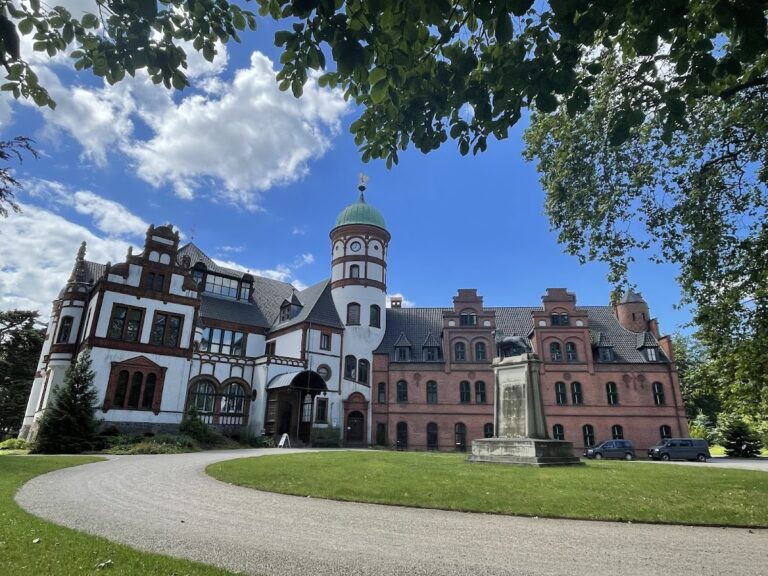
Plüschow Castle is an eighteenth-century Rococo summer residence in Plüschow, Germany, built in 1763 for the Hamburg merchant Philipp Heinrich Freiherr von Stenglin and his wife. Its architect may have been the Lübeck builder Johann Adam Soherr or the Hamburg architect Ernst Georg Sonnin. The house is now a listed historic monument and serves as an artists’ centre.
From Bülow estate to summer residence
The von Bülow family held Plüschow from 1450. In 1758, Philipp Heinrich Freiherr von Stenglin acquired the estate and chose it as a summer residence. The present castle followed five years later, establishing the main form of the house that survives today.
Mecklenburg hereditary prince Friedrich Ludwig, a member of Mecklenburg’s ruling dynasty, purchased the house and its lands in 1802. By the late 1920s, the estate extended across 558 hectares, including 32 hectares of forest. It remained a grand-ducal court estate in the family’s possession until expropriation in 1945. The last owner was Friedrich Franz IV, the former grand duke of Mecklenburg, who lived from 1882 to 1945.
Postwar use and preservation
After the Second World War, the building first accommodated war refugees. It later served several municipal purposes, including a works kitchen, kindergarten, restaurant, and administrative offices. Extensive renovation took place between 1991 and 2002, helping preserve the building as a historic monument.
The castle is now operated by the Förderkreis Schloss Plüschow association as an artists’ centre with exhibition rooms, studios, and workshops. A permanent exhibition presents the history of the castle, while a children’s creative workshop develops projects involving art, sound, theatre, and the environment. The private art library of the art historian Annie Bardon was transferred from her estate to the Mecklenburg Artists’ House at Plüschow. Bardon, who lived from 1946 to 2005, directed the Kunsthalle Rostock until 1999, and her library is maintained as a reference collection.
The property’s cultural history also gained a new piece of evidence in December 2023, when a stolen Baroque wallpaper from the period of the castle’s construction resurfaced. In October 2025, construction of the Ehrhardt Museum began on the castle grounds. The planned 1,400-square-metre venue is intended for photography and contemporary art, with a focus on the photographer Alfred Ehrhardt. Jens Ehrhardt and his wife Elke commissioned its design from Francis Kéré, an architect who received the Pritzker Architecture Prize.
Remains
The castle house
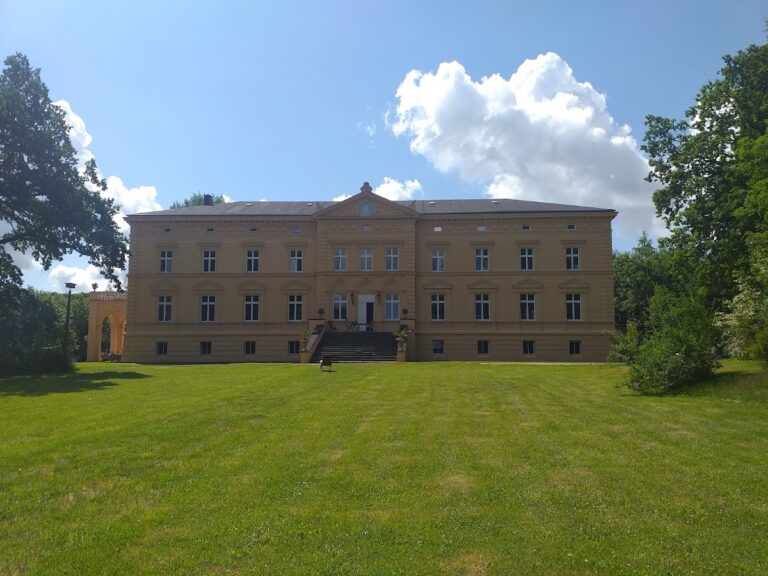
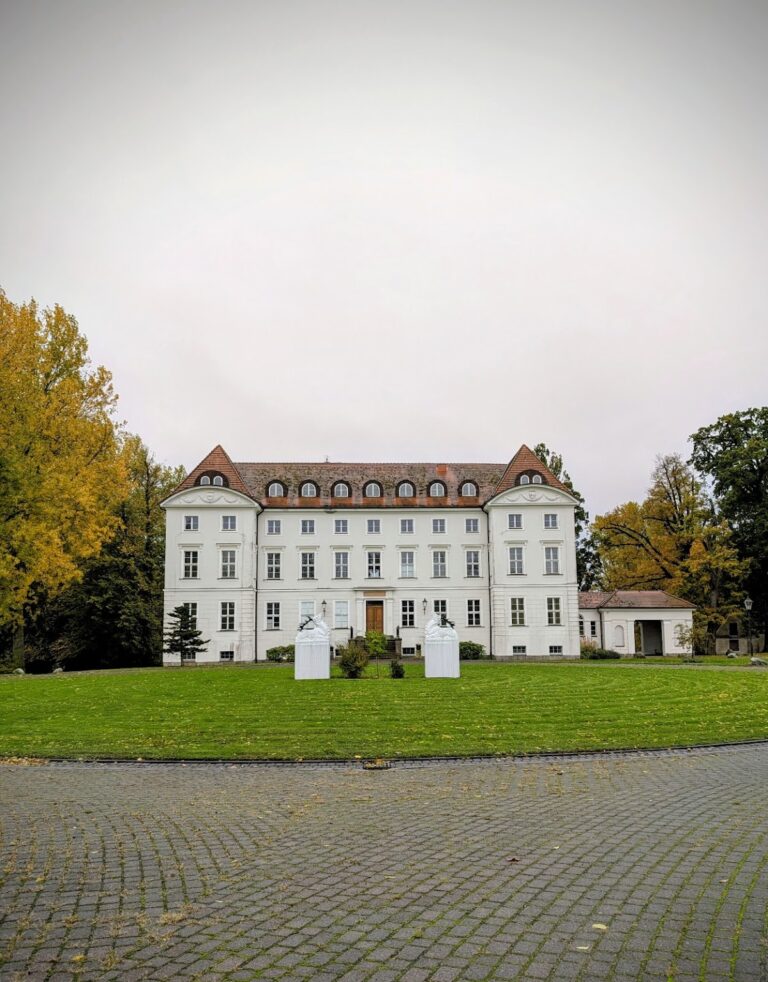
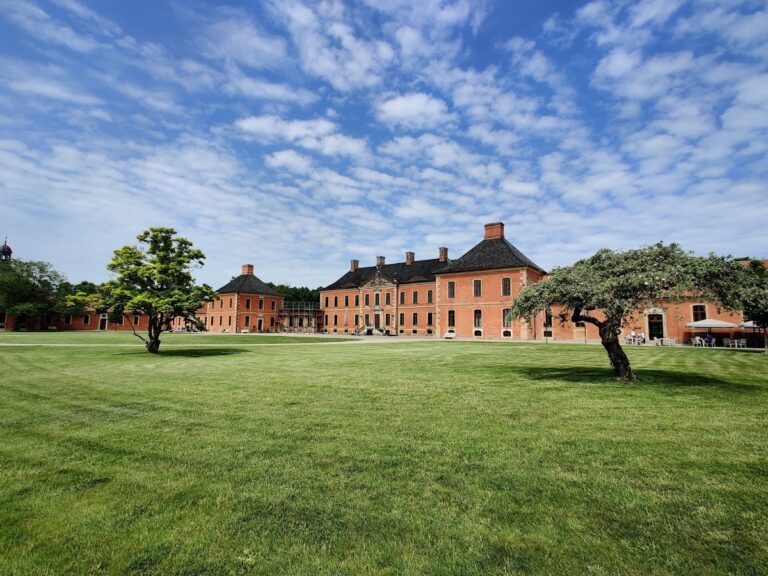
Plüschow Castle is a simply designed, two-storey brick building with eleven bays. Its courtyard and garden facades each have a central gabled wall dormer, while the portals are crowned with rocaille ornament, an asymmetrical shell-like motif characteristic of Rococo design. The cellars are vaulted. On the courtyard side, the sandstone portal surround was renewed in 1910, and the gable carries a clock face with a striking bell dating from 1763.
A veranda was added to the garden side toward the end of the nineteenth century. Inside, the original arrangement has remained largely unchanged. A large two-flight staircase occupies the stairwell leading to the upper floor. Three Classicist stoves from around 1810 survive there, with designs based on the balanced forms associated with ancient Greek and Roman architecture. The spacious entrance hall and other ground-floor rooms retain Rococo stucco ceilings.
Estate buildings
Former administrator’s house
The former administrator’s house stands northeast of the castle. Built around 1760, it is a single-storey, six-bay building with a half-hipped roof and two basket-arched entrances.
Former granary
The elongated, single-storey granary was erected between 1924 and 1928 on the orders of Friedrich Franz IV. It was the last building constructed on the estate during the twentieth century. The building now provides exhibition space for artists from Mecklenburg, and the painter Matthias Kanter established his studio there.
Ehrhardt Museum
The Ehrhardt Museum is being built on the castle grounds on an area of 1,400 square metres. Its planned exhibition spaces will be devoted to photography and contemporary art, particularly the work of Alfred Ehrhardt.
Nearby sites