Abbey of Our Lady in Leffe: A Premonstratensian Monastery in Belgium


Site at a Glance
- Rating
- 4.2
- Popularity
- Low
- Country
- Belgium
- Primary era
- Early Modern
- External website
- Open
- Eras represented
- Medieval, Early Modern
- Civilizations
- Holy Roman Empire
- Site type
- Religious
- Remains
- Monastery
On this page18 sections
History
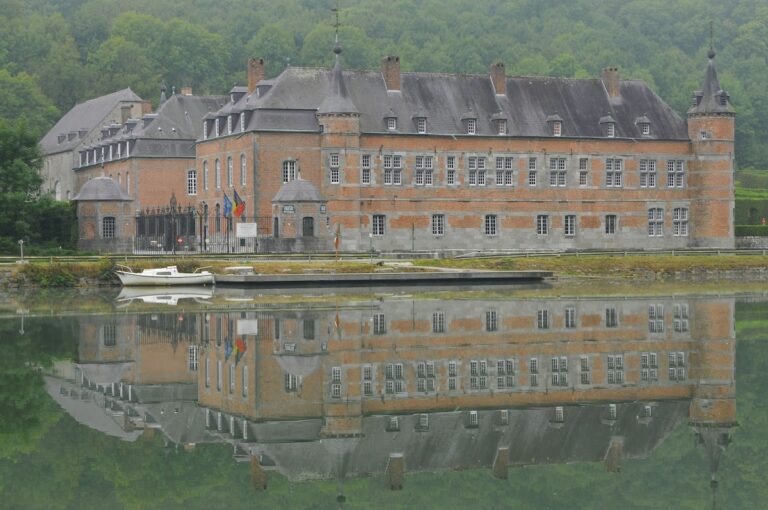
Abbey of Our Lady in Leffe is a Premonstratensian monastery in Leffe, a district of Dinant, Belgium. Founded in 1152 as a priory and raised to abbey status in 1160, it developed under the Premonstratensians, a Catholic order that combines monastic observance with pastoral and parish ministry. The abbey stands on the right bank of the Meuse, downstream from Dinant, at a site whose religious and economic history has been closely connected with the river.
Foundation and early development
The foundation was associated with Henri IV, Count of Luxembourg and Namur, known as Henri the Blind. Around 1140, Henri received Leffe as a fief from Frederick Barbarossa, the twelfth-century German king and emperor. He later donated the Church of Our Lady of Leffe, together with its dependencies and revenues, to Gerland, abbot of Floreffe, so that a Premonstratensian community could be established there.
Earlier traditions connect the first Christian oratory at Leffe with Saint Materne, bishop of Tongeren. Another tradition places a community of religious women at the site from the seventh century. From the tenth century until 1152, secular canons served the sanctuary. The relationship between these early traditions and the later, clearly recorded foundation remains uncertain, but the sanctuary already possessed a long religious history when the Premonstratensians arrived.
The new community settled at Leffe in 1152 under a prior and remained subject to Floreffe Abbey, the senior Premonstratensian house. Frederick Barbarossa confirmed the donation in 1153. Pope Adrian IV confirmed it on 22 April 1155, followed by Pope Alexander III on 12 May 1178. A new church was built in 1155 on the site of the earlier one and consecrated by Henri de Leyen, bishop of Liège.
As the community expanded, Jean d’Auvelais, the fifth abbot of Floreffe, promoted the elevation of Leffe from priory to abbey in 1160. Wéric, formerly prior of Floreffe, became its first abbot and was proclaimed in 1200. The bishop of Liège also granted him the dignity of archdeacon, a senior church office with delegated administrative and judicial responsibilities within a diocese.
Growth and medieval crises
Until the end of the eighteenth century, Leffe had its own abbots. The religious community elected them, the abbots of Floreffe approved them, and the prince-bishop of Liège blessed them. Floreffe retained visitation and confirmation rights as the mother abbey. During the thirteenth century, Leffe increased its resources through donations and purchases of churches, villages, woodland, tithes, fields, and mills.
The Premonstratensians served parishes at Leffe, Dinant, Waha, Sart-en-Fagne, Awagne, Jassogne, and Courrière. Their work in clearing land and developing agriculture supported the abbey’s prosperity. The estate also included farms and other dependencies, while mills along the Leffe stream and the Meuse formed part of the community’s economic life.
Disaster struck in September 1400, when plague killed Abbot Albéric de Pecheroux and seven other religious. In 1408, Abbot Wéric de Beaumont resigned without authorization. The abbatial seat then remained vacant for an extended period during resistance to the authority of Floreffe.
A major flood on 7 August 1460 devastated the church. Only its four walls remained, and Abbot Jean Ghorin drowned. The other religious escaped by taking refuge in the tower. Six years later, Leffe was caught up in the Burgundian campaign against Dinant. Charles the Bold, Duke of Burgundy, established his headquarters at Leffe on 17 August 1466. Burgundian forces captured the district the following day, and Dinant surrendered on 23 August.
The abbey was pillaged and devastated. Its church was burned and almost entirely destroyed, while Abbot Wauthier de Wespin and the community were taken captive. The abbey remained abandoned for six months. When the religious returned, they found the complex in ruins and faced the additional loss of property records, which led to disputes and lawsuits over earlier donations.
Recovery and eighteenth-century rebuilding
Between 1484 and 1583, the community gradually recovered, helped especially by income from mills on the river. Because records of the estate had been destroyed in 1466, the abbey was forced to sell or lease parts of its property while defending its claims. Wars between France and Spain, and later between France and Austria, repeatedly affected the region from the reign of Charles V to the government of Maria Theresa. Plague epidemics and a serious famine also disrupted the abbey and its surrounding society between 1577 and 1636.
In 1618, Abbot Jean Noizet presided over the translation of the miraculous statue of Our Lady from Celles Castle to the church at Foy near Dinant. This religious event formed part of the abbey’s wider spiritual connections in the region.
Abbot Perpète Renson governed Leffe from 1704 to 1743 and sought to restore strict observance of poverty. In 1707, he abolished the personal allowance received by each religious. From 1710 he directed substantial building works, including a mill, barns, and sheds. Four years later he ordered the complete rebuilding of the church. The finished church was visited and praised by the prince-bishop of Liège.
The rebuilt complex nevertheless suffered damage before the end of Renson’s abbacy. In 1735, a Hussar regiment, a light cavalry unit, was quartered at the abbey and damaged its buildings, furnishings, and brewery. The military presence formed part of the continuing instability caused by European conflicts.
Revolution, suppression, and industrial use
The political and religious upheavals that began in 1789 drew Leffe into the Brabant Revolution, the 1789 to 1790 uprising in the Austrian Netherlands against the reforms and rule of Emperor Joseph II. Military occupation followed. In 1790, the abbey formed one of Dinant’s administrative sections, and new electoral assemblies held meetings in the abbey church.
Revolutionary authorities declared ecclesiastical property to be national property, imposed heavy contributions, and dissolved religious communities. French forces forced the abbey’s doors on 7 February 1793 and detained Abbot Gérard. In May 1794, the Premonstratensians fled in two groups. Eleven religious, including Gérard, escaped by boat to Maastricht under cover of straw. The abandoned complex was stripped of its bells, metals, grain, furniture, and library materials.
Religious orders in Belgium were formally suppressed on 1 September 1796, and Leffe became national property. Former members of the community later reacquired parts of the estate, but the property was repeatedly resold. The church was demolished, leaving sections of wall. The site was successively converted into a glassworks, a paper mill, and a flax factory. Brewing on the monastic site declined after 1796 and ended in 1809.
After Frédéric Gérard died in 1813, the abbey was sold in 1816 to a French company and converted into a glassworks. The industry continued for about fifteen years. Parts of the complex later became a paper mill and a flax factory, while ownership passed through private owners and inheritances.
Premonstratensian revival and modern community
Henri Collard sold the property in 1902 to French Premonstratensian canons from Frigolet near Avignon. They repaired the buildings and adapted a former barn as a new abbey church, reviving religious life at Leffe. Their restoration and alterations used forms associated with the seventeenth and eighteenth centuries.
The revival was tested by the First World War. German forces invaded Dinant in August 1914. Two religious were shot while attempting to flee beneath the abbey, and other members of the community were imprisoned. Seventeen religious, including the abbot, were held at Marche-en-Famenne for about a month. Of the sixty religious who had left Frigolet in 1903, thirty survived in 1919.
After a fire partly destroyed Tongerlo Abbey on 28 April 1929, part of its community found refuge at Leffe. Under Pope Pius XI, Leffe became a daughter house of Tongerlo and joined the Brabant circary, a regional administrative grouping within the Premonstratensian order, while remaining legally autonomous. Financial hardship followed, and the community supported itself partly through the production and sale of incense and ink.
During the Second World War, many of the abbey’s priests served as military chaplains, and two religious were wounded by an aerial bomb. Young brothers and their instructors temporarily took refuge at Espaly during the German offensive of 1940. They returned on 28 August to an abbey that had suffered little damage. Abbot Bauwens resigned during the war, and Hugues Lamy, emeritus abbot of Tongerlo, succeeded him first as administrator and then as abbot.
Cyrille Nys became abbot on 16 January 1950. He enriched the library and sacristy and improved the comfort of the buildings. Marc Mouton succeeded him in 1963 and oversaw work on the sacristy, the enlargement of the south-façade windows, and the creation of an access path behind the buildings. Reforms associated with the Second Vatican Council, held from 1962 to 1965, altered communal life at Leffe. The 4:30 a.m. office was abolished, and French was introduced into the liturgy.
François Martens became abbot in 1981 after a two-year vacancy. The community experienced renewed vocations and placed greater emphasis on pastoral work. Leffe became a religious and cultural meeting centre, as well as a base for parish priests and retreats. Bruno Dumoulin succeeded Martens on 29 May 1989 and strengthened local pastoral links through the administration of nearby parishes, including Bouvignes and Leffe.
A new organ, built in 1996 at the initiative of Prior Patrick Johnson, contributed to the abbey’s cultural and liturgical life. From October 2013 until summer 2020, Leffe maintained a small priory at La Cambre Abbey in the Archdiocese of Mechelen-Brussels. The community remained an active Premonstratensian Catholic monastery in the early twenty-first century.
The brewing tradition
Leffe’s brewing tradition reaches back at least to 1240. Brewing supported monastic self-sufficiency and provided drinking water made safer through fermentation. A brewery first stood at Saint-Médard across the Meuse before the mill and brewery were moved into the abbey precinct. In the seventeenth century, the brewery was leased to a lay brewer while remaining under the abbot’s control. The brewer and his family lived in a house behind the large mill, beside the leased brewery.
Perpète Renson enlarged and renovated the brewery in the early eighteenth century. A description from 1729 called it spacious and convenient. The Hussars damaged it in 1735, breaking or emptying many beer barrels. Later works included repairs to its lock, the purchase of a new millstone and equipment, and repainting the brewer’s house. After the Revolution, the former brewery and hop garden along the large garden were assigned to former Leffe religious members in 1802. Brewing continued at a reduced level until it ceased on the monastic site in 1809.
Brewing was revived after 1952 through cooperation between the abbey and Albert Lootvoet of Brasserie Lootvoet in Overijse. Brown Leffe beer was being produced again by the mid-1950s. Production moved to Mont-Saint-Guibert in 1977 under Brasserie Artois, and after the creation of Interbrew in 1987 it continued through the corporate succession that led to Anheuser-Busch InBev. Leffe is recognized as a Belgian abbey beer, although its commercial production takes place outside the abbey.
Remains
The surviving complex occupies the Leffe district beside the Meuse, where the Leffe stream enters the river. The watercourse once powered flour and bark mills, marble sawmills, polishing mills, and flax-combing machinery. The abbey developed around a sanctuary dedicated to Our Lady, while its wider estate included churches, villages, woodland, tithes, fields, farms, mills, and other dependencies.
Church and restored monastic buildings
Abbey church
The church built in 1155 replaced an earlier sanctuary and was later destroyed in two stages, first by the flood of 1460 and then by the Burgundian attack of 1466. Abbot Perpète Renson ordered a complete rebuilding in 1714, but that church was demolished after the Revolution. Sections of its walls survived among the later changes to the site.
Present church
The French Premonstratensians who acquired Leffe in 1902 adapted a former barn into the present abbey church. The restored and altered buildings incorporate forms associated with the seventeenth and eighteenth centuries. The church has a large wooden vault and an interior with relatively low reverberation, qualities considered suitable for polyphonic music and for the eighteenth-century German organ tradition associated with Gottfried Silbermann.
Abbots’ Room
The Abbots’ Room contains a large fireplace, Renaissance furniture, sculptures, and portraits. These elements form part of the surviving interior furnishings associated with the abbey’s restored complex.
Organ
Case and divisions
The organ installed in 1996 was designed by the Belgian organ builder André Thomas. Its design drew on the case of the 1741 organ at Grosshartmannsdorf and on instruments built by Gottfried Silbermann in early eighteenth-century Saxony. The organ case is nearly 7 metres high, 4.64 metres wide, and 2.30 metres deep. It is made of Burgundian oak covered with natural oil, with carved openwork panels that are painted and gilded.
The case contains three divisions, following an arrangement characteristic of Silbermann organs. The Oberwerk, Hauptwerk, and pedal identify the upper, main, and foot-operated sections of the instrument. Suspended key action, a mechanical system in which keys operate valves through directly suspended linkages, connects the keyboards to the pipes.
Mechanism and pipes
The Oregon-pine keyboards have 56 keys, with ebony-covered naturals and bone-covered sharps. Oregon pine is also used for the frames and roller boards, hornbeam for the arms and supports, and cedar for the trackers. The keyboard coupling uses a sliding system modeled on Silbermann’s instruments.
Each division has two windchests. Their frames and upperboards are solid oak, while the false chests, bracing, and pallets are made of Oregon pine. Two wedge bellows supply the wind, one for the Oberwerk and Hauptwerk and another for the pedal division, at a pressure of 78 millimetres. The instrument contains 1,532 pipes. Its reed stops follow Silbermann’s construction principles, and the pipes are cut to pitch. The tuning reference is A = 440 Hz at 18 degrees Celsius, with Kirnberger III temperament.
River works and brewery
Mills and water installations
The river installations were central to the abbey’s economy. Water from the Leffe stream and the Meuse powered flour and bark mills, marble sawmills, polishing mills, and flax-combing machinery. A former island opposite the abbey, now disappeared, was once connected to both banks of the Meuse by the Bridge of Leffe, which is known from the tenth century.
Brewery
The brewery documented from 1240 was first located at Saint-Médard across the Meuse before being transferred into the abbey precinct. It stood beside the large mill, with the brewer’s house behind the mill. Renson’s eighteenth-century enlargement and renovation gave it the spacious form described in 1729. The complex included a lock, mill equipment, and a hop garden along the large garden.
Hussar occupation damaged the brewery in 1735, while later repairs renewed its lock and equipment and included the purchase of a millstone. After the Revolution, former religious members received the former brewery and hop garden in 1802. Brewing continued there at a reduced level until 1809, after which the commercial continuation of Leffe beer developed outside the monastic site.
Nearby sites