Village Church Kirchdorf: A Medieval Lutheran Church on Poel


Site at a Glance
- Rating
- 4.7
- Popularity
- Very Low
- Country
- Germany
- Primary era
- Medieval
- External website
- Open
- Eras represented
- Medieval, Early Modern, Modern
- Civilizations
- Holy Roman Empire
- Site type
- Religious
- Remains
- Church
On this page15 sections
History
Village Church Kirchdorf is an Evangelical Lutheran church in Kirchdorf, Germany, on the Baltic island of Poel. German immigrants began building it under Prince Heinrich Borwin I at the beginning of the thirteenth century, creating a church whose surviving fabric spans Romanesque, Gothic, Baroque, Neo-Gothic, and modern restoration periods.
Foundation and Medieval Building Phases
The original church was built after 1210 and by about 1258. Its first written appearance is in a 1259 list of the churches and monasteries belonging to the Diocese of Lübeck, and Heinrich the Pilgrim, a thirteenth-century Mecklenburg prince, mentioned it in a wine endowment of 1266.
Construction developed in several stages. A Romanesque nave was added to the tower around 1230 to 1240. About fifty years later, a Gothic choir replaced the earlier arrangement, and around the beginning of the fourteenth century the nave was raised and adapted to the choir. Around 1400, a larger and more modern church was built, while the medieval tower remained as the principal surviving part of the earlier building.
Reformation and Early Modern History
The Reformation reached Poel after 1533. The change followed the Wittenberg model in a conservative manner, and the church did not undergo iconoclasm. Valuable medieval altars continued to be used on Poel and in the Wismar area, probably in connection with the influence of Johann Wigand, the Wismar superintendent and theologian. His Gnesio-Lutheran position belonged to a strict Lutheran movement that emphasized the doctrinal authority of Martin Luther’s teachings.
A storm in 1660 seriously damaged the building. In 1662, disputes over loans of 150 Reichstaler, a large silver currency used in the German territories, for repairs were brought before the Poel district court.
The church also entered the records of a 1693 sorcery case. The Poel district court accused Peter Ruge and his sons, but the Wismar Tribunal acquitted them. Their neighbours continued to insult and ostracize the family, so the Kirchdorf pastor, Magister Martin Cassius, was instructed to read the tribunal’s judgment publicly after a sermon to demonstrate their innocence. The later outcome is unknown.
Repair, Restoration, and Continuing Religious Use
Political conditions between 1933 and 1989 restricted urgently needed repairs and renovation. A severe storm in January 1995 badly damaged the tower roof and exposed the tower’s generally poor condition. Much of the tower was repaired and reroofed during the same year, and a new gilded weather vane was installed.
Repairs to the church have continued in stages since 2001. The roof structure, roof, windows, exterior walls, and vaults have been restored. The tower clock was returned to working order in 2001, and a small clock bell was placed above it in the tower’s northern gable. Since 2022, an organ-support association has pursued a new instrument intended to resemble the historical 1704 organ more closely. The commission went to the firm Jürgen Ahrendt and includes restoration of the Baroque organ case and reconstruction of its original colour scheme.
Until 27 May 2012, the congregation belonged to the Wismar church district of the Evangelical Lutheran State Church of Mecklenburg. It has since belonged to the Evangelical Lutheran Church in Northern Germany and its Mecklenburg church district. The church is also associated with Poel’s maritime community and is known as a sailors’ church, an identity expressed through its religious furnishings and maritime memorial objects.
Remains
Building and Tower
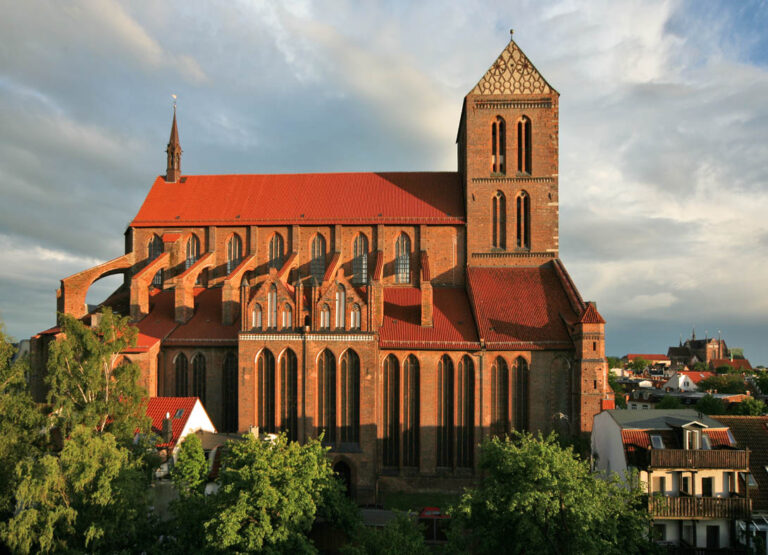
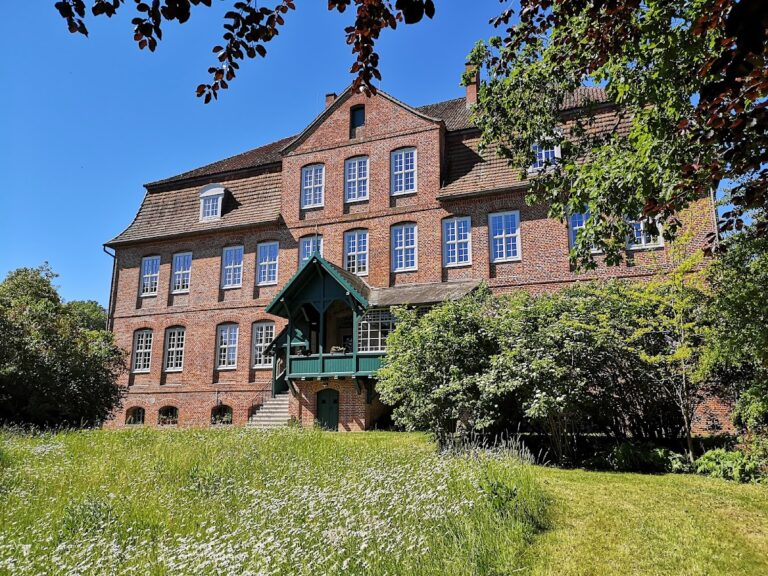
Village Church Kirchdorf is a three-bay brick hall. During the medieval rebuilding, the walls of the hall were raised, buttresses and wall supports were added, a vault was inserted, and the earlier narrow slit windows were converted into pointed-arch openings.
Medieval Tower
The square western tower is the surviving part of the late Romanesque church of the second quarter of the thirteenth century. Its upper section was raised by six metres during medieval remodelling. Four gable shields support an octagonal spire that reaches 47 metres and is locally called a bishop’s mitre, a regional form characteristic of the area.
Over time, the tower served as a refuge, storehouse, lookout, and bell tower. Its conspicuous position made it a landmark near the entrance from the Baltic Sea to Wismar Bay. The tower roof and fabric underwent major repairs after the 1995 storm, while the clock and small clock bell form part of its continuing architectural use.
Medieval Altars and Tomb Slab
Marian Altar
A small carved Marian altar from around 1470 stands against the north wall. Its central shrine contains an apocalyptic Madonna, an image of Mary in eschatological glory, within a halo of rays. She holds the infant Jesus, an apple, and an unidentified flower that may be a lily, tulip, or rose. Four angels surround her, including one carrying a portative, a small portable organ.
Scenes from Mary’s life fill the shrine and wings. They include the Nativity, the Adoration of Christ by the Magi, represented through three ages of man, the Annunciation by the Archangel Gabriel, and the Circumcision of Jesus in the Temple of Jerusalem. The side wings are divided horizontally.
High Altar
The present high altar was made around 1420 and may have come from the workshop of Henning Leptzow, a woodcarver who lived and worked in Wismar in the early fifteenth century. Its central shrine and wings present the Coronation of the Virgin, a medieval devotional theme representing Mary’s exaltation. The carved figures include Saint Nicholas, the Apostle Paul with a sword, John the Baptist pointing to the Lamb of God, Saint Peter with a key, and other apostles.
Sixteen female saints appear below the apostles. Among the identifiable figures are Gertrude with a hospital and roof turret, Barbara with a tower, Dorothy with a rose branch, Margaret with a dragon and sword, Mary Magdalene with a salve vessel, Agnes with a lamb, Catherine with a sword and wheel, and Elisabeth of Thuringia with a vessel and fish.
Gothic Tomb Slab
A medieval tomb slab of Gotland limestone is set in a niche to the right of the high altar in the choir. It dates from the earliest period of the island’s Christianization in the thirteenth century and may have belonged to the church’s founder. The slab lay in the centre of the church until 1850.
Its surface bears an uninscribed cross with rounded, outward-curving arms that suggest rays of light and the resurrection glory of the crucified Jesus. Comparable early Gothic slabs with this cross form are known from Denmark and territories formerly occupied by Denmark. The slab is described as the only example of its type so far found in Central Europe. In the nineteenth century, Mecklenburg archivist Friedrich Crull argued that it might be the oldest Christian gravestone in Mecklenburg.
Choir Furnishings and Interior
Triumphal Cross
Before the Reformation, a rood screen, a partition between the nave and choir, stood where the pulpit is now. A beam above it carried a triumphal cross group, a large crucifix accompanied by Mary and John. During the Neo-Gothic remodelling of 1851, the group was removed and the crucifix was placed on the north wall of the choir. Its short, heavily folded loincloth suggests a date around 1450. The figures of Mary and John have not been located.
Organ
The church acquired its organ in 1704 from the monastery church at Neukloster. Its builder is unknown. The visible Baroque prospect, the decorative front or case of an organ, dates from the seventeenth century and is attributed to the circle of Henning Kröger of Wismar. An old inscription reads, “To God alone the glory, Anno 1704.”
In 1875, Friedrich Albert Mehmel installed a new Romantic organ behind the Baroque prospect and widened its front by 30 centimetres on each side. The instrument had two manuals, a pedal, eleven stops, manual and pedal couplers, and fully mechanical slider-chest action, in which movable sliders control the air reaching the pipes.
Between 1967 and 1983, Wolfgang Nußbücker of Plau am See carried out work described as a general overhaul but rebuilt much of the instrument. About one-third of the Mehmel pipes were reused. The resulting organ had two manuals, a pedal, thirteen stops, couplers II/I and I/P, and fully mechanical slider-chest action.
The late nineteenth-century interior decoration, the two-storey western gallery, the pulpit, and the pews date from the end of that century. Other furnishings belong to later periods, including a brass chandelier donated in 1656 by Peter Evers, a free farmer from Brandenhusen, and the present baptismal font, donated in 1992 by Neustadt in Holstein stonemason Dirk Bollmann and brought to Poel by boat across the Baltic Sea.
Maritime and Bell Furnishings
A historical model of the fishing boat Zeesboot P 45 stands against the north wall. Built in 1936 by Poel fisherman Richard Schwarz, the model bears an inscription asking for protection and guidance at sea and in life. The letter “P” refers to Poel, while “45” was the fishing number of Gustav Schwarz, the builder’s brother.
The church formerly had four bells. The oldest was dated 1396 and was recast in 1864 by Wismar bell founder Peter Martin Hausbrandt. Two further bells were made by the Bachert bell foundry in Karlsruhe in 1993. One bears the inscription “Christ Kyrie, come to us upon the sea.” An eighteenth-century weather vane, placed on the western gallery after the January 1995 storm, completes the church’s collection of maritime and weather-related reminders.