St. Mary’s Church Uelzen: A Gothic Brick Hall Church in Germany


Site at a Glance
- Rating
- 4.5
- Popularity
- Very Low
- Country
- Germany
- Primary era
- Medieval
- External website
- Open
- Eras represented
- Medieval, Early Modern
- Civilizations
- Holy Roman Empire
- Site type
- Religious
- Remains
- Church
On this page26 sections
History
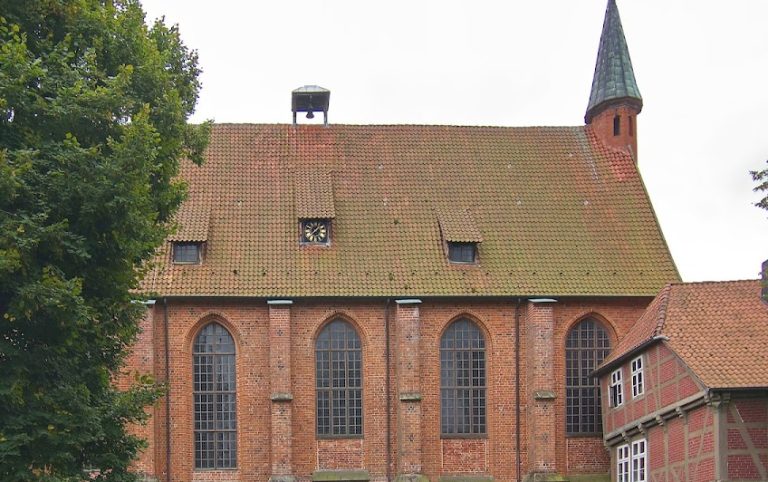
St. Mary’s Church Uelzen is a Gothic church in central Uelzen, Germany, built in the thirteenth and fourteenth centuries in the North German brick-Gothic tradition. It belongs to the Evangelical Lutheran Church of Hanover, a regional Lutheran church serving much of Lower Saxony, and is one of the oldest churches in the Uelzen district. The Bishop of Verden consecrated the church and made it a parish church in 1292, although the exact beginning of construction is unknown.
Medieval foundation and enlargement
The first building consisted of the low central part of a three-aisled Gothic hall church. In a hall church, the aisles have vaults that are approximately as high as those of the central nave. The high vaults of the nave are thought to belong to a phase completed before 1300. The church was then gradually raised as burials accumulated in the cemetery surrounding it. This process altered the relationship between the building and the ground: the former entrance was reached by climbing two steps, while the present entrance lies five steps below the surrounding level.
The High Choir and its crypt were constructed in 1385. A crypt is a chamber, often beneath a choir, used for worship, burial, or both. The design deliberately followed the hall crypt of St. Michael’s Church on a smaller scale, while aspects of the choir arrangement at St. John’s Church in Lüneburg were also adopted. A related choir design, without a crypt, was later used in planning a church at Salzwedel.
Chapels and religious use
Provost Hermann Nigebuhr founded the Apostles’ Chapel on the south side of the church in memory of people who died during the plague epidemic of 1350. The chapel was consecrated in 1357. It later became the burial chapel of the Ellendorf family and is consequently also known as the Ellendorf Chapel.
The Chapel of the Three Kings was added to the south side of the tower almost a century later and completed in 1430. Its present use is connected with morning devotions. From the Reformation onward, the first pastoral post and the provost’s office were linked with the superintendency of the Uelzen inspection. A provost, or Propst, is a senior cleric responsible for an important church office or district, while an inspection was an administrative ecclesiastical district supervised by an inspector or superintendent.
Fires, tower, and bells
The first major city fire damaged part of the church and destroyed its library, including important documents. Between 1671 and 1680, the tower received its Baroque appearance. A second major city fire in 1945 destroyed the tower’s spire, which was rebuilt in 1954.
The church’s medieval six-bell peal was lost through recasting, fires, and the two world wars. Two of its oldest bells, cast in 1647 and 1695, were sent for wartime melting in 1943. Both returned from the Hamburg bell collection in 1948 because they had not been destroyed. The present installation and the survival of these bells reflect the repeated changes imposed on the church by fire and war.
Modern restoration and continuing use
St. Mary’s has continued as a place of worship and regional church activity. Its parish serves about 4,900 members from central Uelzen, the Königsberg district, and the villages of Hambrock, Halligdorf, Niendorf, Ripdorf, and Woltersburg. Services, weddings, funerals, confirmations, school ceremonies, concerts, and performances by the St. Mary’s Choir and the Uelzen Chamber Orchestra remain part of the church’s use.
A decision taken in 1997 led to the restoration of the main organ, which returned to service on the First Sunday of Advent in 2001. The work corrected serious technical problems, restored the organ case, and broadened the instrument’s musical capabilities. Weather damage required the church facade to be almost completely renewed in 2012 and 2013. On the night of 7 September 2014, a severe thunderstorm struck the tower with lightning. The sound system and exterior lighting were almost completely destroyed, and the clock and bell electrics were damaged.
Remains
St. Mary’s stands on the small street An der Sankt-Marien-Kirche in central Uelzen. A paved church square extends before the building on the site of the former cemetery. The Martin Luther House stands beside the church, the city library is opposite it, and the Ulenköper Monument is in front of it. The Ulenköper is a traditional figure associated with Uelzen’s civic identity.
Building and tower
Brick-Gothic church
The church is an imposing three-aisled hall church in the North German brick-Gothic style. This medieval tradition used fired brick instead of the dressed stone common in many western European Gothic buildings. A wooden framework was built first, with a brick facade constructed around it, and brick columns support the interior. The church’s gradual enlargement and the later High Choir give the building a physical record of its successive medieval building phases.
Tower
The square tower is sparsely articulated and rises 86 metres. Its masonry section and its kinked helmet are each 42 metres high, producing a slender overall form. The tower was built only after the High Choir had been completed. A very narrow staircase contains 196 small steps. Through a side door in the first section, the tower reveals Gothic vaults, masonry, and fishbone patterns formed freehand without preliminary centering. Higher up, a ladder leads to the completely wooden roof structure, which is accessible only in suitable weather.
Choir and chapels
High Choir
The High Choir contains the large main altar and is surrounded by tall stained-glass windows. A small choir organ stands inside it, while the pulpit is placed immediately before the choir. An upper-floor opening above the sacristy faces into the choir. The choir has octagonal pillars, and blind windows were present on the exterior.
Apostles’ Chapel
The Apostles’ Chapel on the south side contrasts with the larger church through its delicate forms and colored medieval wall paintings. It serves as the burial chapel of the Ellendorf family and is therefore also called the Ellendorf Chapel.
Chapel of the Three Kings
The Chapel of the Three Kings is attached to the south side of the tower. Completed in 1430, it is now used as a space for morning devotions.
Art and historic furnishings
Choir paintings and windows
Paintings uncovered and restored in 1962 cover the choir vault. Their subjects include the twelve Apostles, the Mercy Seat, and the enthroned Christ. The Mercy Seat is a Christian image of the Trinity in which God the Father presents the crucified Christ, with the Holy Spirit often represented by a dove. The colored windows depict scenes from the lives of the Apostles and were designed by Renate Strasser, a German artist and stained-glass designer.
Pulpit and altar
The pulpit before the High Choir is Neo-Gothic and dates from 1900. Conrad Wilhelm Hase made it and also created the main altar. Hase was a nineteenth-century German architect associated with the Gothic Revival.
Saint Anne Altarpiece
The Uelzen Saint Anne Altarpiece is a Gothic Lüneburg carving made in 1506 for Uelzen’s St. Vitus Chapel. Saint Vitus was an early Christian martyr who became widely venerated in Europe. Since 1949, the altarpiece has stood in the Apostles’ Chapel.
Mary Chandelier
The Mary Chandelier dates from 1450 and is made of cast yellow brass. It depicts a Gothic double Madonna on a crescent moon and hangs near the pulpit at the centre of the hall, where it forms part of the church lighting.
Golden Ship
The Golden Ship occupies a wall niche beside the tower hall and is regarded as a symbol of Uelzen. It probably reached the town during the Hanseatic period, when the Hanseatic League connected trading towns across northern Europe. Its origin, age, and original use remain uncertain. It has been described as a medieval table ornament, perhaps a gift from English merchants, and probably a former reliquary, a container made to hold a relic associated with a saint or other sacred person. A duplicate stands in Uelzen Town Hall.
Organs
Principal organ
The principal organ stands above the entrance to the central nave on the west side and has 53 stops. An organ stop is a controllable set of pipes producing a particular tone or timbre. The instrument was moved and structurally modified twice, partly to make room for large oratorio performances and partly because side galleries were built in the central nave. An oratorio is a large musical composition for voices and instruments, normally performed without theatrical staging. Between 1951 and 1954, the organ was substantially altered in a process described as Baroque styling, which changed much of its pipework.
Johann Georg Stein made the original organ and case in 1756. Stein was an eighteenth-century German organ builder, and the case is described as his largest surviving organ case. Between 1960 and 1966, a Berlin organ-building workshop installed a new three-manual organ with 40 stops, following North German Baroque tonal models. The later restoration retained 23 of the old stops and added 30 new ones.
The restored case was returned toward its original appearance using descriptions of Stein’s 1756 organ and an 1885 photograph. Original marble-pattern paint layers were restored, missing areas were retouched, and carved work covered with gold and silver leaf was uncovered or newly gilded. The console is faced with cherry wood, the stop knobs are walnut, and the manually lettered knobs are porcelain. The instrument has 256 setter combinations, a disk drive, MIDI connection, mechanical and electric couplers, electric octave couplers, and a playable glockenspiel.
Choir organ
A second, smaller organ was built in 1981 by a Hamburg organ builder for weddings, funerals, and table communion in the High Choir. Its positive can be removed for use as a continuo instrument. It has eight stops on one manual and pedal.
Bells
Bell installation
The bell installation contains seven bells, including two clock-strike bells and five ringing bells. The clock bells sound the hour and quarter-hour through a radio-linked tower-clock system. The other five are swung during devotions and special occasions. Forty programmed combinations provide different signals for events such as baptisms and weddings.
Maria and the other bells
Maria was consecrated in 1949. With a diameter of 2.06 metres and a weight of approximately 3,500 kilograms, it is the largest bell in the tower. Its reverberation is said to last about 80 seconds. An inscription refers to its rebuilding after war and hardship. Maria is rung only on Good Friday at the hour of Christ’s death and for funerals of deceased provosts. Its age and extensive rusting have led to the expectation that it will eventually need replacement.
Engelbert was cast in Hemelingen in 1898 and came to the congregation in the 1950s as an ownerless bell adopted under a sponsorship arrangement. The other ringing bells include Queen of Peace, a cast-steel bell made by the Bochumer Verein in 1954, and the Easter Bell, a bronze bell cast by Friedrich Wilhelm Schilling in Heidelberg in 1953.
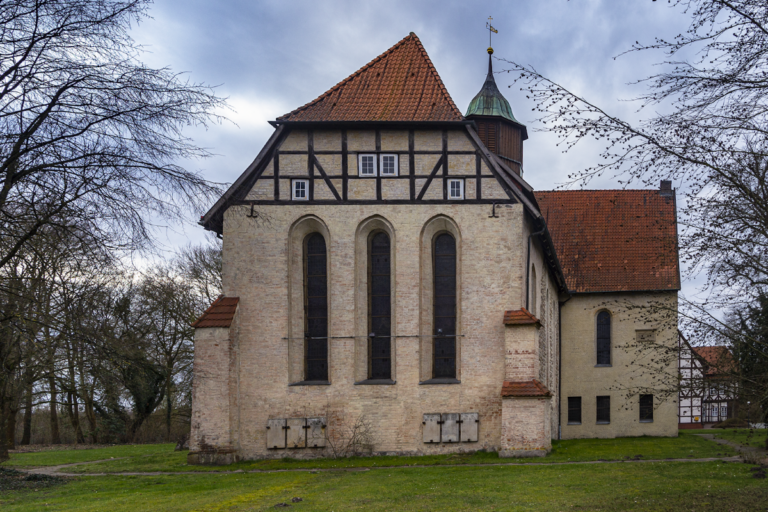
Exterior memorials
Grave slabs and memorial stones belonging to mayors, pastors, and their relatives are mounted on the exterior facade. They were transferred from the cemetery that formerly surrounded the church. Among them are a 1636 memorial to the twelve-year-old daughter of a Uelzen mayor, a memorial to a mayor and his second wife, a seventeenth-century tombstone for a pastor and his wife, and a memorial to the seven-year-old daughter of a provost who died of plague in 1597.