Klosterkirche Oldenstadt: A Romanesque Benedictine Monastery Church in Germany


Site at a Glance
- Rating
- 4.5
- Popularity
- Very Low
- Country
- Germany
- Primary era
- Medieval
- External website
- Open
- Eras represented
- Medieval, Early Modern
- Civilizations
- Holy Roman Empire
- Site type
- Religious
- Remains
- Church
On this page11 sections
History
Klosterkirche Oldenstadt is a Romanesque church in Germany, within the urban area of Uelzen, built as the monastery church of Benedictine monks between about 1150 and 1200. It is the surviving part of the former Oldenstadt monastery, a foundation regarded as the nucleus of the Hanseatic city of Uelzen. Its history reaches back to the Christianization of the region and to several earlier churches on the same site.
The early Christian foundations
Bishop Bruno I of Verden founded a community for canonesses, women living in a religious foundation under ecclesiastical rules, on the Ullishusen estate in either 966 or 973. The foundation was dedicated to Mary and St John the Baptist and appears in written records from 973 or 974. Its position helped it develop, since Oldenstadt lay on the long-distance route linking Goslar with Brunswick and Lüneburg, near a crossing of the Wipperau.
Excavations revealed three earlier churches. The oldest was a single-nave wooden building dating from around or before 800. A second wooden church with the same plan was later destroyed by fire, and it was followed by a three-nave basilica built of fieldstone during the Ottonian period, the tenth and early eleventh centuries shaped by the Ottonian ruling dynasty. This basilica was probably constructed for the canonesses’ foundation and was likely demolished after the foundation ended, before Benedictine monks arrived.
Graves associated with the two wooden churches make Oldenstadt the oldest identified Christian burial place in present-day northeastern Lower Saxony. The association with St John the Baptist, alongside Mary, is recorded from 1006 and probably reflects the church’s regional role as a baptismal church. St John the Baptist, regarded in the Gospels as the forerunner of Jesus, therefore remained central to the site’s religious identity.
The Benedictine monastery
Monks from Corvey, an important Benedictine monastery and missionary center in medieval Saxony, settled at Oldenstadt between 1133 and 1137. The present fieldstone basilica was probably erected between 1150 and 1200 for their community. Benedictines followed the Rule of Saint Benedict, a Western Christian monastic tradition that regulated communal religious life.
Reformation and later use
The monastery was dissolved during the Reformation under Abbot Heyno Gottschalk in 1529 or 1531. The Reformation was the sixteenth-century movement that brought major changes and divisions within Western Christianity. After the dissolution, only the eastern part of the church continued to function as a worship space, and that section was extended seven metres eastward in 1728.
Following the Reformation, the church and former monastic estate belonged to the Duke of Brunswick-Lüneburg. A weather vane bearing the ducal arms and dated 1621 recalls this phase. The church is now the center of the Evangelical Lutheran congregation of Oldenstadt, within the Uelzen church district of the Evangelical Lutheran State Church of Hanover, and continues to be used for worship.
Remains
Church layout and surviving fabric
Eastern church
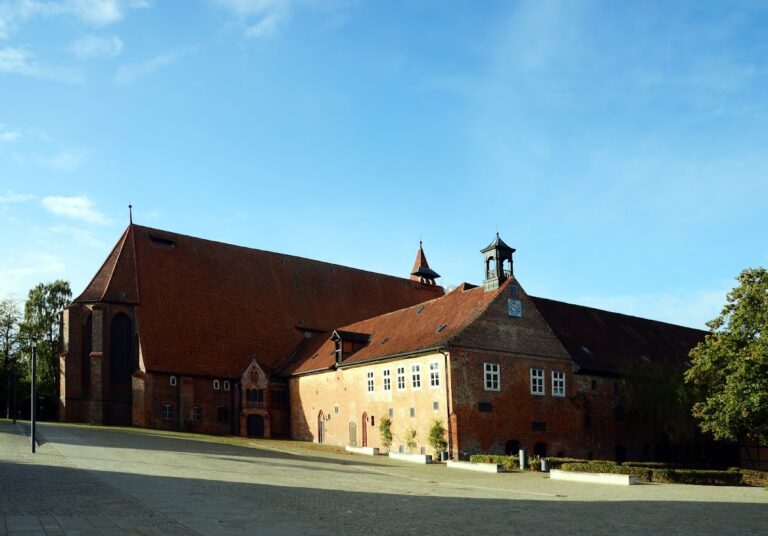
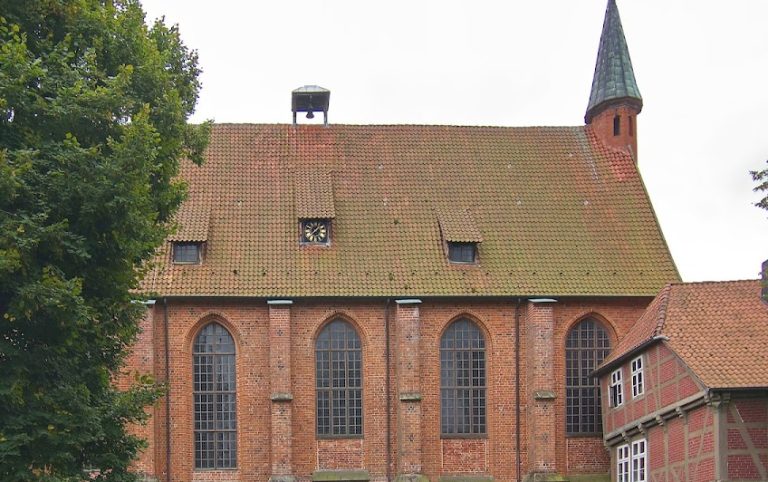
The surviving church is a fieldstone basilica approximately 47 metres long and 25 metres wide, with an internal width of 12 metres. The former crossing and the monks’ choir make up much of the present parish church. This eastern part remained the worship space after the monastery was dissolved and was lengthened by seven metres in 1728.
Nave and westwork
To the west lies the former congregational area, originally formed by a nave with two narrow aisles. The nave ended in a westwork with two towers, but only the outlines of its foundations remain visible. The partition between the nave and the eastern church preserves remains of a Gothic rood screen on the nave side. A rood screen was a medieval partition separating the clergy’s area from the congregation. The former nave is now owned by the Uelzen district and is used for exhibitions and concerts.
Fittings, windows, and music
Altar, baptismal angel, and stained glass
Most of the interior furnishings date from approximately the last 150 years and give the church its present Neoclassical character. The central pulpit altar predates 1770. Above its sounding board, an eye within a triangle represents the Trinity, the Christian belief in one God in three persons. Since 2006, paintings by Hermann Buß of Norden have adorned the pulpit basket, including local motifs such as the grave monument before the church with its butterfly symbol and the Klein Liederner stream.
A Neoclassical baptismal angel by Friedrich Pfannschmidt of Berlin dates from 1901. Three late-Romantic windows behind the pulpit altar were made in 1909 by the Ferdinand Müller workshop in Quedlinburg. They depict the story of Jesus’s birth, from the Annunciation to Mary to the Adoration of the Magi. Three north-side nave windows, made by Alois Plum of Mainz in 1998, recall the life of St John the Baptist. A 1960 south-side window by Renate Strasser of Bielefeld depicts Jesus delivering the Sermon on the Mount, while a postwar south-transept window uses abstract forms to evoke the Last Supper.
Bells and organ
A roof turret carries the 1621 weather vane with the Brunswick-Lüneburg ducal arms. The three bells include one Gothic bell from the monastery period, dating from the fourteenth or fifteenth century, and two twentieth-century bells made in 1930 and 1957.
The organ stands on the gallery in the northern transept. Ernst Röver of Hausneindorf built the original instrument in 1909 with a Baroque-inspired Neoclassical façade. That instrument no longer survives in its original form. In 1971, Ludwig Hoffmann of Betheln fundamentally rearranged it and added a rear-positive, a smaller organ division positioned behind the organist in the gallery rail.