St. Jakobi: A Gothic Maritime Parish Church in Lübeck


Site at a Glance
- Rating
- 4.6
- Popularity
- Medium
- Country
- Germany
- Primary era
- Medieval
- External website
- Open
- Eras represented
- Medieval, Early Modern, Modern
- Civilizations
- German, Holy Roman Empire
- Site type
- Religious
- Remains
- Church
On this page19 sections
History
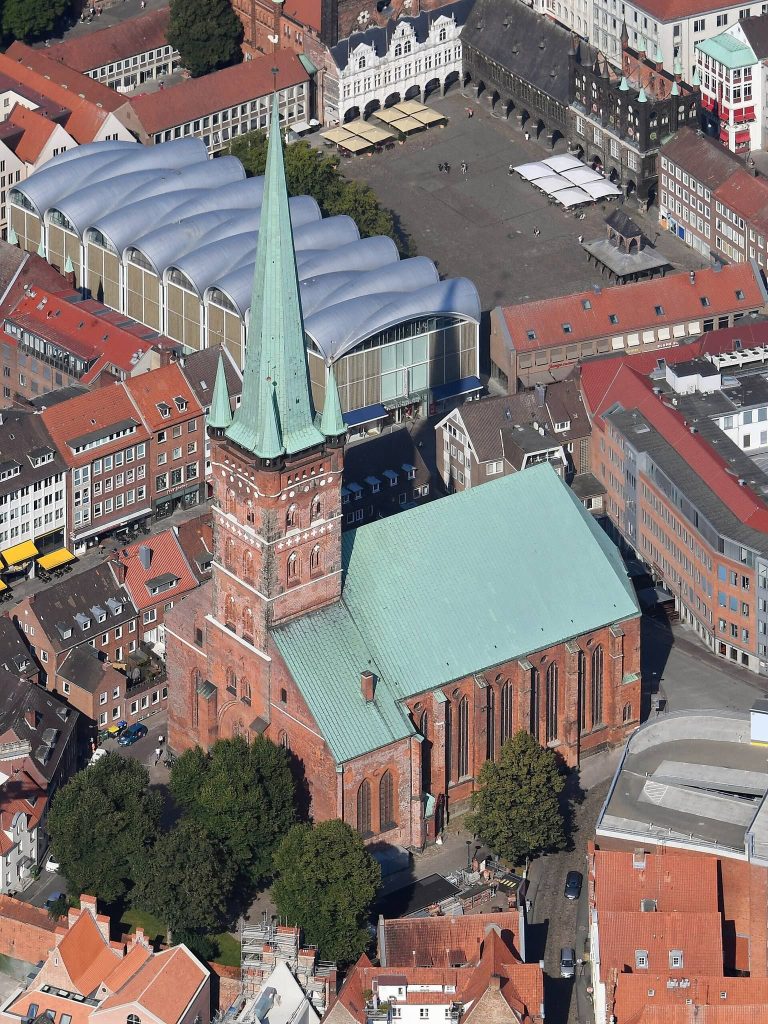
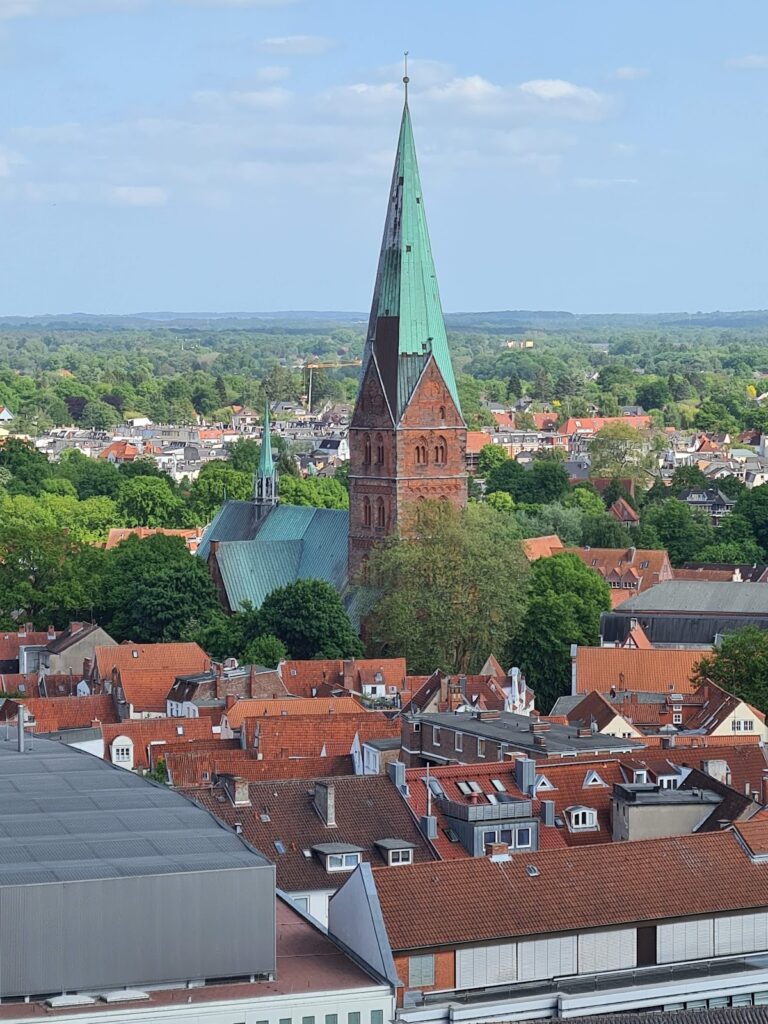
St. Jakobi is a Gothic brick parish church in Lübeck, Germany, consecrated in 1334 for the city’s sailors and fishermen. One of the five principal Evangelical Lutheran parish churches in Lübeck’s Old Town, it stands on Koberg and remains dedicated to Saint James the Elder, the traditional patron of pilgrims. The church forms part of the UNESCO World Heritage property of Lübeck’s Old Town, listed since 1987.
From Romanesque church to Gothic rebuilding
A Romanesque hall church occupied the site by about 1227. A new altar was endowed in 1287, and the altar is recorded in 1312. After Lübeck’s great city fire of 1276, the earlier building was replaced by the present Gothic church, whose main construction dates from around 1300. Bishop Heinrich II Bochholt consecrated the new altar table and choir in 1334.
The fabric of the church preserves evidence of changing plans during construction. Work began on a central single-tower church, but the substantial chapels beside the tower indicate that a two-tower design was later considered. The builders also began altering the hall-church plan toward a basilica, in which the central nave rises clearly above the side aisles and is normally lit by an upper row of windows. That conversion was left incomplete, and St. Jakobi retained its hall-church arrangement.
A church of Lübeck’s maritime community
St. Jakobi’s original purpose was closely tied to the city’s seafaring population. Sailors and fishermen maintained their meeting house, the Schütting, in the Schiffergesellschaft opposite the church. The dedication to Saint James the Elder also connected the church with pilgrimage. Together with the Holy Spirit Hospital and the neighboring Gertrudenherberge, St. Jakobi is a station on a branch of the North German Way of St. James.
The church’s chapels reflect the religious and civic life of medieval Lübeck. The Brömsen Chapel began with a foundation made by Canon Detmar Schulop in 1338. Mayor Heinrich Brömse acquired it in 1488, and his family held it until 1826. It returned to the church in 1877 through a family executor. The neighboring Vellin, or Warendorp, Chapel was founded by Councilor Gotthardt Vellin, who died in 1350. After his widow’s death, it passed to the Warendorp family, which retained it until the eighteenth century.
The Hoghehus, also called the Haleholtscho Chapel, was founded by Konrad Hogehus, who died in 1351. It later passed to the Haleholtscho and Warendorp families, and then to the von Dorne family in 1712. Two further chapels on the western north side are recorded from 1392. The chapel beneath the central tower belonged to the brewers’ guild. The chapel north of the tower was named the Witten Chapel after Mayor Hinrich Witte and later became known as the Pallbearers’ Chapel because equipment was stored there. The southern tower chapel was formerly the Marientiden Chapel.
Storms, fire, and changing use
The tower roof suffered severe storm damage in 1375, when a quarter of it was blown into the courtyard of the Holy Spirit Hospital. In 1628 the tower was dismantled down to the bells, its masonry was renewed, and it received a simple wooden roof in 1636. The spire was rebuilt in 1657 and 1658, when it acquired its four corner balls. Lightning struck the tower several times, most recently in 1901, when the top burned for about a day.
Renovation work at the end of the nineteenth century led to the rediscovery of important medieval frescoes. In 1930 Pastor Axel Werner Kühl brought the church musician Bruno Grusnick to the congregation as cantor. Through the mediation of Günther Ramin, the composer and church musician Hugo Distler became organist in 1931. St. Jakobi consequently became an important center of the renewal movement in Protestant church music during the late Weimar Republic.
St. Jakobi was one of the few Lübeck churches to remain undamaged during the bombing raid on Palm Sunday night in 1942. Its survival preserved Lübeck’s two remaining historic organs. In 2016, restoration of the box pews revealed colored devotional and edifying sheets from the mid-seventeenth century inside locked prayer-book compartments. The compartments were opened in June 2018, and the sheets were fully documented. Nearly all survive as unique examples in their original state of use.
Memorials and continuing religious associations
In September 2007 the northern tower chapel became the Pamir Chapel, a national memorial for civil seafaring. It commemorates the sinking of the four-masted sailing barque Pamir in 1957, when 80 of the 86 crew members died. The memorial was formally declared a National Memorial for Civil Seafaring on 21 September 2007, and a columbarium, a chamber with niches for cremation urns, was established beneath the chapel in the same year.
A relief plaque on the exterior north wall of the nave marks the first station of Lübeck’s Way of the Cross, described as the oldest surviving Way of the Cross in Germany. The route continues through Breite Straße to the Chancellery building, returns through Große Burgstraße and the Burgtor, crosses the Burgfeld, and ends on Jerusalemsberg in the suburb of St. Gertrud.
Remains
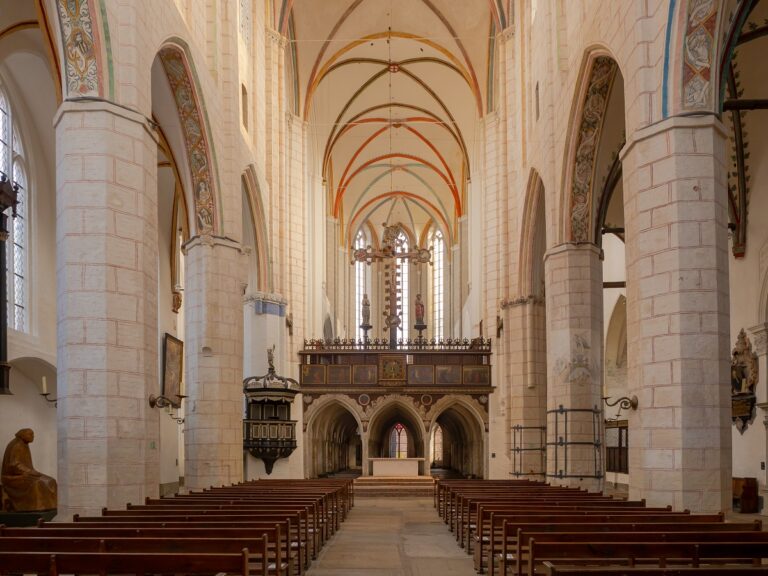
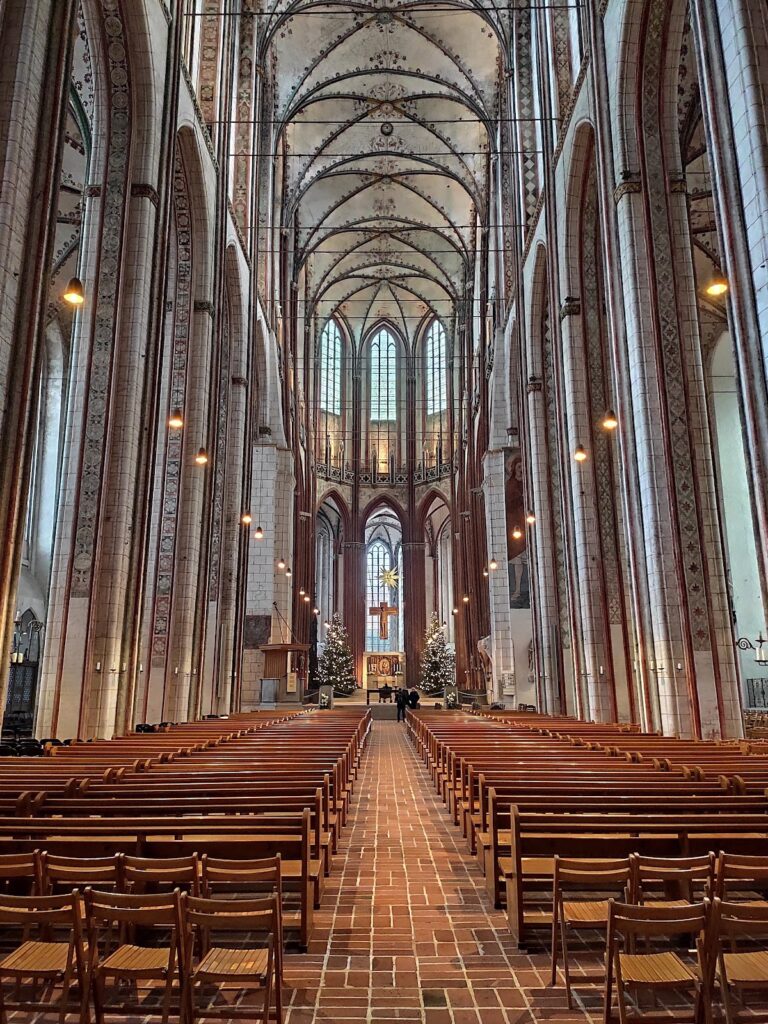
St. Jakobi survives as a three-aisled brick hall church with five bays. Each aisle ends in an eastern choir, while the walls of the central nave rise five meters above those of the side aisles. Round-arch friezes around the tower and sections of the aisle walls are believed to incorporate elements of the earlier Romanesque church. The surviving building therefore combines evidence of the medieval rebuilding with traces of the structure that preceded it.
Church fabric and tower
Main church
The church’s hall arrangement gives the nave and side aisles broadly comparable height, although the central nave rises above them. Its brick construction and five-bay plan belong to the Gothic rebuilding begun around 1300. The eastern ends of the aisles form their own choirs, creating a layered interior arrangement around the central space. The building’s incomplete change toward a basilica remains legible in the relationship between the nave walls and the lower side aisles.
Main tower
The tower originally rose only two complete stories above the ridge of the central nave. Pointed gables stood above these stories, followed by an octagonal pyramidal spire. The upper portion rebuilt in 1657 and 1658 carries four corner balls, a feature related to the corner turrets of St. Petri but not copied from them. A copper-engraved document by Lübeck master calculator Arnold Möller records the rebuilding and the people involved.
Roof turret and sacristy
The present roof turret, a small turret rising from the roof rather than the main ground plan, is a Baroque structure dating from 1622 to 1628. An earlier turret was erected in 1496, blown down in a storm, and rebuilt by the middle of the sixteenth century. The lower section of the present turret retains late Gothic features, including pinnacles, while its bell-bearing lantern and spire show Renaissance influence. Its upper part has delicate finials with gilded flags and a vase frieze from which the pinnacles rise.
The sacristy was added on the southeast side at the beginning of the fifteenth century. Its wooden paneling, dated 1667, carries a shell motif associated with the scallop shell of pilgrimage to the shrine of Saint James at Santiago de Compostela.
Chapels and associated buildings
Brömsen Chapel
The Brömsen Chapel occupies the south side of the church and contains the Brömsen Altar. The altar was donated by Mayor Heinrich Brömse around 1490 to 1500. Its central relief is attributed to the workshop of the Westphalian sculptor Evert van Roden, while the Brömse family shown on the wings was added around 1515. The work is regarded as one of Lübeck’s important artworks because of its highly accomplished composition.
Vellin and Warendorp Chapel
The Vellin, or Warendorp, Chapel stands beside the Brömsen Chapel. Its foundation by Councilor Gotthardt Vellin and later connection with the Warendorp family are reflected in its name and position among the church’s side chapels.
Hoghehus Chapel
The Hoghehus, or Haleholtscho, Chapel is on the north side, opposite the Brömsen Chapel. Founded by Konrad Hogehus, it subsequently passed through the Haleholtscho and Warendorp families before coming to the von Dorne family in 1712.
Pamir Chapel
The northern tower chapel contains the Pamir memorial and the wrecked lifeboat from the Pamir. The columbarium lies beneath the chapel. Together, these physical features connect the medieval church’s maritime associations with a twentieth-century memorial to civil seafaring.
Altars, baptismal font, and organs
Altars and baptismal font
The present high altar was made by Hieronymus Hassenberg in 1717 and donated by Mayor Hermann Rodde, whose bust is mounted on it. The earlier high-altarpiece, made in 1435, is a triptych, a three-part altarpiece with a central section and two hinged wings. Attributed to the Master of the St. James Altar, it is now held in the medieval collection of the Schwerin State Museum at Güstrow Castle and is the oldest surviving Lübeck high-altarpiece.
The bronze baptismal font was cast by Klaus Grude in 1466. The pulpit dates from 1698. Parts of the earlier pulpit made in 1577 have been in St. Thomas’s Church in Tribsees since 1735.
Historic organs
The large organ on the west wall began as a Gothic blockwerk, an early organ formed from a single unified set of pipes, and was enlarged and altered repeatedly during the Baroque period. The smaller northern instrument, known as the Stellwagen organ, also developed from a medieval organ dating from 1467. Friedrich Stellwagen rebuilt and enlarged it in 1636 and 1637. The Stellwagen organ is regarded as among the most important organs in Europe. The gallery beneath the large organ was enlarged in 1932 for a larger choir and a small orchestra.
Clock, bells, and exterior memorial
The tower clock is a one-hand clock displaying the hours. On 20 February 2019, the hand from the northern dial detached and fell 50 meters onto the church forecourt. Material testing attributed the failure to fatigue in a load-bearing screw. The bell chamber contains four bells, which are rung individually, in groups, or together for specified occasions including Good Friday, weekday hours, worship, Christmas, and New Year.
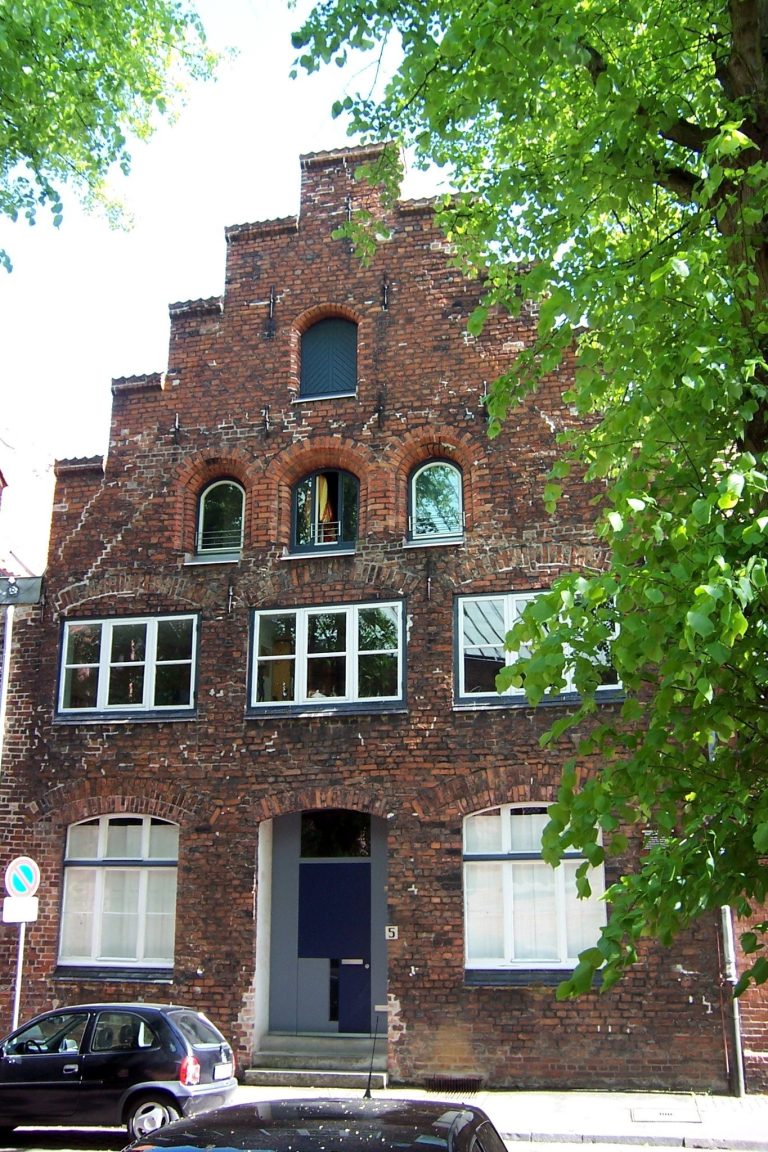
The relief plaque marking the first station of the Lübeck Way of the Cross is fixed to the exterior north wall of the nave. Beside the church on Jakobikirchhof toward Koberg stand the pastors’ houses, built in the Dutch Brick Renaissance style.