Coldingham Priory: A Benedictine Monastic House in Scotland


Site at a Glance
- Rating
- 4.6
- Popularity
- Low
- Country
- United Kingdom
- Primary era
- Medieval
- Eras represented
- Medieval
- Civilizations
- Kingdom of Scotland
- Site type
- Religious
- Remains
- Monastery
On this page12 sections
History
Coldingham Priory is a Benedictine house in Scotland whose church was constructed and consecrated around 1100, within the medieval Romanesque tradition. The priory stood at Coldingham in Berwickshire and belonged for centuries to Durham Cathedral Priory, while lying within the Diocese of St Andrews. Its dependent religious community controlled churches across the surrounding region, including those at Aldcambus, Ayton, Berwick, Coldingham, Earlston, Ednam, Edrom, Fishwick, Foulden, Gordon, Lamberton, Mordington, Nenthorn, Smailholm, Stichill, and Swinton.
The monastery of St Æbbe
An earlier monastery was founded at Coldingham by St Æbbe the Elder around AD 640. She was an early medieval Northumbrian royal woman and Christian founder, and her community was associated with the conversion of Northumbria and with the Columban tradition linked to Lindisfarne and Iona. The monastery was a double house for monks and nuns, probably occupying Kirk Hill on the headland now known as St Abb’s Head. A deep trench and high palisade enclosed the settlement.
St Cuthbert came to Coldingham in 661 to instruct the community. The monastery burned in 679, shortly after Æbbe’s death, and was rebuilt. It probably became a community of nuns again during the eighth or ninth century, and devotion to St Æbbe remained strong when the later Benedictine foundation was created.
A later St Æbbe, described as a semi-mythical abbess, became associated with a story about a Danish attack in 870. According to the legend, the nuns mutilated themselves to avoid sexual assault before being killed as martyrs. The tale was first written down about 250 years later and has no support in near-contemporary evidence.
The Benedictine foundation
King Edgar of Scotland confirmed Durham’s possession of the lands of Coldingham in 1098. A church was built there and dedicated to St Mary in 1100. The Benedictine priory was founded during the reign of David I, the twelfth-century Scottish king associated with the expansion of reformed religious institutions, although its precise foundation date remains uncertain. The first recorded prior appears in 1147, and within fifty years the community had accumulated enough land charters to be treated as a priory.
The religious house appears to have moved from the earlier site at St Abb’s Head to its present location around the time of the eleventh- or early twelfth-century refoundation. Coldingham remained subordinate to Durham until the fourteenth century. In 1378, Robert II transferred it to Dunfermline Abbey, declaring that the English monks threatened the king and kingdom and had harmed the surrounding district.
Conflict and changing control
The transfer followed accusations against Prior William Claxton, including espionage, unlawful export of money, sacrilege, robbery, homicide, rape, devastation, and offences against Robert II. Claxton was removed in 1379 and replaced by Michael of Inverkeithing, a monk of Dunfermline. The change took place during the papal schism, when Scotland supported Clement VII and England supported Urban VI. This division prevented the Durham monks from defending their position through an appeal recognised in England.
Dunfermline exercised effective control after the transfer, granting Coldingham lands to George Dunbar, Earl of March, in 1380 and probably to Sir John Swinton in 1382. The priory later became the caput, or administrative head, of the Barony of Coldingham, and its prior served as the barony’s feudal lord. A royal charter issued on 2 January 1392 confirmed the priory in its ancient possessions.
The church was destroyed on the order of King John of England in January 1216 during the Scottish-English war. A substantially larger church was later built with a cruciform plan. In November 1528, the Earl of Angus stayed at Coldingham and wrote to the Earl of Northumberland and Henry VIII about his success against James V’s forces, which were besieging Tantallon Castle.
During the Rough Wooing, the series of Anglo-Scottish wars fought mainly in the 1540s after Henry VIII sought to force a marriage alliance between the two royal houses, George Douglas installed a garrison at Coldingham. John Hume expelled it in April 1544, but English forces led by Sir George Bowes, John Widdrington, Henry Eure, and Lionel Grey burned the claustral buildings in June. Regent Arran briefly placed six gunners at the priory in October. Henry VIII then ordered Coldingham to be captured and fortified. George Bowes retook it in November, and William Eure sent Bowes with the military engineer Archangelo Arcano to establish a fort. Bowes became petty-captain with 100 men, gunners from Berwick, and ten Irish arquebusiers.
Secular ownership and destruction
After the Reformation, the priory and barony passed into secular hands. Alexander Home, 1st Earl of Home, took possession in 1592 and moved into the priory with his wife, Christian Douglas. They arranged repairs and brought furniture into the hall and chamber. The priory was disestablished in 1606. John Stewart, the second son of Francis Stewart, 1st Earl of Bothwell, was its last commendator, a lay or clerical administrator who held the rights and revenues of a former monastic house after its community had declined or ended.
In 1621, the Crown made the barony a temporal lordship and granted John Stewart a charter uniting the priory’s lands and baronies. He transferred them in 1622 to his elder brother, Francis Stewart. In a petition to Charles I dated 4 April 1636, Coldingham’s feuars and tenants still described themselves as the “vassals of the Abbacy of Coldingham.” They complained of oppression by the Stewarts and asked the king to become the sole superior lord.
The church was severely damaged during Cromwell’s campaigns by 1648, and the priory was largely destroyed by 1650. Its monastic function had already ended, although religious activity continued in part until the damage caused during the campaigns. Harry Home of Renton took the barony from the Stewarts in settlement of a debt during the 1650s and transferred his claim to Alexander Home. About seventy feu-holders held land in the barony in 1857; feudal land tenure was abolished in Scotland in 2005.
Parish church and conservation
The surviving church became the Church of Scotland parish church of Coldingham. The priory was placed in Scotland’s highest Category A listing in 1971, while the wider claustral remains received designation as a Scheduled Monument, a site protected under Scottish law for its national archaeological or historical importance. Later conservation addressed erosion, vegetation growth, and the risk of collapse, helping to preserve the ruins and support their continuing community use.
Remains
The surviving site combines the remains of two medieval churches with the parish church that developed from the former priory complex. The earliest monastery occupied a defended headland at Kirk Hill, while the later Benedictine house stood at the present Coldingham location. Medieval fabric survives in Romanesque and Gothic forms, together with fragments of the thirteenth-century rebuilding. The ruins were once badly eroded and overgrown, but conservation stabilised them, reinstated paths, and improved the surrounding grounds.
The earlier monastery at St Abb’s Head
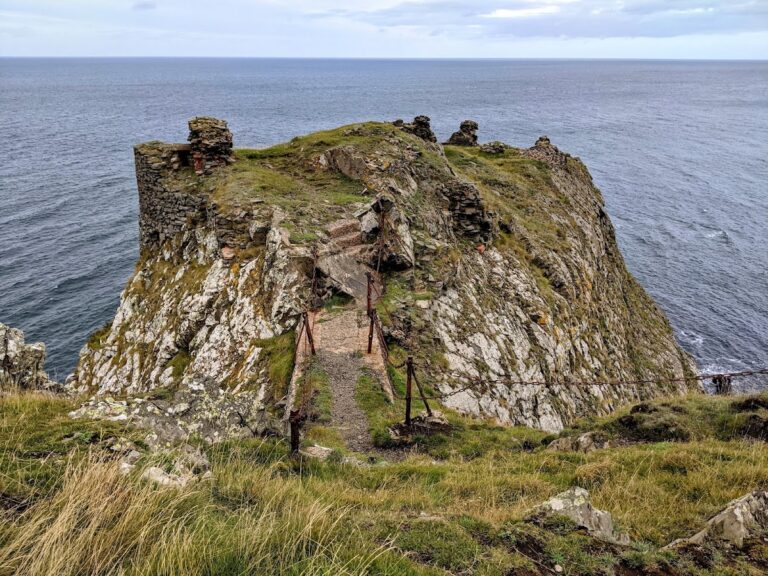
Kirk Hill preserves the physical setting of the early monastery associated with St Æbbe. Its remains include a defensive trench, several grassy mounds, and the ruins of a fourteenth-century church built by monks of the later priory. These features occupy the headland now called St Abb’s Head and represent the earlier monastic location from which the religious house appears to have moved during its later refoundation.
The medieval church and parish building
The former priory church
The present priory site contains remains of the church built around 1100 and of the larger cruciform church raised after the destruction ordered in 1216. The surviving masonry incorporates Romanesque and Gothic elements, as well as remnants of the thirteenth-century building. These fragments form part of the present parish church and preserve evidence of the successive medieval phases of construction.
The surviving parish church
The present church developed from the south wing of the former priory church. Its restored choir forms the surviving medieval portion and remains in use for Church of Scotland worship. A bell tower added in 1662 collapsed around 1770, and a fire devastated the church in 1745. Poor overall condition was noted in 1851, followed by renovation in 1856. During the nineteenth century, stone from the former priory was reused in restoring the church. Coldingham is described as the only major medieval church in south-east Scotland whose surviving remains continue in use as an active church.
Claustral ruins and community garden
The external ruins include the wider remains of the former claustral buildings, whose erosion, overgrowth, and instability were addressed by later conservation. The work included stabilising the masonry and reinstating footpaths. Adjoining wasteland was converted into a monastic-themed community garden with culinary, medicinal, and aromatic plants. Interpretation boards and educational activities for schools and community groups form part of the conservation project’s continuing use of the site.