St Martin’s Church: A Christian Church Above Diocletian’s Palace


Site at a Glance
- Rating
- 4.7
- Popularity
- Very Low
- Country
- Croatia
- Primary era
- Classical
- Eras represented
- Classical, Medieval
- Civilizations
- Byzantine, Kingdom of Croatia, Roman, Venetian
- Site type
- Religious
- Remains
- Church
On this page10 sections
History
St Martin’s Church is a Roman Catholic church of the Roman Rite in Split, Croatia, occupying a former Roman guardhouse above the Golden Gate of Diocletian’s Palace. The narrow military space was converted for Christian worship during the sixth century, making the church one of Split’s oldest. Its development continued through a pre-Romanesque renovation in the ninth century and later medieval changes.
From Palace Guardhouse to Church
Diocletian’s Palace was the fortified imperial residence of the Roman emperor Diocletian, who ruled from AD 285 to 305. Its walls, gates, and guard passages later offered spaces for Christian reuse. St Martin’s Church was created when the former guardhouse was adapted for worship, probably during the sixth century as refugees from communities around Split entered the palace complex.
The church was first dedicated to the Virgin Mary, Pope Gregory I, and St Martin of Tours, a fourth-century Christian bishop widely venerated in western Europe and associated with soldiers. Its later dedication is principally to St Martin. The church’s position above a palace gate formed part of a broader transformation of the complex, where Christian places of worship were also created above other entrances.
The Ninth-Century Renovation
During the rule of Duke Trpimir, the priest Dominic renovated the former guardhouse as a Christian church. Trpimir was a ninth-century Croatian duke whose reign is associated with the early institutional development of Christianity and Benedictine monasticism in Croatia. An inscription identifies Dominic as the duke’s chaplain and invokes God while describing the church as established in honor of St Martin within the small cavern.
A charter issued by Trpimir on 4 March 852 records his decision to build a church, possibly St Martin’s, and the first Benedictine monastery at Rižinice, a locality in the Split region. The charter is associated with the introduction of the Benedictines, monks and nuns who follow the Rule of Saint Benedict, into Croatia. Another chaplain named Martin is also mentioned in the altar-screen inscription.
Medieval Reuse and Rediscovery
A monastery for Dominican sisters was established beside the church during the Middle Ages and is first mentioned in 1372. Dominican sisters belong to a Catholic religious order traditionally devoted to preaching, study, and religious education. Following one of the city’s plague epidemics, the monastery was rebuilt and the church was converted into a storage space.
Archaeologist Frane Bulić rediscovered the church in 1890 while investigating Diocletian’s Palace and recommended its renovation. The work included a new altar and pavement. In 1929, a tablet carrying the inscription identifying the “unworthy servant, priest Dominic, chaplain of Duke Trpimir” was found when a window was enlarged. Bulić considered it possibly Dominic’s gravestone; the tablet is now held by the Archaeological Museum. The church has national-monument status and is listed in the Register of Cultural Goods of Croatia. It remains cared for by the Dominican sisters whose monastery stands beside it.
Remains
The Narrow Church and Its Walls
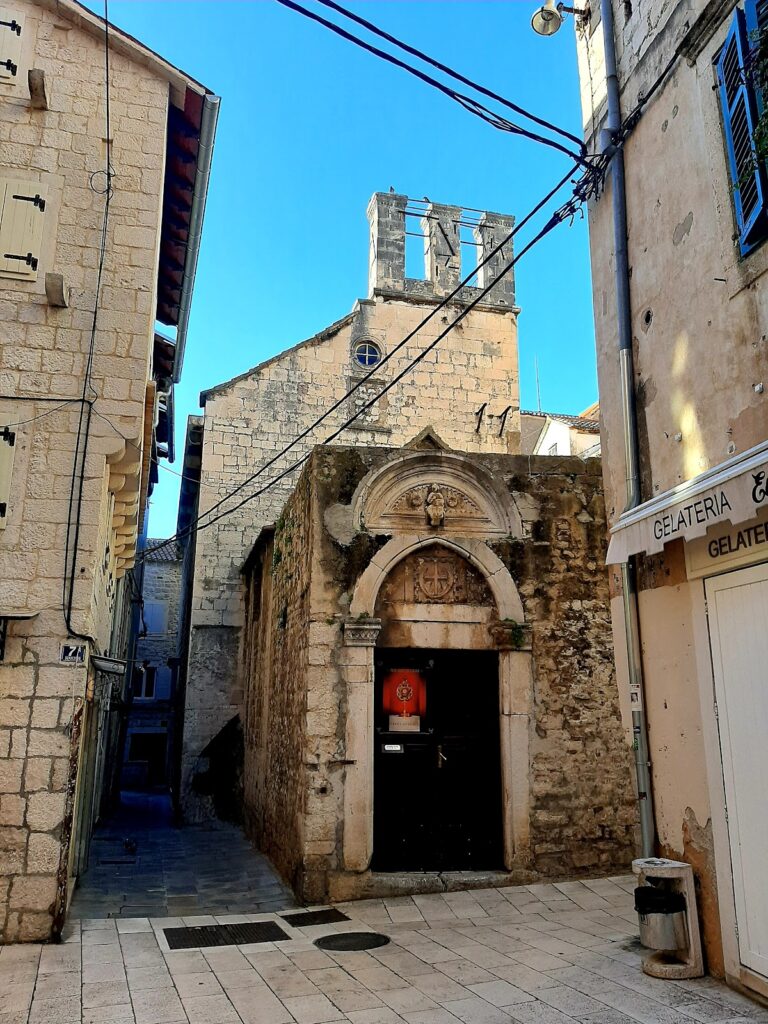
St Martin’s occupies a narrow cavity in the west wall of Diocletian’s Palace, directly above the Golden Gate. The space is approximately 10 metres long and 1.64 metres wide, dimensions inherited from its earlier use as a guard corridor. The southern windows once allowed guards to watch the approach to the palace’s main entrance. They are now blocked, although their original forms survive, and smaller windows were later opened within the blocked openings.
Openings on the northern side belong to the medieval period, more specifically to the fifteenth-century defence of Split against the Ottoman Turks. They served as loopholes, narrow openings used by defenders. An iron grille that once descended during danger to the fortress was later removed. Together, the preserved windows and defensive openings reveal how the same confined space served both palace security and later religious use.
The Early Medieval Sanctuary
The interior is divided by a marble altar screen, or chancel screen, a barrier separating the clergy’s sanctuary from the nave used by the congregation. Decorated with vines, grapevines, and griffins, it is described as the only altar screen preserved in place in Dalmatia. Its gable bears an inscription dedicating the church to the Virgin Mary, Pope Gregory, and Blessed Martin.
Ninth-Century Features
The church’s probably ninth-century pre-Romanesque phase includes a barrel vault, a continuous curved ceiling, together with an apse altar, a sanctuary end containing the altar, carved with an early Christian cross. A small transenna, a pierced stone screen or window element, is set centrally within large blocked ancient openings in the southern wall. The main altar also dates from the ninth century.
Later Medieval Additions
The altar screen belongs to a later eleventh-century phase, as does the pre-Romanesque bell tower that once rose above the church. The tower was demolished in the nineteenth century. The surviving altar screen therefore preserves a later medieval alteration within a building whose narrow Roman framework and ninth-century sanctuary features remain central to its present form.
The Golden Gate Setting
The northern entrance of Diocletian’s Palace was originally elaborately decorated. Niches in its upper level held statues of the emperors Diocletian and Maximian, with an eagle representing Jupiter between them. Lower niches contained the Caesars Galerius and Constantine. Four statue pedestals survive on the top of the wall, while eighteenth-century drawings showed five. The reason for the apparent duplication of imperial imagery on the façade remains uncertain.
St Martin’s belongs to a wider group of churches associated with the palace gates. A church dedicated to St Theodore stood above the Iron Gate, and St Apollinaris was associated with the Silver Gate. St Julian’s Church stood above the Bronze Gate. These buildings demonstrate the later Christian reuse of spaces connected with the palace’s original entrances.
Nearby sites