St Martin’s Basilica, Liège: A Late Gothic Pilgrimage Church


Site at a Glance
- Rating
- 4.6
- Popularity
- Low
- Country
- Belgium
- Primary era
- Early Modern
- External website
- Open
- Eras represented
- Early Modern, Modern
- Civilizations
- Holy Roman Empire
- Site type
- Religious
- Remains
- Basilica
On this page10 sections
History
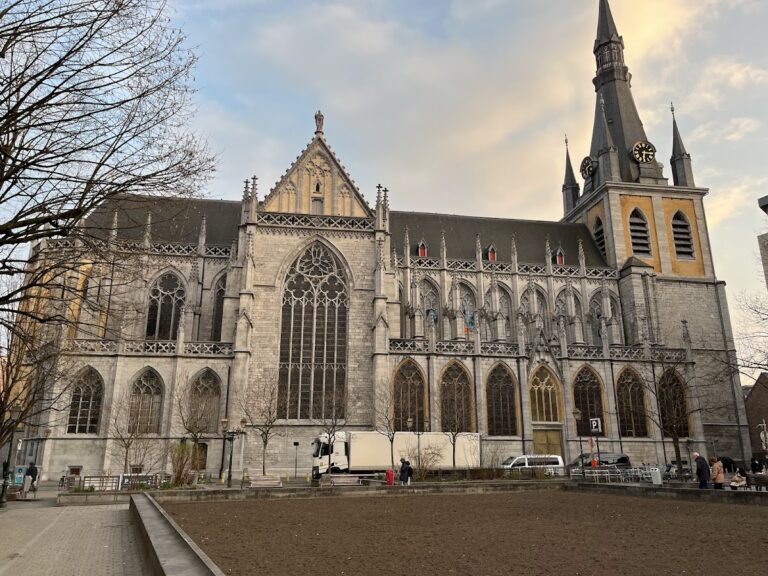
St Martin’s Basilica, Liège, is a Roman Catholic church in Belgium and one of the city’s former seven collegiate churches. The present building is a late Gothic basilica constructed between 1506 and 1542, but its history reaches back to a tenth-century foundation on Publémont hill. It belongs to the Diocese of Liège and follows the Roman rite.
Foundation and collegiate chapter
Tradition connects the church’s origin with Bishop Éracle, a tenth-century bishop of Liège. After experiencing a miraculous healing at the tomb of Saint Martin of Tours, a fourth-century Christian bishop and major saint of Western Christianity, Éracle is said to have founded a church dedicated to him on Publémont in 962. He endowed the foundation from his own property and established thirty canons, chaplains, and other clergy.
On 2 June 965, Éracle issued the foundation charter for a church intended to become Liège’s new cathedral. Its proposed dedication was to the Virgin Mary and Saint Lambert. His successor, Bishop Notger, redirected the dedication to Saint Martin and made the church the seat of a collegiate chapter. A collegiate church was served by a chapter of canons rather than by monks, and its liturgy required a substantial choir for the canons’ duties.
Destruction and rebuilding
The original church was a Romanesque building of the tenth century. It was burned during the uprising of 3 and 4 August 1312, an episode known as the Mal Saint-Martin, or Saint-Martin catastrophe. Nobles had taken refuge inside the church, and several dozen died in the fire.
The present church replaced that earlier building during the rule of Prince-Bishop Érard de La Marck. Construction ran from 1506 to 1542 and followed plans by the architect Paul de Ryckel. The new church preserved Saint Martin’s collegiate identity while providing the setting for later religious practices associated with the Blessed Sacrament.
Corpus Christi and Eucharistic devotion
Saint Martin became closely associated with the Feast of Corpus Christi, also called the Feast of the Blessed Sacrament. This Christian feast is devoted to the Eucharist. Its first liturgical celebration took place at Saint Martin in 1246, following the efforts of Juliana of Cornillon, a thirteenth-century religious visionary, and Eve of Saint Martin, a religious recluse associated with the church. The feast later developed into an important pilgrimage tradition connected with Saint Martin.
Eucharistic devotion at the collegiate church grew through the establishment of the Confraternity of the Blessed Sacrament, the strengthening of the Perpetual Adoration confraternity from 1765, and the creation of a chapel devoted exclusively to Eucharistic worship. In 1846, Felix Mendelssohn’s Lauda Sion, commissioned for the six-hundredth anniversary of Corpus Christi, received its first performance at the basilica during the feast on 11 June. Mendelssohn was present.
Parish church and basilica
The collegiate chapter remained attached to the church until Liège’s chapters were suppressed under French rule in 1795. Saint Martin then became a parish church. The building was restored in 1840 and again in 1871, with the later work carried out by Liège architect Jean-Charles Delsaux.
Pope Leo XIII granted the church the status of minor basilica on 9 May 1886. A minor basilica is a church given a special papal title because of its religious, historical, or pilgrimage importance. At Saint Martin, the title reflected the church’s established connection with the Blessed Sacrament and the Corpus Christi tradition.
In the twentieth century, the church complex, apart from the winter chapel, the gallery organ, and the dismantled Le Picard organ with its instrumental parts and cases, was protected as classified heritage in 1936. It was recognized as exceptional heritage in 2016. The funerals of Julie Lejeune and Mélissa Russo, victims of the Marc Dutroux child-murder case, were held at Saint Martin on 22 August 1996.
Remains
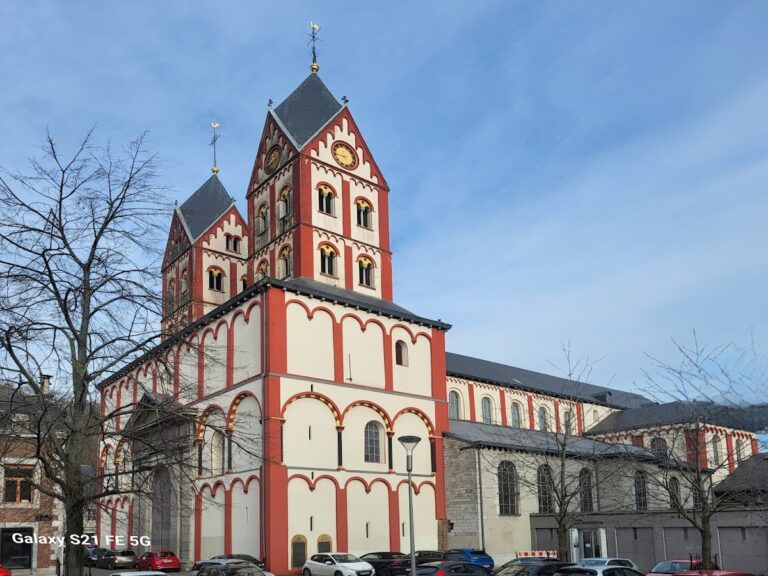
St Martin’s is a three-aisled, cruciform basilica built principally in brick faced with local natural stone or hardstone. Its square bell tower incorporates elements from earlier construction phases. A crypt lies beneath the church, with the sacristy positioned above it in two rooms. The choir occupies approximately one third of the building’s total length, a proportion linked to the church’s original function as the seat of a collegiate chapter.
Choir and liturgical architecture
The choir contains a star vault attributed to Arnold van Mulken, the builder of Liège’s Prince-Bishop’s Palace. The vault was repainted in the nineteenth century. Five choir windows date from the sixteenth-century Renaissance, while most of the other windows are nineteenth-century Neo-Gothic works by Joseph Osterrath, a glass artist of German origin.
At the rear of the church is a Gothic rood screen, a substantial internal partition or gallery separating the nave from the choir and traditionally associated with the display of a crucifix. The high altar is a Baroque work of the eighteenth century. Together with the extended choir, these features express the building’s liturgical organization around the celebration of worship and the duties of its former canons.
Chapels, paintings, and sculpture
The Chapel of the Blessed Sacrament is decorated with medallions by Jean Del Cour. It once contained paintings by Del Cour and Englebert Fisen, but those works were dispersed during the Revolution. Del Cour’s tomb remains in the church. Eight paintings by Fisen, a painter from Liège, are also held in the building.
The church’s sculpture ranges from the fifteenth to the nineteenth century. It includes a wooden Christ by Jean Del Cour and two angels made by Cornélis Vander Veken between 1701 and 1710. Wooden statues of the Virgin and Child and Saint Martin of Tours were made by the Liège sculptor Jacques Vivroux. A polychrome wooden statue of Notre-Dame de Saint-Séverin dates from the sixteenth century.
Memorials and devotional objects
Among the church’s devotional and commemorative features is an early-sixteenth-century Calvary, together with the mausoleum of Éracle, the founder traditionally associated with the church. A reliquary of Blessed Eve and material commemorating the Feast of Corpus Christi preserve the connection between the building and its Eucharistic traditions.
The crypt contains a black Theux-marble funerary monument to Provost Conrad de Gavre, who died in 1602. The church also contains fifteenth- and sixteenth-century tombstones and the tomb of Blessed Eve of Liège, whose association with the Corpus Christi tradition forms part of the site’s religious memory.
Wall paintings
Wall paintings produced by Adolphe Tassin date from 1902 to 1907. They belong to the later artistic history of the building and complement the older Gothic, Renaissance, Baroque, and nineteenth-century elements preserved within the basilica.