Perron of Liège: A Civic Pillar and Fountain
Site at a Glance
- Popularity
- High
- Country
- Belgium
- Primary era
- Early Modern
- Eras represented
- Medieval, Early Modern, Modern
- Civilizations
- Belgian, Holy Roman Empire
- Site type
- Civic
- Remains
- Fountain
On this page9 sections
History
The Perron of Liège is a civic pillar and fountain on the central Market Square in Liège, Belgium. Built in its present form in 1305, it became an emblem of the city’s civic liberties. A perron is a civic pillar associated with public authority and, in some towns, with civic rights. In medieval Liège, a prince-bishop combined church leadership with political rule.
Origins and civic meaning
A fountain stood at the site by 942, while the Perron’s exact age is uncertain. It appears in written references from the twelfth century, during the rule of Prince-Bishop Rudolf of Zähringen, and on a coin from the reign of Prince-Bishop Henri de Leyen (1145–1165). Between 1285 and 1308, a fountain was installed beneath the pillar. After coal-mining operations dried up its spring, the monument was built in its present form in 1305.
The Perron first represented the prince-bishop’s authority and right to administer justice. As the city council and shared civic decision-making gained importance during the Middle Ages, the pillar came to represent civic freedom and independence as well. It served as a place to announce decisions and to stage the ceremonial display and punishment of criminals. Some prince-bishops placed it on their coins, and it has appeared in Liège’s coat of arms since the fourteenth century.
Burgundian rule and return
After the Battle of Brustem, Duke Charles the Bold imposed the Peace of Saint-Laurent as part of his effort to end Liège’s old constitution and public liberties. Following the city’s defeat in its 1468 uprising against Burgundian rule, known as the Third Liège War, Charles had the Perron dismantled and taken to Bruges. He also abolished several independent civic institutions and brought them under centralized control. In Bruges, the pillar was displayed prominently, and Charles had a taunting inscription carved on its pedestal to proclaim his victory.
Charles died near Nancy on 5 January 1477. Prince-Bishop Louis de Bourbon secured the Perron’s return while in Bruges for the wedding of Mary of Burgundy, Charles’s daughter. After a decade away, the monument was restored to its pedestal in Liège on 10 July 1478 amid public celebrations. A Latin inscription commemorated its return and ten years of exile.
Rebuilding and civic use
A storm toppled the Perron at about nine o’clock in the evening on 9 January 1693. Sculptor Jean Del Cour was commissioned to repair it and designed a new fountain, built in 1696–1697. In 1697, he added the Three Graces, figures from classical mythology associated with beauty and grace, holding a pine cone.
During the Belgian Revolution, the 1830–1831 revolt that led to Belgium’s independence from the Netherlands, the Perron served as a gathering place and a site for raising flags. The Liège flag was raised first. After the Belgian victory over the Dutch army in Brussels, in which Liège volunteers took part, Denis François Delemme raised the Belgian flag there.
Renovations in 1848 replaced marble columns with dressed stone and marble basins with cast iron. The fountain opened for public use in July 1864, supplied by underground passages that carried water out of mines.
Restoration and protection
Work in June and July 2012 included a study of how the limestone pieces were assembled, informing plans to return them to their original state. A major restoration began in March 2018. The Perron is protected as a heritage monument and classified as an exceptional monument.
Remains
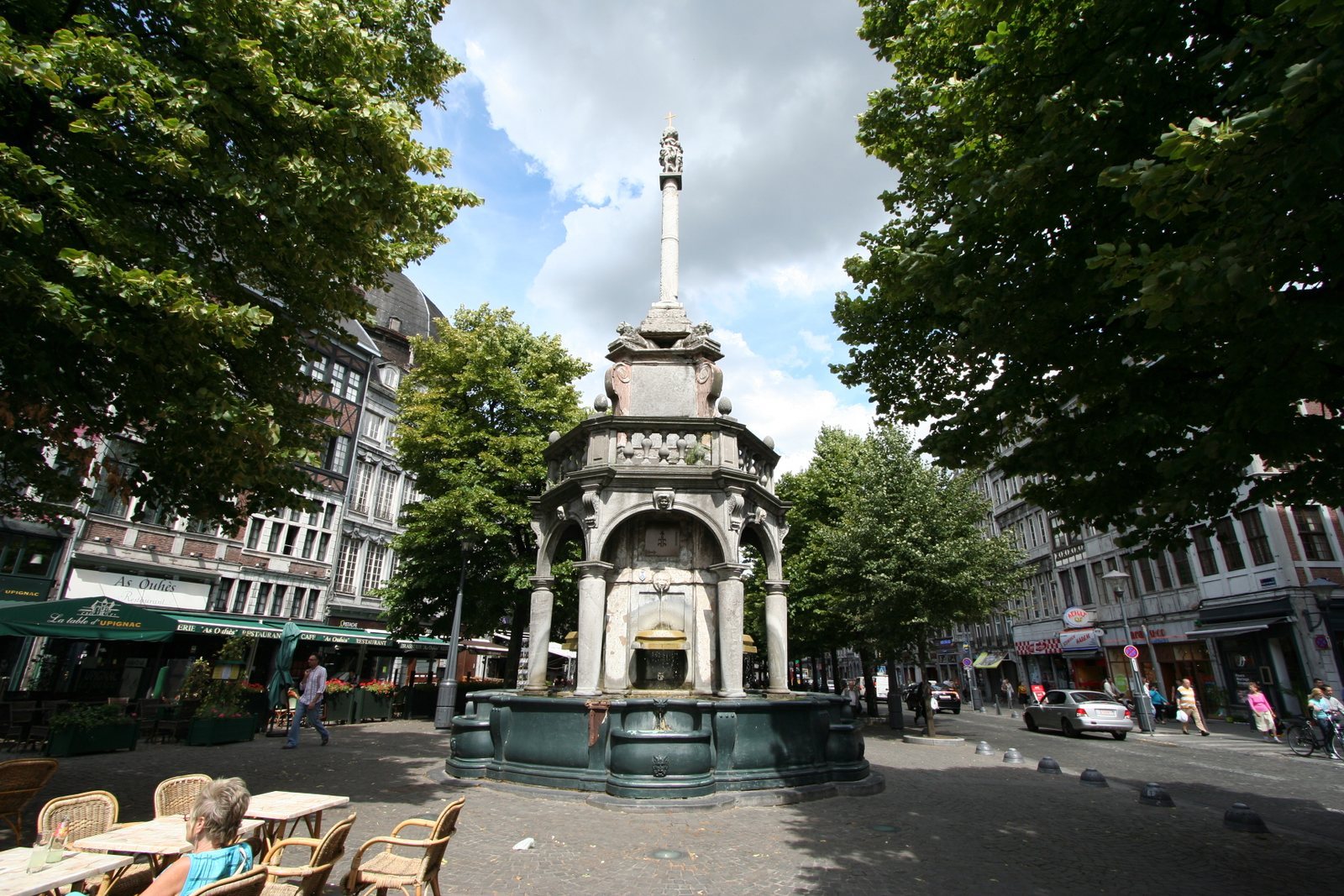
Opposite Liège’s city hall on the central Market Square, the Perron brings together a hexagonal fountain structure, a gallery supported by columns, and a square upper structure. Four stone lions support its central column.
Fountain and gallery
Del Cour’s fountain was made from marble quarried near Hamoir, where the quarries are now abandoned. Multiple basins and arches form its lower structure. The basins are cast iron, and the columns are dressed stone. Six marble busts once decorated the arches. In 1717, mayors Michel-Nicolas de Lohier and Louis-Lambert de Liverlo moved them to the city hall vestibule, where they remain above the doors.
Central column
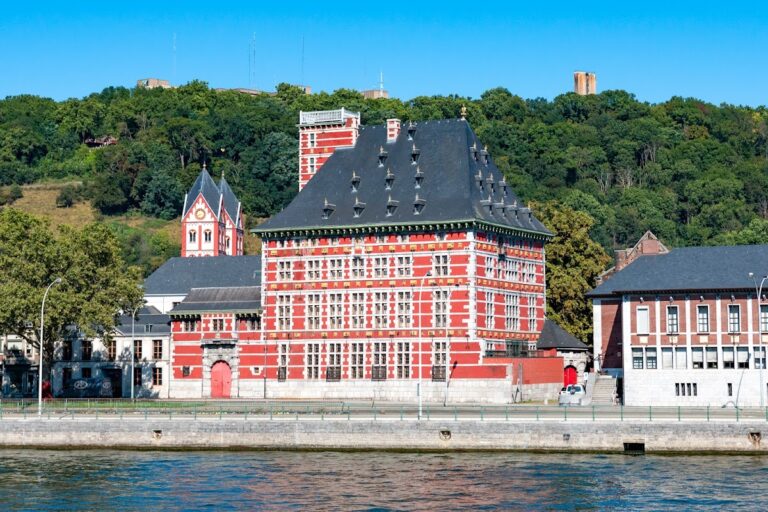
The original marble column was judged too fragile and is preserved at the Grand Curtius Museum. Its replacement is made of Carrara marble and fits over a metal rod rather than being joined with the lead solder used before. The four stone lions at its base support the central shaft.
Three Graces and pine cone
The upper sculpture shows the Three Graces holding a pine cone. The original figures, carved from white marble, were damaged by pollution and weather. Concrete copies made by sculptor Paul Renotte in the 1960s later gave way to a Carrara-marble replica by sculptor Alexandre Callet. The original statues are preserved at the Grand Curtius Museum.