Church of St. Denis (Liège): A Fortified Collegiate and Parish Church


Site at a Glance
- Rating
- 4.6
- Popularity
- Low
- Country
- Belgium
- Primary era
- Medieval
- External website
- Open
- Eras represented
- Medieval, Early Modern
- Civilizations
- Holy Roman Empire
- Site type
- Religious
- Remains
- Fortified Church
On this page10 sections
History
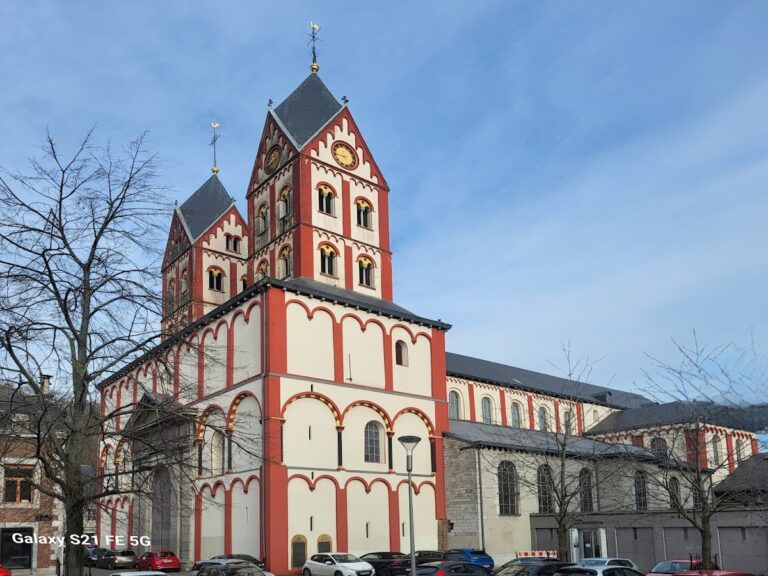
The Church of St. Denis is a Roman Catholic parish church in Liège, Belgium, founded in 987 under Prince-Bishop Notker in the Romanesque period. Its establishment created a collegiate church, a church served by a chapter of canons rather than a monastic community, within the city’s first enclosure. The church is dedicated to Saint Denis of Paris, a third-century Christian martyr traditionally regarded as the first bishop of Paris.
Foundation and early rebuilding
Three canons of St. Lambert, Nithard, John, and Godescalc, established the chapter with 20 canons. Its membership later rose to 30. The first consecration took place on 12 March 990, but a lightning-caused fire destroyed the church in 1003. Notker directed its rebuilding, and Baldéric II, bishop of Liège, presided over a renewed dedication in 1011.
St. Denis became one of Liège’s seven collegiate churches, alongside St. Peter, Holy Cross, St. Paul, St. John, St. Martin, and St. Bartholomew. In Liège, these institutions formed part of the city’s secondary clergy alongside the cathedral chapter. The chapter of St. Denis remained part of the secondary clergy of the Prince-Bishopric of Liège, a territory whose bishop also exercised the authority of a territorial prince, until the Liège Revolution of 1789.
Medieval and early modern changes
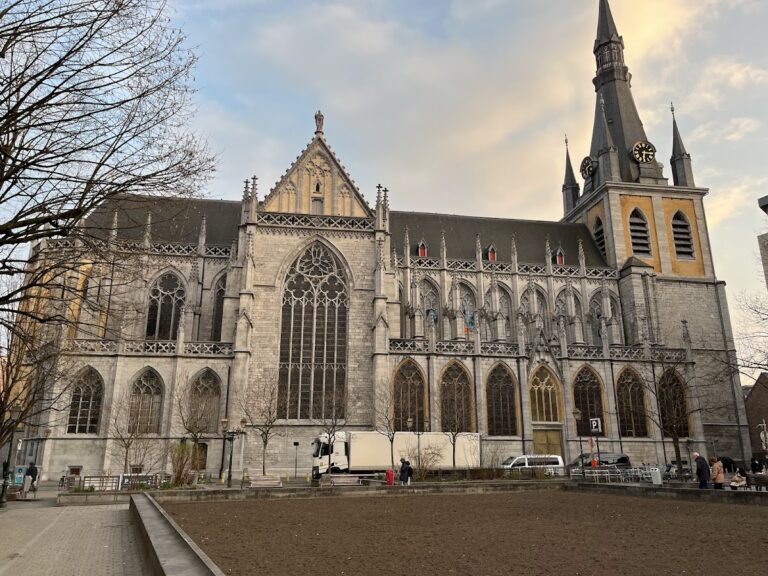
The church was integrated into Liège’s first city enclosure, and its tower served a defensive purpose within the fortifications. At the beginning of the fifteenth century, the earlier Romanesque choir was replaced by the present Gothic choir, while chapels were built alongside the aisles. During the late seventeenth century, the interior was remodelled in the Baroque style, and brick vaulting was installed in 1701.
From collegiate church to parish church
The collegiate chapter was suppressed in 1797 after the Liège Revolution, and part of the church treasury was lost. The Concordat of 1801, an agreement between Napoleon Bonaparte and Pope Pius VII that reorganized relations between the French state and the Catholic Church after the Revolution, preceded the building’s return to parish use. St. Denis formally became a parish church in 1803, incorporating the territories of the suppressed parishes of Sainte-Aldegonde, Saint-Étienne, Saint-Gangulphe, Sainte-Catherine, and Sainte-Madeleine.
The church now belongs to the Diocese of Liège and has continued as a Roman Catholic parish church. It was restored in 1987, while much of its older furnishing survived the nineteenth century and later underwent comprehensive restoration. St. Denis has been protected as classified heritage since 1936. In 2016, the church ensemble, except for the organ mechanism, received designation as exceptional heritage of Wallonia.
Associations with Liège figures
The composer André-Ernest-Modeste Grétry learned the fundamentals of music while serving as an altar boy at St. Denis. His father, François Grétry, played first violin at the collegiate church. The writer Georges Simenon was baptized there in 1903.
Remains
The surviving building is a fortified Romanesque-Gothic church historically incorporated into Liège’s first enclosure. Its heavy tower, built of coal sandstone from Eschweiler, dates from around 1100, in the late eleventh or early twelfth century. The present Gothic choir replaced the Romanesque predecessor at the beginning of the fifteenth century, and chapels extend along the side aisles. Inside, late-seventeenth-century Baroque alterations and the brick-vaulted ceiling of 1701 preserve evidence of later changes to the medieval structure.
Structure and medieval fabric
The nave roof structure retains tie beams dated by dendrochronology, the study of annual growth rings in wood, to 1012–1015. The tower’s coal sandstone construction and defensive role form part of the church’s fortified character. The Gothic choir and the chapels beside the aisles represent the principal medieval enlargement of the building.
Windows and altarpiece
Painted stained-glass windows in the choir date from 1852. The church also contains stained-glass work associated with Jean-Baptiste Capronnier and a window depicting Albertus Magnus, the thirteenth-century German theologian, philosopher, and Dominican friar. A Brabant altarpiece from the early sixteenth century presents the Passion of Christ and the life of Saint Denis.
Furniture, organ, and sculpture
An eighteenth-century pulpit stands among the church’s furnishings. The organ case dates from 1589, and the organ was made in the workshop of Guillaume Robustelly, a Liège organ builder. To the left of the high altar is Arnold de Hontoire’s statue of the Virgin and Child, made between 1688 and 1692; to the right stands Robert Verbure’s statue of Saint Denis. Cornélis Vander Veken made the 1690 crucifix and sculptures of Saint Roch and the Guardian Angel.
Paintings and later devotional works
The interior contains Louis Counet’s The Assumption of the Virgin, Ludwig Brüls’s Descent from the Cross of 1845, and Ferdinand Daems’s Christ among the Doctors. Other paintings are by Jean-Guillaume Carlier, Édouard van Marcke, and Jules Helbig, while additional sculpture is associated with Arnold de Hontoire and other artists. Alfred Martin’s 1926 triptych, The Virgin of the Pont des Arches, stands with a statue of the Virgin of the Pont des Arches before it. A replica of a bronze statue of Saint Peter dates from 1887.