St Catherine’s Church, Elsterwerda: A Protected Baroque Protestant Church
Site at a Glance
- Rating
- 4.6
- Popularity
- Very Low
- Country
- Germany
- Primary era
- Early Modern
- Eras represented
- Medieval, Early Modern, Modern
- Civilizations
- Electorate of Saxony, German, Holy Roman Empire, Kingdom of Prussia
- Site type
- Religious
- Remains
- Church
On this page12 sections
History
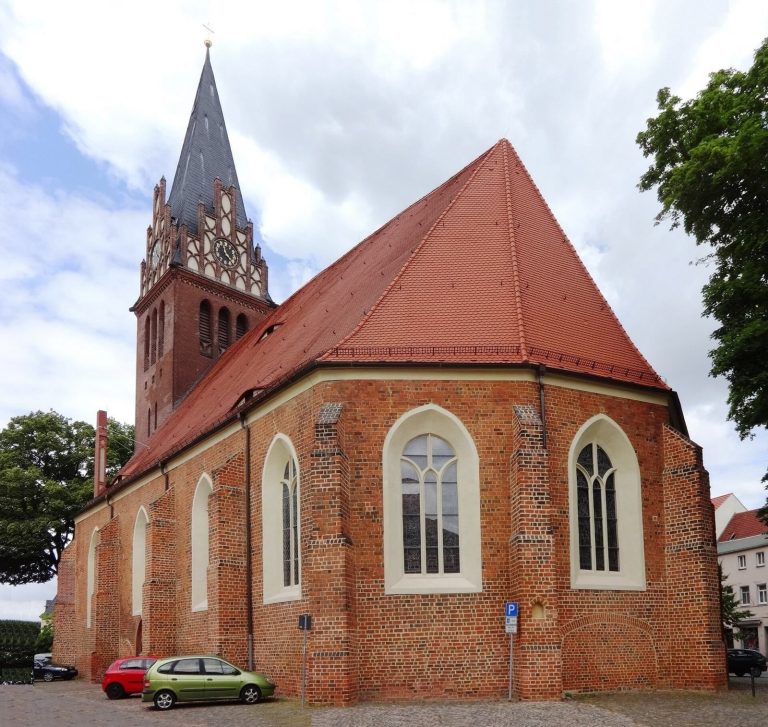
St Catherine’s Church is a protected Protestant church in Elsterwerda, Germany, and is regarded as probably the town’s oldest building. Thought to have originated in the fifteenth century, it developed from a medieval brick structure into a Baroque hall church, a church arranged around one main hall rather than separate aisles. The present building probably resulted from a new construction around 1718, following repeated destruction and rebuilding after fires.
Medieval origins and fire damage
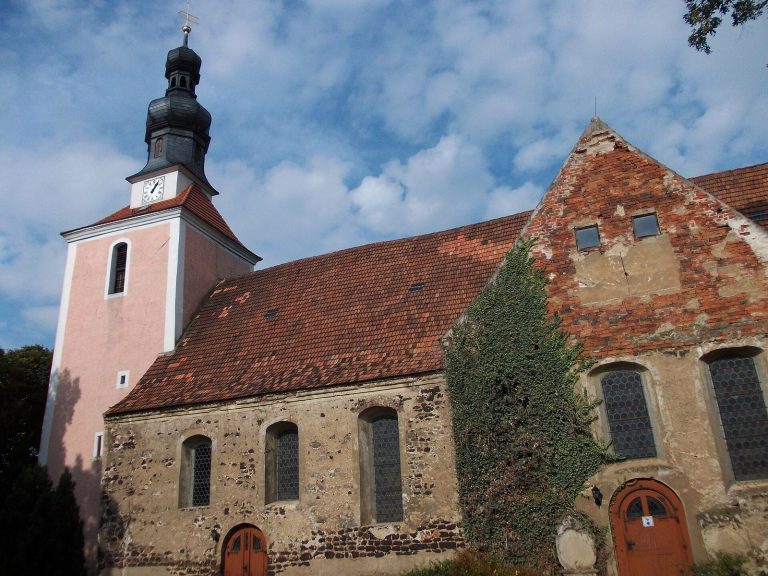
The medieval church was strengthened by projecting masonry buttresses, indicating that it originally carried a vaulted ceiling. That vault probably collapsed during a fire in the Thirty Years’ War, the seventeenth-century conflict that brought widespread military and political disruption across central Europe. The building suffered further severe damage in the Elsterwerda town fire of 1696. Afterward, the earlier vault was replaced with a flat ceiling framed in stucco.
Rebuilding in the early eighteenth century
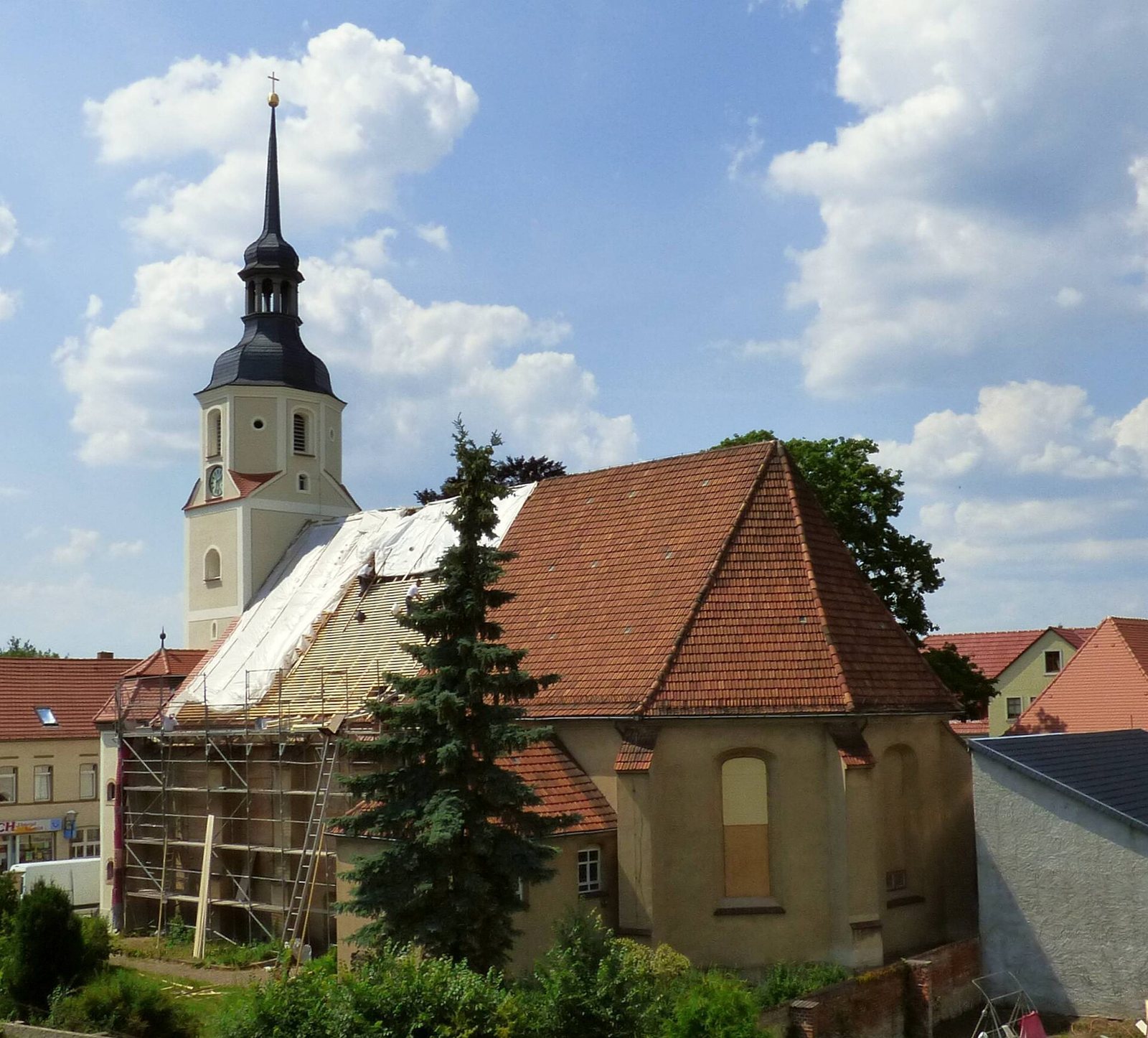
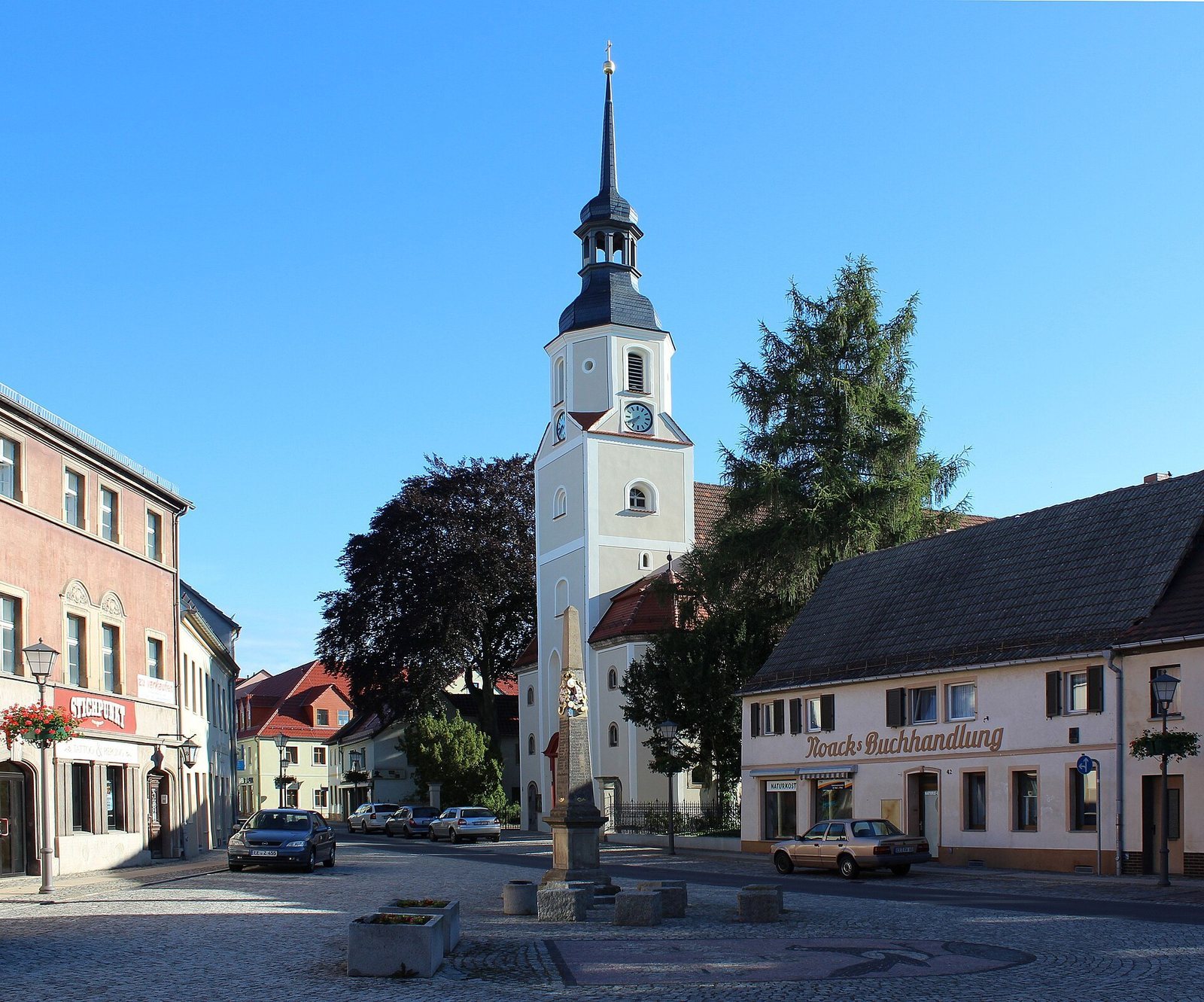
The church tower was rebuilt in 1708. In 1718 it received an octagonal belfry, a curved hood, and an onion dome, while major alterations transformed the church into the form associated with its Baroque phase. Baron Waldemar von Löwendal, who had lived at Elsterwerda Castle since 1708, commissioned the patron’s box, a reserved gallery or enclosed seating area for the church’s patron.
A carved altar made around 1500 was sold from the church to Tröbitz in 1718. Created in the Pankratius Grueber workshop at Großenhain, it represents Georg von Köckritz, his wife Katharina von Schleinitz, and the von Köckritz coat of arms. Georg von Köckritz belonged to the late-medieval noble family that owned Elsterwerda from 1462 to 1499. The church’s pulpit altar was made in the middle of the eighteenth century.
Nineteenth- and twentieth-century changes
The churchyard wall was begun in 1838 by master mason Weigelt of Doberlug. When he failed to fulfill his obligation, the work was offered for tender again. The wall was completed in 1841, apart from its gate. The interior retains the color known as Leipzig green, applied in 1831.
The entrance hall was redesigned in 1922 and 1923 after the First World War as a memorial hall for the fallen. The work was created by Hans Nadler, an artist born in Elsterwerda. The church underwent extensive reconstruction in 1973 and again during the 1990s. Its protected-monument status preserves the building as part of Elsterwerda’s historic fabric.
The church’s bells also reflect the effects of war. In 1896, the Schilling foundry in Apolda supplied three bells weighing 600, 300, and 200 kilograms. The two larger bells were removed on 23 July 1918 during the First World War. A replacement bell from 1490 was acquired from the congregation at Edersleben, and another was bought the following year from Germendorf near Oranienburg. By 1922, the three-bell peal had been restored. The two larger bells were removed again during the Second World War. The larger of them was found in Hamburg in 1949 and rehung in May 1950, but it cracked while being rung that September and was recast at Apolda. Another bell was cast there as well, restoring the three-bell peal.
Remains
Building and interior arrangement
St Catherine’s Church retains the form of a Baroque hall church derived from its medieval brick predecessor. Its square tower rises into the octagonal belfry added in 1718 and is completed by the curved hood and onion dome. Inside, the flat ceiling framed with stucco reflects the replacement of the earlier vault after the church’s fire damage.
A three-sided gallery runs through two levels of the interior and has a baluster-like railing. Two stairways leading to the galleries were added within the tower in 1903. The interior is substantially shaped by the alterations of 1718 and retains the Leipzig green color applied in 1831.
Furnishings and memorials
Baptismal font
The octagonal baptismal font dates from around 1520 to 1530. Its basin carries intersecting tracery, while three lilies on the shaft repeat a motif found in the coat of arms of the von Köckritz family. The family probably donated the font.
Pulpit altar and epitaphs
The pulpit altar dates from the middle of the eighteenth century. It combines the preaching pulpit with the altar structure, placing the pulpit prominently within the arrangement. Twelve portrait tombstones, or epitaphs, commemorate members of the von Maltitz and von Rohr noble families from the sixteenth and seventeenth centuries and are set into the interior walls.
Former carved altar
The carved altar made around 1500 in the Pankratius Grueber workshop at Großenhain is preserved at Tröbitz, where it has remained since its sale from St Catherine’s Church in 1718. Its figures identify Georg von Köckritz and Katharina von Schleinitz, and it includes the von Köckritz coat of arms.
Memorial hall
The entrance hall contains a sgraffito painting, a decoration made by scratching through one surface layer to expose a contrasting layer below. Hans Nadler created it as part of the memorial hall designed in 1922 and 1923 for those who fell in the First World War.
Organ and bells
The organ was built in 1887 by Friedrich Gerhardt of Merseburg. The original instrument had more than 25 registers arranged 10/8/7. A. Voigt of Liebenwerda altered it in 1924 and converted it to pneumatic action, in which air pressure operates the valves. In 1950, the Dresden firm Gebrüder Jehmlich enlarged the upper division and rebuilt the console. The instrument now has 27 registers arranged 10/10/7. It was taken out of service in 2016 and returned to operation in 2024 after comprehensive restoration.
The church has an electrically operated three-bell peal. It includes the bell dating from 1490 acquired from Edersleben, together with bells cast or recast at Apolda after the wartime removals and the cracking of the recovered bell.