Schloss Saathain: A Historic Fortified Estate in Germany


Site at a Glance
- Rating
- 4.5
- Popularity
- Low
- Country
- Germany
- Primary era
- Medieval
- External website
- Open
- Eras represented
- Medieval, Early Modern, Modern
- Civilizations
- Electorate of Saxony, German, Holy Roman Empire, Margraviate of Meissen
- Site type
- Military
- Remains
- Castle
On this page10 sections
History
Schloss Saathain is a historic fortified site in Germany, in Saathain, now a district of Röderland in southern Brandenburg. The castrum Sathim was documented in 1140, making Saathain one of the oldest fortified sites on the Black Elster. Its position beside a river crossing near the confluence of the Große Röder and the Black Elster gave it a role in securing the local boundary and controlling military and trading routes along the river.
Medieval lordship
The Saathain lordship included Stolzenhain, Schweinfurth, Reppis, Gröditz, and Mühldorf, the last of which was incorporated into Kröbeln in 1935. Until the middle of the fourteenth century, Saathain and the lordships of Tiefenau, Elsterwerda, Frauenhain, Ortrand, and Großenhain were imperial fiefs of the Naumburg ecclesiastical foundation. This church institution held territorial possessions within the feudal system of the Holy Roman Empire.
In 1274, Bishop Meinherr of Naumburg granted Saathain Castle to Heinrich the Illustrious, the thirteenth-century margrave of Meissen, for life. The grant was extended in 1276 to Heinrich’s son Friedrich Clem and his descendants. The fortification stood within a wider defensive landscape. About one kilometre downstream, on the opposite side of the confluence, Würdenhain Castle guarded the area until its destruction in the middle of the fifteenth century.
Noble ownership
The von Köckritz family lived at Saathain from 1348 to 1475. The Schleinitz family then took possession and remained there until 1716. The Schleinitzes also held the Mückenberg lordship, roughly 20 kilometres east of Saathain, and the two estates were linked by the Schleinitzweg.
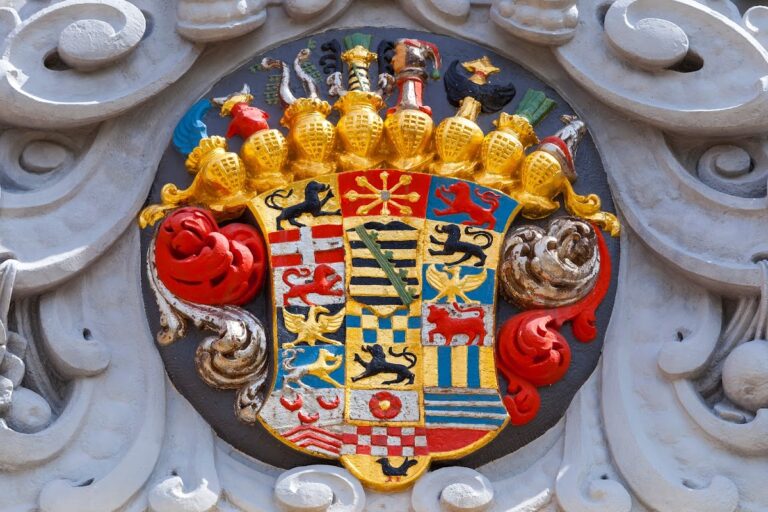
Woldemar Freiherr von Löwendal acquired the Saathain and Mückenberg lordships in 1716, after obtaining the neighbouring Elsterwerda lordship in 1708. He transferred Saathain to his wife, Benedicta Margaretha von Löwendal, in 1727. She sold it to Johann George von Einsiedel in 1748. After his death, his three children inherited the estate. In 1761, Johann Georg Friedrich and his brother Detlev Carl Count von Einsiedel, later a Saxon cabinet minister, received it jointly. Detlev Carl became sole owner after acquiring his brother’s share in 1777 and transferred Saathain to his son in 1794. The younger Detlev sold it two years later.
Daniel Gottfried Wilhelm Freiherr von Stutterheim acquired Saathain in 1796, followed by the Count of Solms in 1798. Ownership changed several more times before the estate passed to retired Captain Bormann. His family retained it until the land reform of 1945.
Destruction and later history
In April 1945, during the final phase of the Second World War, the castle was deliberately set on fire and destroyed. The blaze consumed its extensive archive, stored art treasures, and the old church registers of neighbouring Würdenhain and Stolzenhain. The Würdenhain registers contained baptismal, marriage, and burial entries dating from 1655 to 1812.
The estate covered 587 hectares before the land reform in the Soviet occupation zone. A total of 489.91 hectares was distributed among 281 people in Haida, Reichenhain, Saathain, Stolzenhain, Würdenhain, and Kröbeln.
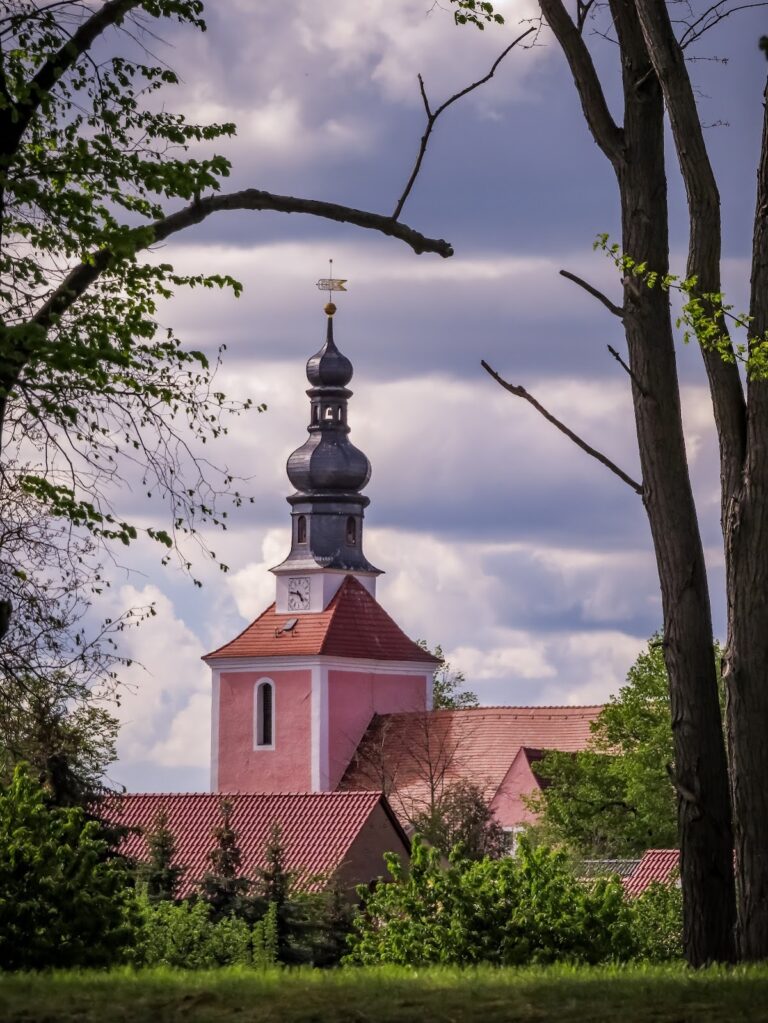
Saathain’s former manor church has been protected as a historic monument since 1968. Extensive renovation brought it back into use in 1990, and civil wedding ceremonies have taken place there since May 2006. From 1972, part of the former estate park was developed as a rose garden, while the church and restored adjoining manor yard became settings for concerts and exhibitions.
A memorial stone in front of the church commemorates Pastor and local historian Wolfgang Bastian. His renovation work in the middle of the 1930s helped prevent the church from deteriorating further. He died in Torgau in 1942 during interrogations by the Gestapo, Nazi Germany’s secret state police responsible for political repression.
A stone chronicle monument was inaugurated in the castle park on 6 July 1958. Its historical information was supplied by Karl Fitzkow, then director of the Bad Liebenwerda District Museum, following an initiative by former mayor Heinz Dreißig. Dreißig led the municipality from 1951 to 1990 and received the German Prize for Monument Protection in 1991 for his services.
Remains
The surviving remains lie on the left bank of the Black Elster near the Große Röder’s confluence with the river. The former castle and manor occupied a fortified river landscape that also included Würdenhain Castle on the opposite side of the confluence. Today, the physical complex combines the castle foundations, the manor church, the adjoining yard, the former park, and later commemorative and artistic features.
Castle foundations
Most of the burned castle fabric was removed after the 1945 fire. The surviving foundation walls support a terrace that formerly held a summer café. The terrace ceased to operate as a café around 2008, and its access was subsequently sealed because of the stated danger of collapse. These foundations are the principal visible remains of the destroyed fortified castle.
Manor church and yard
The former Saathain manor church is a half-timbered building dating from 1629. Half-timbering combines a visible timber framework with infill panels made from materials such as masonry or plaster. The church was built on the site of a castle chapel documented in 1575 and acquired its present appearance through alterations completed in 1816. A restored manor yard adjoins the church, and the two buildings contain spaces used for concerts and exhibitions.
Park and landscape features
Part of the former manor park is now a rose garden containing more than 70 varieties and approximately 5,000 rose bushes. Across the present road to Elsterwerda, a surviving section of the Black Elster’s old floodplain forest contains extensive stands of protected wood anemones.
Sculpture park
A sculpture park opened on a meadow behind the church in May 2004. It contains works by the Armenian-born artist Ararat Haydeyan, who established a studio and gallery on the estate grounds. The sculptures use different materials and include works titled The Family, The Kiss, and The Chancellor’s Cushion.
Stone chronicle
The stone chronicle in front of the castle remains is an unworked granite boulder bearing the village name, an oak, and a water lily. The symbols refer to the water-rich Röderwald landscape, while an inscription below them gives chronological information about Saathain’s development.