San Francesco Church: A Franciscan Church in Lodi, Italy
Site at a Glance
- Rating
- 4.7
- Popularity
- Very Low
- Country
- Italy
- Primary era
- Medieval
- External website
- Open
- Eras represented
- Medieval, Early Modern
- Civilizations
- Duchy of Milan
- Site type
- Religious
- Remains
- Church
On this page7 sections
History
San Francesco Church is a Roman Catholic church in Lodi, Italy, built by the Franciscan Order in the late thirteenth and early fourteenth centuries. Construction began in 1280 and ended in 1307. Dedicated to Saint Francis of Assisi, it was established on the site of a smaller church dedicated to Saint Nicholas that had belonged to the Order of Friars Minor, the religious community founded by Saint Francis and commonly known as the Franciscans.
Foundation and Medieval Development
Bishop Bongiovanni Fissiraga of Lodi initiated the new construction, with financial support from the nobleman Antonio Fissiraga. A fourteenth-century fresco inside the church later portrayed Antonio Fissiraga presenting a model of the building, preserving a visual connection between the patron and the completed church.
Changing Religious Administration
In 1527, responsibility for the church passed to the Reformed Franciscans of Saint Bernardino, a reform branch of the Franciscan tradition. The Barnabites replaced them in 1840. Members of the Congregation of Clerics Regular of Saint Paul, the Barnabites had already taken possession of the adjoining convent in 1834 and converted it into a college.
During the first years of their tenure, the Barnabites carried out an extensive restoration of the complex, completed in 1842. They received perpetual use of the church for apostolic ministry, while ownership remained with the parish of Lodi Cathedral, on which San Francesco Church still depends. The church is designated among Italy’s national monuments.
Remains
Facade and Church Plan
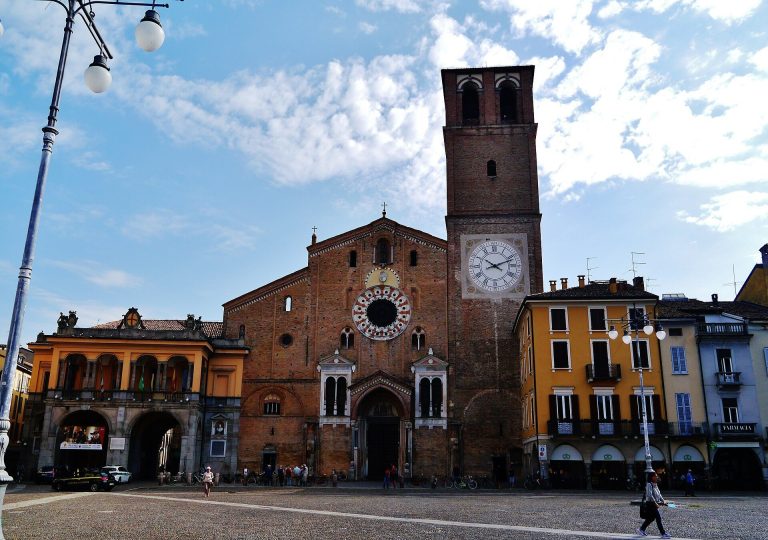
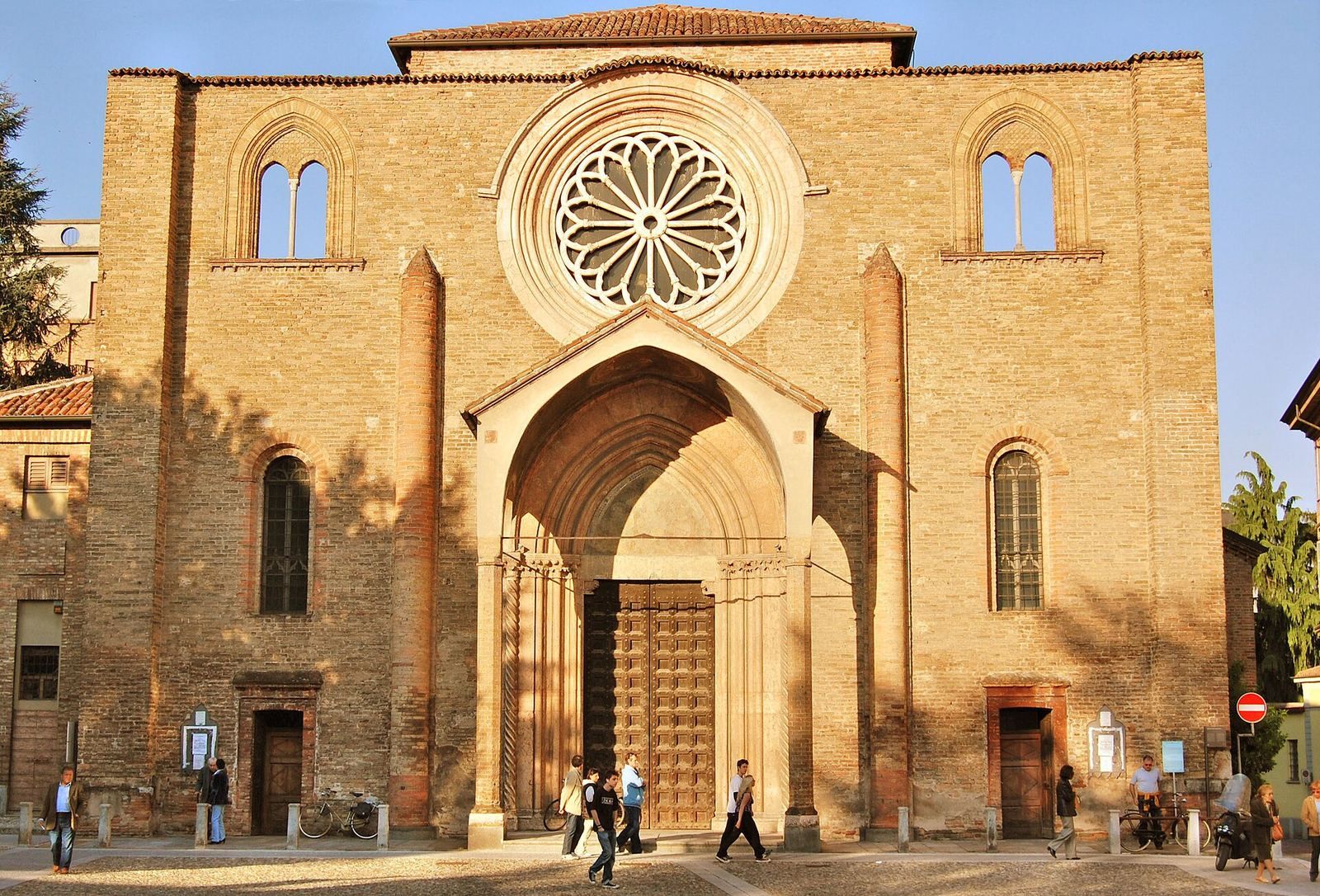
The unfinished facade faces Piazza Ospitale and is built of pinkish terracotta brick. Its composition includes a tall pointed portico with terracotta columns set on stone plinths, two semi-cylindrical pilasters, and a large white-marble rose window. At either side of the rose window are two unusual pointed double-mullioned windows that open directly to the sky. This design is described as the earliest example of a form later repeated across northern Italy during the fourteenth and fifteenth centuries.
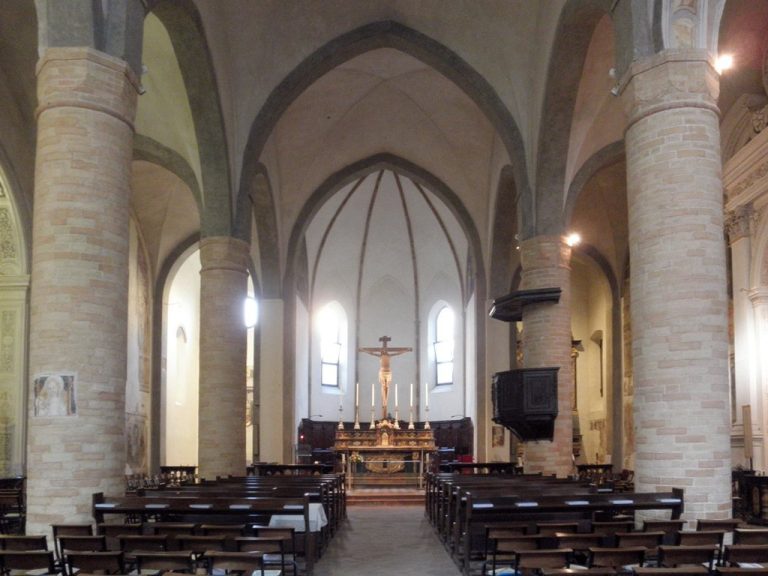
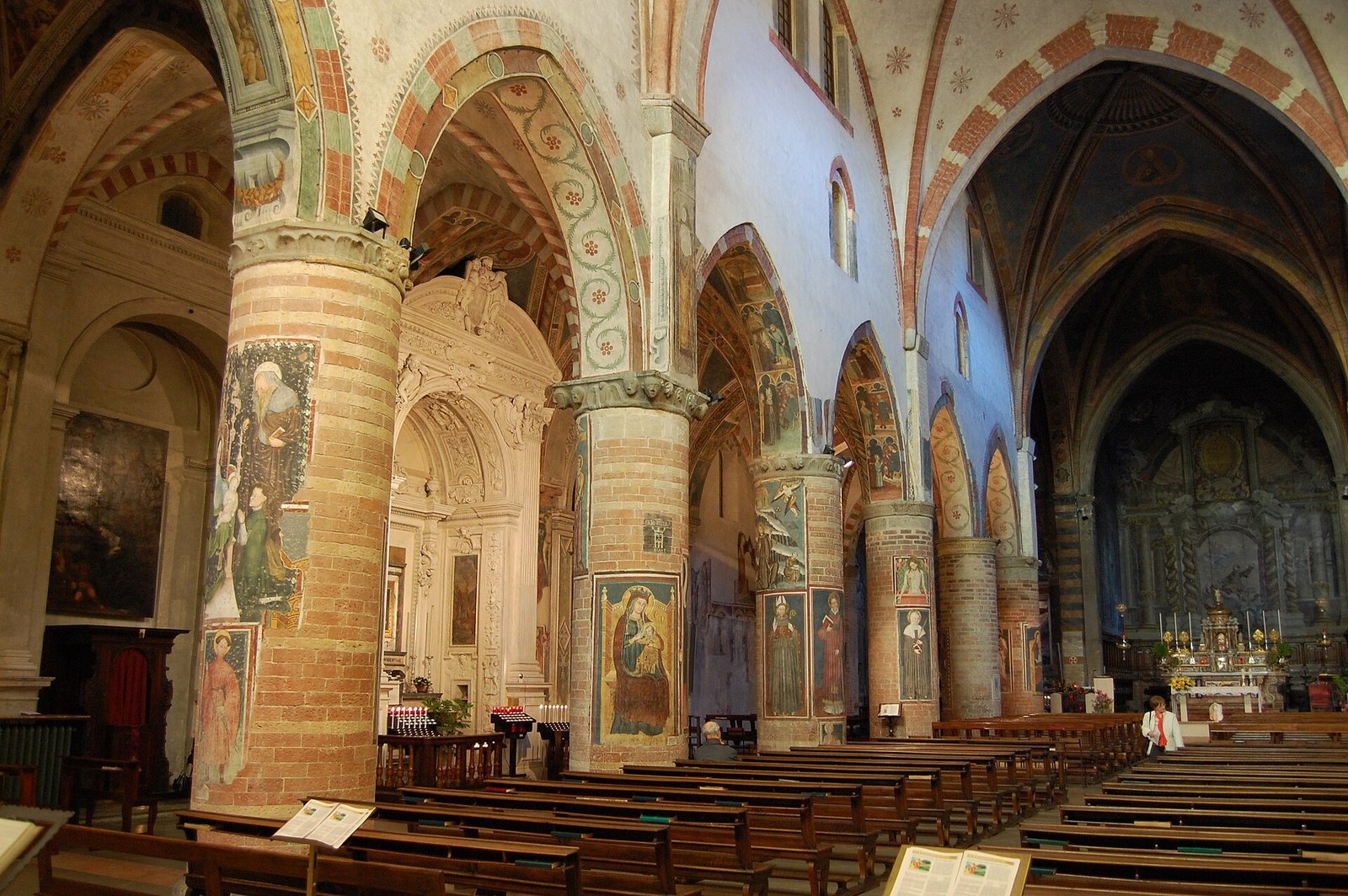
Inside, the church follows a Latin-cross plan, with a long central axis crossed by a shorter transept. The nave and two aisles are each divided into four bays, and side chapels extend from the interior. Large brick columns carry pointed arches and cross-vaults, which are formed by the intersection of two barrel vaults. The apse, the rounded termination of the church, contains eighteenth-century frescoes by Sebastiano Galeotti that are in notably deteriorated condition.
Chapels and Painted Decoration
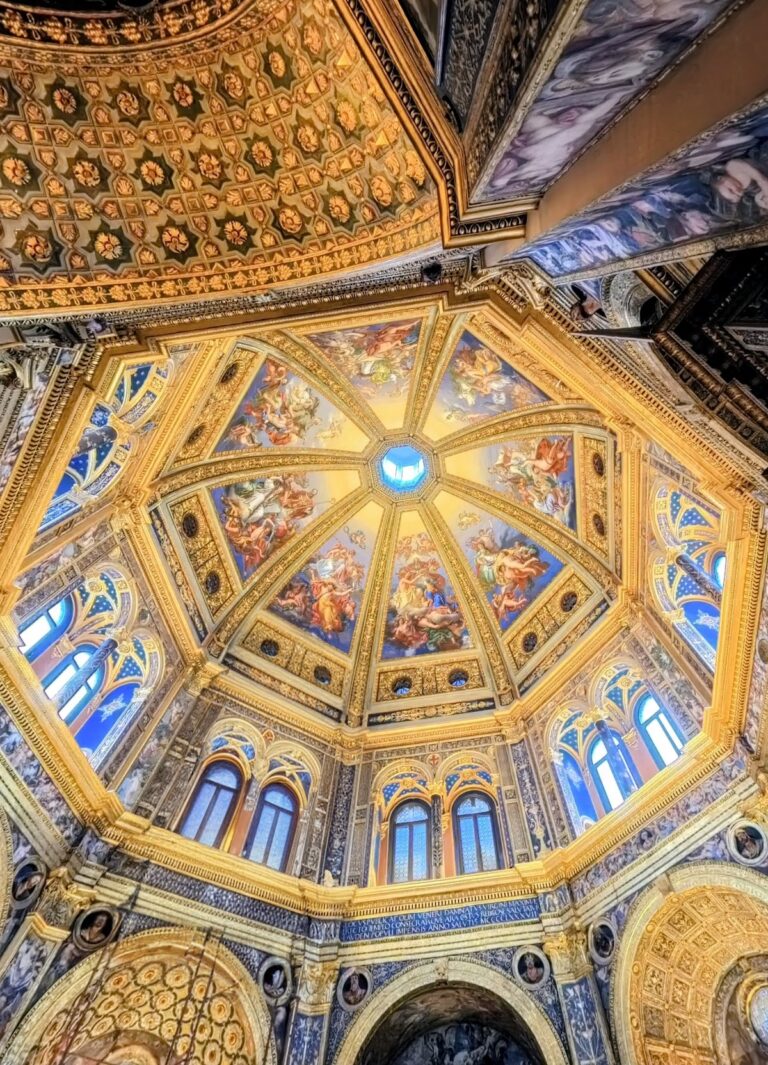
The third chapel on the right is dedicated to Saint Bernardino. Created in 1477, it was formed from an earlier fortified turret. The Chapel of the Immaculate Conception retains an eighteenth-century decorative scheme, including a polychrome and gilded wooden statue of the Virgin with a flowing mantle, marble revetments, and a delicately frescoed vault. The vault paintings were made by the Torricelli brothers from Lugano, who also worked in Valtellina and the Canton of Ticino.
The chapels of Saint Catherine and Saint Margaret of Cortona contain work by marble and iron craftsmen as well as decorative painters. The walls and columns throughout the church carry numerous frescoes dating from the fourteenth to the eighteenth centuries. A prominent fourteenth-century painting in the right transept shows the Madonna and Child with Saints Nicholas and Francis, together with Antonio Fissiraga presenting a model of the church. It is attributed to an unidentified Lombard master, who also painted a Madonna and Child on the right-aisle wall between the chapels of Saint Catherine and Saint Bernardino.
The wall of the second bay on the right contains sixteenth-century frescoes, including an Immaculate Madonna with Saints Francis and Bonaventure and a donor. The work was painted by Francesco Soncini of Lodi, a collaborator and pupil of the Renaissance painter Callisto Piazza.
Paintings and Memorials
The church preserves paintings from the sixteenth and seventeenth centuries. They include Saint Anthony of Padua Meeting Ezzelino da Romano by Giovan Battista Trotti, known as Il Malosso, in the Fissiraga Chapel; Saint Francis Receiving the Stigmata by the Lodi painter Fra Sollecito Arisi; and Madonna of Caravaggio by Enea Salmeggia. Ezzelino III da Romano was a powerful and violent thirteenth-century lord of northeastern Italy, while Saint Bonaventure was a Franciscan theologian and cardinal.
Tombs inside the church commemorate the librettist Francesco De Lemene, the poet Ada Negri, and the naturalist Agostino Bassi. A niche near the Chapel of the Crucifix preserves the head of Blessed Michele Carcano, a Franciscan preacher. The title Blessed denotes a person formally recognized by the Catholic Church as worthy of veneration without being canonized as a saint.