St. Agatha (Aschaffenburg): A Catholic Parish Church in Germany


Site at a Glance
- Rating
- 4.2
- Popularity
- Very Low
- Country
- Germany
- Primary era
- Medieval
- External website
- Open
- Eras represented
- Medieval, Modern
- Civilizations
- German, Holy Roman Empire
- Site type
- Religious
- Remains
- Church
On this page15 sections
History
St. Agatha (Aschaffenburg) is a Catholic parish church in Germany. Its parish, a local Christian community organized around its principal church, was founded around 1168 to 1171, and the church was first mentioned in 1184 in a charter of Pope Lucius III as a parish outside Aschaffenburg’s walls. The oldest surviving stone evidence dates from around the middle of the twelfth century. The church is dedicated to Saint Agatha, a Christian martyr of late antiquity who is especially venerated in Catholic tradition.
Medieval development
The medieval church had a nave, the main longitudinal space, together with side aisles, a choir, and a tower. During the second half of the fourteenth century, the side aisles were added and the nave was raised. A Chapel of Saint Anne was also built in the church cemetery surrounding St. Agatha. Saint Anne is traditionally regarded in Christianity as the mother of the Virgin Mary.
During the fifteenth and sixteenth centuries, the surrounding walls of the choir, nave, and tower were heightened. Smaller extensions continued until the cemetery was closed in 1811. The Chapel of Saint Anne and its ossuary, a chamber for storing human bones, survived until 1903, when both were demolished.
Nineteenth- and early twentieth-century changes
At the end of the nineteenth century, the church’s Baroque furnishings were removed and replaced with furnishings in the Neo-Gothic style. Baroque was the elaborate European style that preceded the later revival of Gothic forms. Population growth then led to plans for a major enlargement. The existing church would have been incorporated as an atrium into a new building measuring 65 by 23 metres, intended to become the largest church in Aschaffenburg. The outbreak of the First World War prevented construction.
Further alterations were made in 1934 under the direction of the architect Albert Boßlet. In 1942, the parish celebrated “800 years of St. Agatha.” The anniversary probably arose from notes compiled by the local historian Martin Balduin Kittel. His collection provided no sources for the date, while the parish archive retains material relating to the celebrations.
Destruction and reconstruction
High-explosive bombs on 21 November 1944 shattered the windows, damaged the wooden ceiling, and caused severe cracks in the walls of the southern side aisle. Artillery fire on 31 March 1945 then caused the church to burn out completely. Albert Boßlet and government master builder Erwin van Aaken were commissioned to rebuild it.
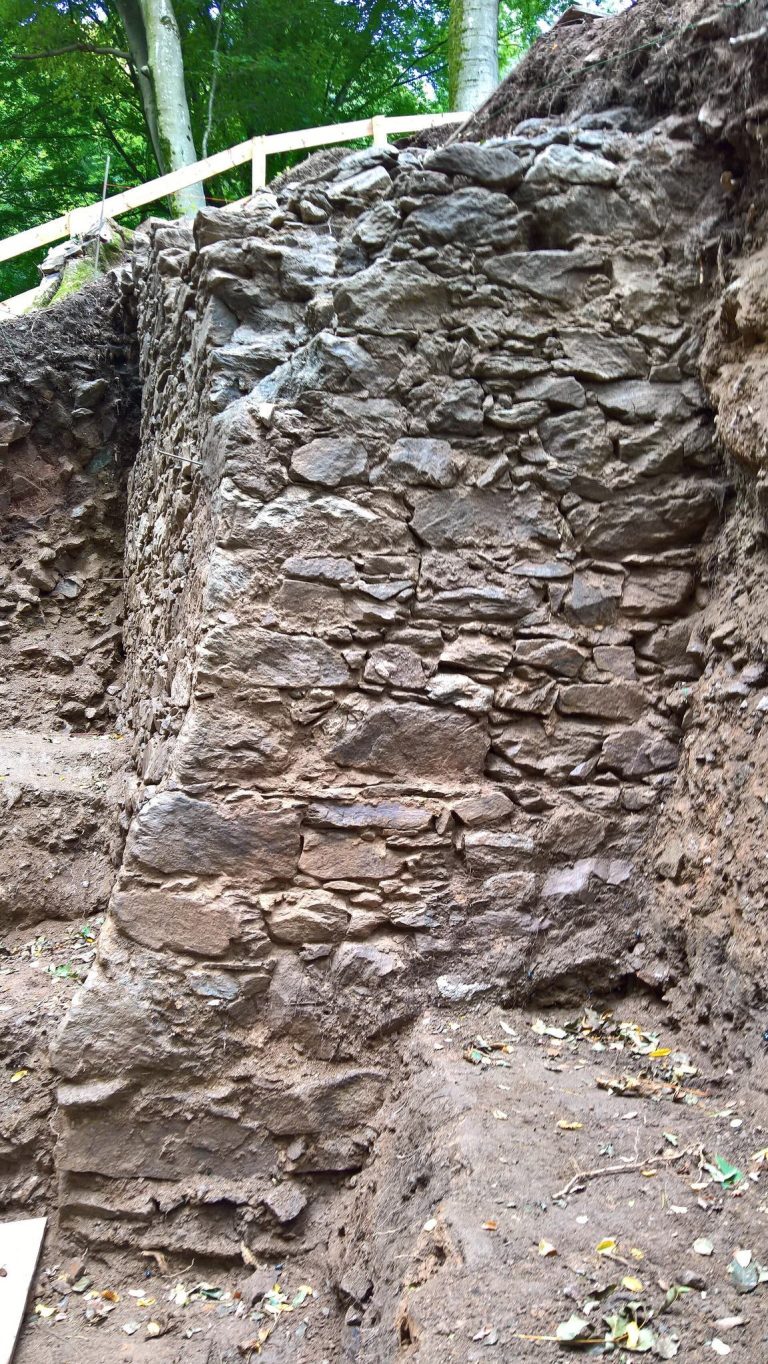
The remaining ruins were demolished in August 1948. The original tower was also removed after its foundation, made of loosely stacked stones, was found unable to support it safely. The church was completed on 1 November 1949 and rededicated by Julius Döpfner, Bishop of Würzburg. Most of the epitaphs, memorial inscriptions or monuments associated with the dead, were saved. Two Baroque tombstones connected with the Echter and Ingelheim families were found beneath the floor and incorporated into the exterior wall.
The planned reconstruction of the Chapel of the Mount of Olives was abandoned because the entire façade required rebuilding. Cracks appeared below the bell frame in the new tower as early as 1953, and bell ringing had to be suspended.
Postwar alterations
In 1962, the façade was moved six metres forward according to a design by the Würzburg architect Gustav Heinzmann. The new modern tower incorporated a baptistery and, on its southern side, a Marian Chapel dedicated to the veneration of Our Lady of Fátima. A four-metre-high sandstone statue of Saint Agatha was placed above the portal on 16 May 1963. Julius Bausenwein designed the statue, which was made by the Würzburg sculptors Ernst Singer and Willi Grimm.
Four bells began ringing in the new tower on 26 April 1964. The Trinity Bell weighs 1,075 kilograms and has the strike note D. It had been removed during the war and taken to the bell cemetery at Hamburg-Wilhelmsburg, but it was not melted down and returned in 1947. Three further bells were cast in 1956 at the F. W. Schilling foundry in Heidelberg: Saint Agatha, weighing 720 kilograms with the strike note F; Mary, weighing 1,100 kilograms with the strike note G; and Joseph, weighing 520 kilograms with the strike note A.
A new organ by the Gustav Weiss company of Zellingen was completed in two stages by the end of 1964 and inaugurated on 6 January 1965. A final renovation in 1987 reorganized the sanctuary and interior furnishings.
Remains
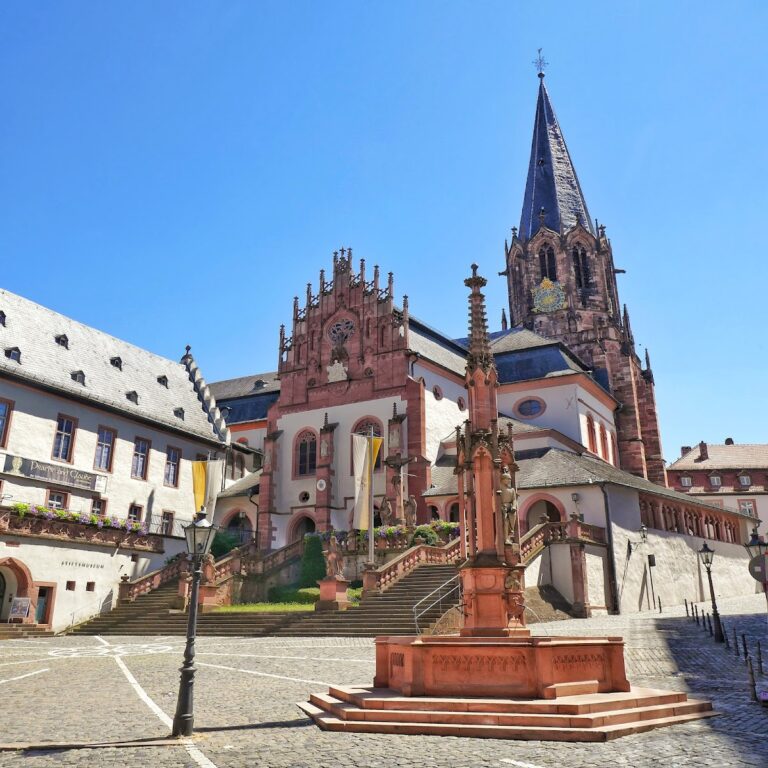
St. Agatha preserves the plan of a medieval church with a central nave, side aisles, choir, crossing, and tower, although the façade and tower were rebuilt after the wartime destruction. The side aisles reflect the fourteenth-century expansion, while the heightened walls of the choir, nave, and tower belong to later medieval alterations. The former cemetery surrounded the building, and the Chapel of Saint Anne with its ossuary once stood within that setting.
Exterior and tower
Rebuilt façade and tower
The façade was reconstructed and moved six metres forward in 1962. The modern tower contains the baptistery and the Marian Chapel on its southern side. Architectural elements from the former tower were reused in the rebuilt church. Its bell-storey string course and sound openings, including their columns and capitals, were reconstructed from old components.
Saint Agatha statue
Above the portal stands a four-metre-high statue of Saint Agatha carved from sandstone. Weighing 12 tonnes, it was designed by Julius Bausenwein and made by Ernst Singer and Willi Grimm. The statue was installed on 16 May 1963.
Sanctuary and furnishings
Crossing and choir
A plain red-sandstone offertory table stands in the crossing, the space where the church’s main axes intersect. An ambo, a raised stand for proclaiming readings, is positioned in front of it to the left, while the priest’s seat, or sedilia, is at the rear right. The baptismal font was later moved into the crossing, and the baptistery was screened with a red curtain.
The former high altar now stands in the left side aisle. In the choir, it was replaced by a sacrament house consisting of a gilded tabernacle, a secure container for consecrated Eucharistic elements, set within a sandstone casing. The five Gothic choir windows were artistically redesigned during the 1987 renovation. A white folded ceiling was installed above the sanctuary, beneath which hangs a suspended altar cross measuring 280 by 220 centimetres.
Suspended altar cross
The altar cross was produced jointly by the sculptor Tilmar Hornung of Bergtheim and the Würzburg goldsmith Markus Engert. It depicts Christ exalted and already released from the cross. Enamel squares at the ends of the cross arms carry the symbols of the four Evangelists: a winged human for Matthew, a lion for Mark, a bull for Luke, and an eagle for John.
Side-aisle altar and music
Bakers’ Altar
The right side aisle contains the Bakers’ Altar, the guild altar of the Aschaffenburg Bakers’ Guild. Kathi Hock of Aschaffenburg carved it from Spessart oak in 1950. Its lower section presents the guild emblem, peasants sowing and harvesting grain, and the coat of arms of Aschaffenburg. Above them, Christ is enthroned in the central field. The left field shows the feeding with manna, while the right depicts the multiplication of the loaves.
Saint Anthony of Padua with the Christ Child and Saint Clement Mary Hofbauer stand at the sides. Hofbauer had been a baker before entering the priesthood. The base carries the words, “The bread we prepare, Lord, give it to us for all time,” and names the Bakers’ Guild of Aschaffenburg city and district, Alzenau, and Obernburg as the donor for the glory of God.
Organ
The Gustav Weiss organ has 39 sounding stops. Its manuals are covered with Elfenit, a durable light-resistant synthetic material, and ebony. The couplers link the manuals and pedals through the combinations II/I, II/I sub, III/I, III/II, I/P, II/P, and III/P. Its listed aids include two free combinations, a tutti, and a crescendo roller.