St. Magnus: A Historic Lutheran Church in Sande, Germany


Site at a Glance
- Rating
- 4.6
- Popularity
- Very Low
- Country
- Germany
- Primary era
- Medieval
- External website
- Open
- Eras represented
- Medieval, Early Modern, Modern
- Civilizations
- Holy Roman Empire
- Site type
- Religious
- Remains
- Church
On this page13 sections
History
St. Magnus is an Evangelical Lutheran church in Sande, Germany, dedicated to Magnus of Trani, a Christian bishop and martyr traditionally associated with the southern Italian city of Trani. Built in 1351, the church is Sande’s oldest building and combines Romanesque origins with Gothic influences. It stands on an artificial mound, or warft, a raised platform used in low-lying coastal areas to provide a secure building site.
Medieval foundations
The present church is the third place of worship to occupy the site. The first church was destroyed during conflict between the Frisian districts of Rüstringen and Östringen around the 1170s. A successor was then built and remained in use for approximately 150 years. By the fourteenth century, however, its structure had deteriorated so severely that it was replaced by the church erected in 1351.
The medieval building was a small hall church, meaning that its interior was organized as a unified nave-like space rather than as strongly separated nave and aisle spaces. Its apse, the usually semicircular or polygonal eastern end of a church, formed part of the original arrangement. The church’s Romanesque elements belong to an earlier architectural tradition of robust, rounded-arch construction, while the nave also displays features associated with the later Gothic period.
Reformation and Lutheran use
The Reformation in Sande proceeded peacefully as the congregation changed from Catholicism to Lutheranism. The Reformation was the sixteenth-century movement that challenged established Catholic practices and led to the formation of Protestant churches. Sande’s first Protestant preacher is documented from 1531, marking the community’s transition to its new religious order.
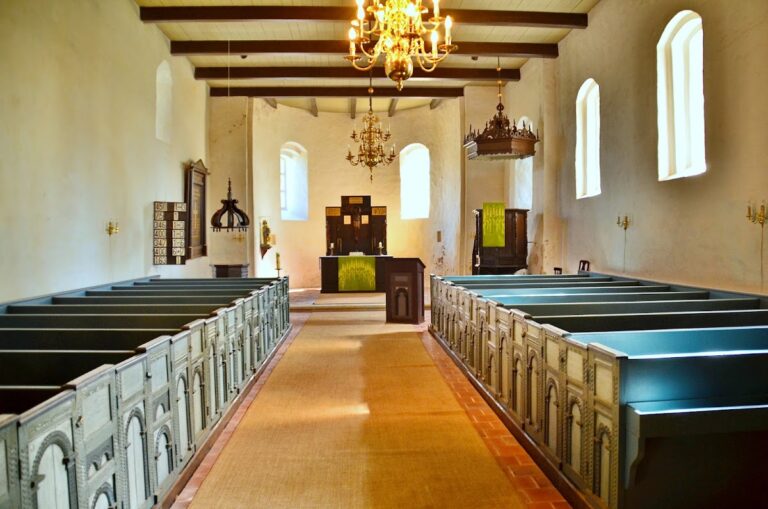
The church’s present interior was shaped largely during the seventeenth century. Its predominantly Baroque furnishings include an altar, pulpit, and baptismal font connected with donations by the Kerker and Hillers families. Baroque decoration often favored elaborate carving and strong visual movement, and these furnishings preserve that period’s religious and artistic character.
Later history
The free-standing bell tower was erected considerably later than the church, probably at the end of the sixteenth century. St. Magnus escaped significant damage during the Second World War. Careful renovation followed in 1991, and the church’s 650th anniversary was celebrated in 2001.
The historic bells probably survived confiscation during both world wars because of their age. Their survival, together with the preserved furnishings and later organ history, allows the church to retain evidence of several centuries of religious and artistic change.
Remains
Church setting and structure
St. Magnus is a small hall church with an apse, standing beside Sande’s main road and the newly established central market square. The old cemetery surrounds the building, while the artificial raised mound supports the church above the surrounding low-lying terrain. A hagioscope, a small opening that allowed a view toward the altar or sanctuary from another part of a church, is positioned at the eastern edge of the south wall. It is now blocked up.
Seventeenth-century furnishings
Altarpiece
The 1663 altarpiece was made and carved by Jacob Cröpelin, a woodcarver and joiner from Esens. Its richly sculptural cartilage-work ornament, a Baroque style formed from cartilage-like scrolls and shapes, surrounds figures of Moses, Aaron, the four Evangelists, and the Risen Christ in the upper zone. Painted scenes of the Last Supper and the Crucifixion are inserted into the structure. The associated communion benches are especially richly decorated.
Pulpit
Cröpelin also made the pulpit, dated 1674. Its flat reliefs depict the Evangelists, and they were repainted in 1974. The restrained ornament reflects the late work of the successors of Ludwig Münstermann, whose style moved away from the artificiality and complex forms associated with Mannerism, a sixteenth-century artistic movement. Remains of an hourglass on the pulpit rail show how the device once helped limit the preacher’s speaking time.
Font and memorials
The wooden casing of the baptismal font was made in 1647 by an unknown Danish craftsman. It is octagonal, rests on four S-shaped curved feet, and contains a copper bowl. Eight S-shaped brackets support the cover and meet at a central finial. A rope once operated this mechanism and held the font in position. After the mechanism was removed, the font became movable within the apse. An inscription records its donation to the church in 1647 by Sophie Kerkers and Elisabeth Hillers.
Parts of former pews or elevated private seating, including pieces dated 1645, have been reinstalled along the walls and on the organ gallery. Beneath round-arched divisions, they display painted figures of the Evangelists, Apostles, Church Fathers, personified virtues, Martin Luther, and Philipp Melanchthon. Luther gave his name to the Lutheran reform movement, while Melanchthon was a leading collaborator in the development of Lutheran theology and education.
A painted epitaph commemorates Pastor Theodor Backhaus, who died in 1625. It portrays him and his family kneeling as donors beneath a Crucifixion scene, within a frame of sawn and painted cartilage-work ornament. An epitaph for Pastor Anton Günther Gottfried, made after 1680, presents his portrait in a frame possibly carved by Cröpelin. A piscina, a wall-set basin used for washing sacred vessels, is built into the north wall of the choir.
Bell tower and organ
Detached bell tower
The detached bell tower rises approximately 30 metres and contains three richly decorated bronze bells with inscriptions. They date from 1522, 1664, and 1756. The largest is the Salvator Bell. Their continued presence connects the tower with the church’s late medieval and early modern history.
Organ
The original organ was probably built by Joachim Kayser in 1688 and had six stops, each controlling a set of organ pipes. In 1886, the Oldenburg organ builder Johann Martin Schmid replaced it with an instrument whose Neo-Gothic case contained two manuals, ten stops, a pedal, and a manual-to-pedal coupling. The manuals are keyboards played by the hands, while the pedal is operated with the feet.
Schmid’s firm removed the front pipes in 1917, and aluminised zinc pipes were installed in 1922. The Alfred Führer firm of nearby Wilhelmshaven renovated the organ in 1959 and altered its arrangement of stops and other technical resources. A further renovation took place in 2012 under the direction of the Wurm organ-building firm of Neustadtgödens, with the necessary funds raised through donations.